
Influence Maximization: A Bounded Linear Approach to Viral Marketing at Scale
Influence Maximization over Large-Scale Social Networks: A Bounded Linear Approach
This paper introduces a "Bounded Linear Approach" for Influence Maximization (IM) in large-scale social networks. It proposes a tractable linear influence model and a quantitative metric called Group-PageRank to estimate the upper bound of social influence efficiently, achieving state-of-the-art results in both speed and influence spread.
TL;DR
The challenge of finding the most influential individuals in a social network—known as Influence Maximization (IM)—has long been hindered by the computational "tax" of Monte-Carlo simulations. This paper introduces a Bounded Linear Approach that replaces stochastic simulations with linear algebra. By defining a new metric, Group-PageRank, the authors provide a way to calculate influence upper bounds in near-constant time, allowing IM algorithms to scale to networks with millions of nodes like LiveJournal while maintaining the effectiveness of traditional models.
Problem & Motivation: The Scalability Wall
Viral marketing relies on "seed nodes" to trigger a cascade of information. To find these seeds, we typically use the Independent Cascade (IC) or Linear Threshold (LT) models. However, these models are descriptive and stochastic: to estimate influence, one must simulate the process thousands of times.
As networks grow to billions of edges, this approach hits a wall. While heuristics like PMIA or DegreeDiscount attempt to bridge the gap, they often lose track of the underlying "physics" of influence, leading to sub-optimal seed selection. The authors' insight was to move from stochastic simulation to linear tractability.
Methodology: Linearizing Influence and Group-PageRank
The core innovation lies in treating influence as a linear system. If a node is not a seed, its influence is a linear combination of its neighbors:
Pre-computing the "Global Pulse"
By connecting this to PageRank theory, the authors derived Group-PageRank (GPR). GPR acts as a "discounted" sum of PageRank values for a set of nodes. It removes the "mutual influence" (overlap) between nodes in a set, which is crucial because if you pick two seeds who are close friends, their total influence is less than the sum of their individual influences.
 Figure 1: The conceptual flow of influence propagation within the network.
The Two Greedy Paths
The paper proposes two algorithms within a Lazy-Forward Greedy framework:
- Linear: Uses the exact linear solution. It is highly effective but slightly slower than GPR.
- Bound: Uses the Group-PageRank upper bound. It is incredibly fast (near-constant time lookups) and highly scalable.
Experiments & Results: Efficiency meets Effectiveness
The authors tested their approach on datasets ranging from small Facebook ego-networks to the massive LiveJournal (2.2M nodes, 14.6M edges).
SOTA Comparison
In terms of Influence Spread, the Linear algorithm consistently matched or outperformed CELF (the gold standard) and PMIA.
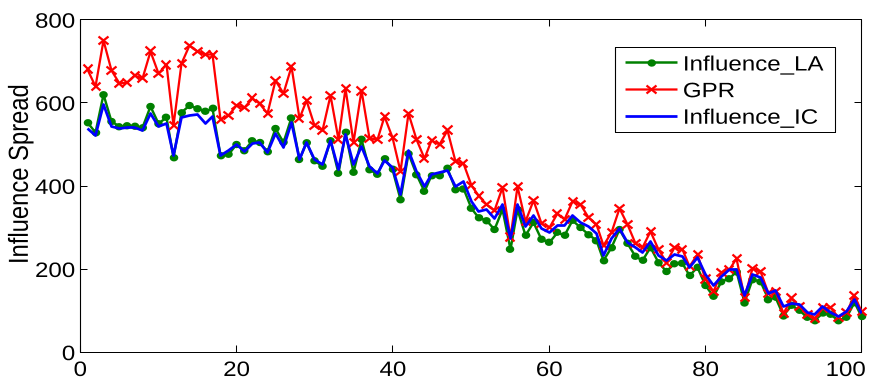 Figure 2: Performance comparison across Facebook, ca-HepPh, and web-NotreDame. Note how Linear and Bound stay at the top of the curve.
The Speed Advantage
The Bound algorithm demonstrated remarkable efficiency. While CELF failed to run on large datasets due to time complexity, Bound performed similarly to basic PageRank in terms of speed but delivered much higher influence spread because it accounts for overlap.
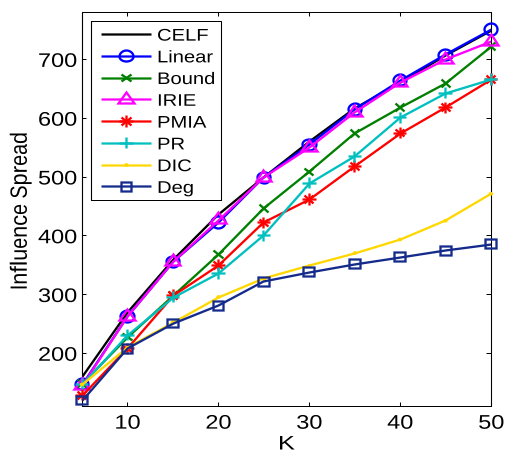 Figure 3: Runtime comparison. Note the logarithmic scale; the gap between the proposed methods and traditional CELF is several orders of magnitude.
Critical Analysis & Conclusion
Takeaway
The research successfully demonstrates that Influence Maximization doesn't require Monte-Carlo simulations. By shifting the problem into the domain of linear algebra and PageRank, we can achieve a "best-of-both-worlds" scenario: the mathematical rigor of descriptive models with the speed of simple heuristics.
Limitations & Future Work
The primary limitation is the Damping Factor (). While works well generally, the influence spread is sensitive to this parameter. Furthermore, the model assumes the transition probabilities are known or pre-learned. Future work could integrate the learning of these probabilities directly into the linear optimization framework, creating an end-to-end pipeline from raw social data to viral marketing strategy.
In conclusion, for developers building recommendation or marketing engines on large social graphs, the Bound algorithm offers a production-ready path to real-time influence estimation.