
Multi-Network Influence Maximization: The Power of Overlapping Users
Influence maximization in multiple online social networks
This paper introduces the Influence Maximization Problem (IMP) across multiple Online Social Networks (OSNs), proposing a novel coupling scheme that reduces multi-network propagation into a single representative network. The method leverages synchronized user IDs and account nodes to preserve influence properties, achieving superior reach compared to single-network optimization.
TL;DR
Most viral marketing research treats Facebook, Twitter, and LinkedIn as isolated islands. This paper breaks that silo by introducing a Coupling Scheme that merges multiple social networks into one while preserving their unique influence dynamics. By targeting users who bridge different platforms, the researchers achieved up to 31% better reach than traditional single-network strategies.
The Problem: The "Silo" Blind Spot
In the real world, a single user often has accounts on multiple platforms. When they post about a product on Twitter, they might also share it on Foursquare or LinkedIn.
Prior Work Limitations:
- Existing algorithms typically optimize influence within a single graph.
- Merging networks into one "flat" graph usually loses the specific influence weights and thresholds unique to each platform.
- Ignoring the "cross-talk" between networks significantly underestimates the viral potential of bridge users.
Methodology: The Coupling Scheme
The core innovation is a three-tier node architecture that transforms a complex multi-network problem into a solvable single-network problem.
1. Network Alignment
The authors first use a linear-time algorithm to assign Universal IDs. This ensures that "User A" on Twitter is recognized as the same "User A" on Foursquare, creating a "user-view" of the multi-network landscape.
2. The Multi-Tier Coupling Architecture
Instead of just drawing lines between users, the authors create a "sub-layer" for each user:
- User Vertex (): The master node representing the person.
- Account Vertices (): Nodes representing their presence in specific networks (e.g., their Twitter persona).
- Transition Vertex (): A synchronization node that ensures if a user is activated in one network, they become active in all their networks.
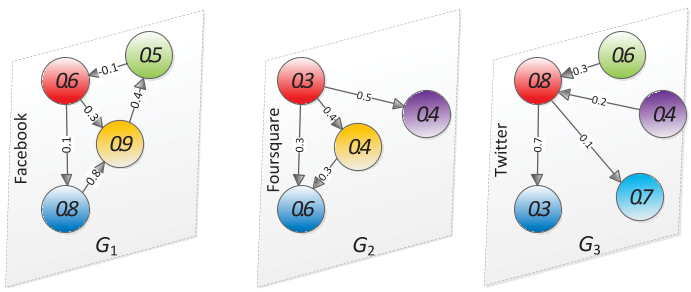 Figure: The coupling scheme representing user-to-user influence through account-specific weights while synchronizing state via transition nodes.
3. The "3-Hop" Equivalence
The authors mathematically prove that solving the problem for hops in the original multiple networks is equivalent to solving it for hops in their coupled graph. This is a critical theoretical bridge that allows them to use existing, high-performance SOTA algorithms (like the LT-model variants) on their new structure.
Experimental Insights: Why Cross-Platform Matters
The researchers tested their model on Foursquare-Twitter datasets and Co-author networks.
Key Findings:
- Amplified Reach: In Foursquare-Twitter datasets, the coupled model outperformed the "optimal combination" of single-network strategies by 17% to 31.2%.
- The Multiplier Effect: The influence gap increases as the number of hops () increases. This means multi-network effects are even more important for long-term campaigns.
- The Value of Overlap: Overlapping users (people on multiple platforms) are disproportionately powerful. They made up 23% of the top 100 seeds, even though they were a tiny fraction of the total user base.
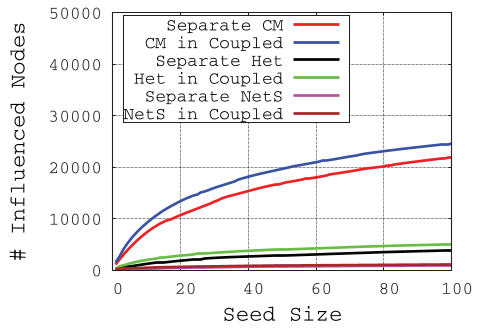 Figure: Comparative performance showing the significant gain in influenced nodes when using the Coupled Network approach versus separate network optimization.
Critical Analysis & Future Outlook
The beauty of this work lies in its simplicity and mathematical rigor. By reducing the complexity to a single graph, the authors make it possible to use 20 years of existing influence maximization research in a modern, multi-platform context.
Takeaways for the Industry:
- Target the Connectors: Marketing budgets should prioritize users with high "cross-platform density" rather than just high follower counts on a single platform.
- Synergy is Real: Networks support each other. A weak influence in Network A can be bolstered by a strong presence in Network B.
Limitations:
- The model assumes we can accurately map users across platforms (User ID Alignment), which part of the industry is still struggling with due to privacy constraints.
- It uses the Linear Threshold (LT) model; future work could explore how this coupling handles the Independent Cascade (IC) model or continuous-time diffusion.
Conclusion
This paper provides the first formal framework to evaluate influence propagation across multiple OSNs. It proves that the "sum is greater than the parts"—considering networks together isn't just a minor improvement; it's a fundamental shift in how we understand digital word-of-mouth.