
Flow Over Friction: Maximizing Influence in a Noncooperative World
Influence maximization in noncooperative social networks
This paper investigates the Influence Maximization (IM) problem in social networks where nodes exhibit noncooperative behavior. It generalizes the Linear Threshold Model (LTM) to include a cooperativeness factor and proposes a novel seed selection strategy based on generalized maximum flow to achieve superior robustness.
TL;DR
Most social influence research assumes people are perfectly willing to spread word-of-mouth. This paper shatters that idealistic view by introducing Noncooperative Influence Maximization. By reformulating the problem through the lens of Generalized Network Flow, the authors provide a seed selection strategy that remains robust even when the "middlemen" in your network are reluctant to hit the share button.
The Friction in the Machine: Why "Good" Seeds Fail
In classic Influence Maximization (IM) theory, once a node is activated, it becomes a tireless advocate. But in the real world, the cost of resources (time, attention, social capital) creates a "bottleneck" of noncooperation.
Current SOTA methods often rely on Weighted Degree or Betweenness Centrality. The logic is simple: pick the person with the most connections. However, the authors identify a critical failure mode:
- The "Dead End" Influence: You might pick a seed with 1,000 followers, but if those followers are 80% non-cooperative, your campaign dies at the first hop.
- The Hub Paradox: High-centrality nodes often cluster together (homophily), leading to redundant activations that waste a marketing budget.
Methodology: From Paths to Flows
The core innovation of this paper is moving away from simple graph traversals to Generalized Maximum Flow.
1. The Noncooperative Linear Threshold Model (LTM)
The authors modify the standard LTM activation criteria. If node is a neighbor of active node , the influence exerted is no longer just , but , where represents the "cooperativeness" of the communicator. Seed nodes are assumed to be (fully cooperative), while others are .
2. Modeling Noncooperation as Flow Loss
The authors argue that influence doesn't just travel along shortest paths; it flows through all possible independent paths. They refine the flow conservation equation to reflect node reluctance:
In this equation, is the amount of flow the node "reserves" for itself. This treats every user in the social network as a "leaky pipe"—the more non-cooperative they are, the more "influence pressure" is lost.
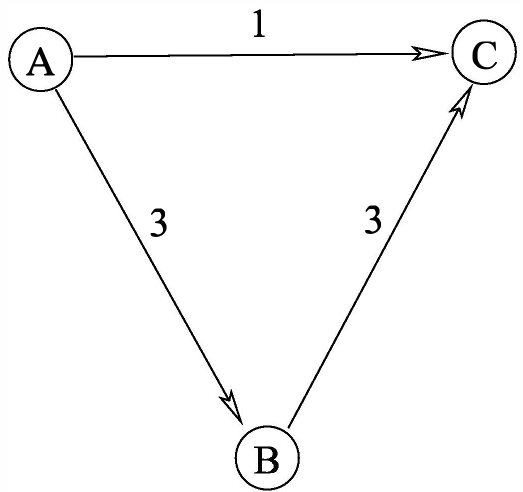 Figure 1: Traditional Max Flow (A to C). The paper generalizes this to account for losses at intermediate nodes.
Experiments: Proving Robustness
The researchers tested their Flow-Based Centrality on the Arxiv collaboration network (4,158 nodes). They compared it against the "Weighted Degree" scheme across various cooperation levels ().
Key Findings:
- Robustness Under Apathy: When nodes are highly non-cooperative (), the Flow-Based strategy maintains a higher final active set size than other methods.
- Budget Efficiency: The Flow-Based metric with only 50% cooperation performed as well as traditional metrics with 80% cooperation. This implies that choosing smarter seeds is more effective than spending more on across-the-board incentives.
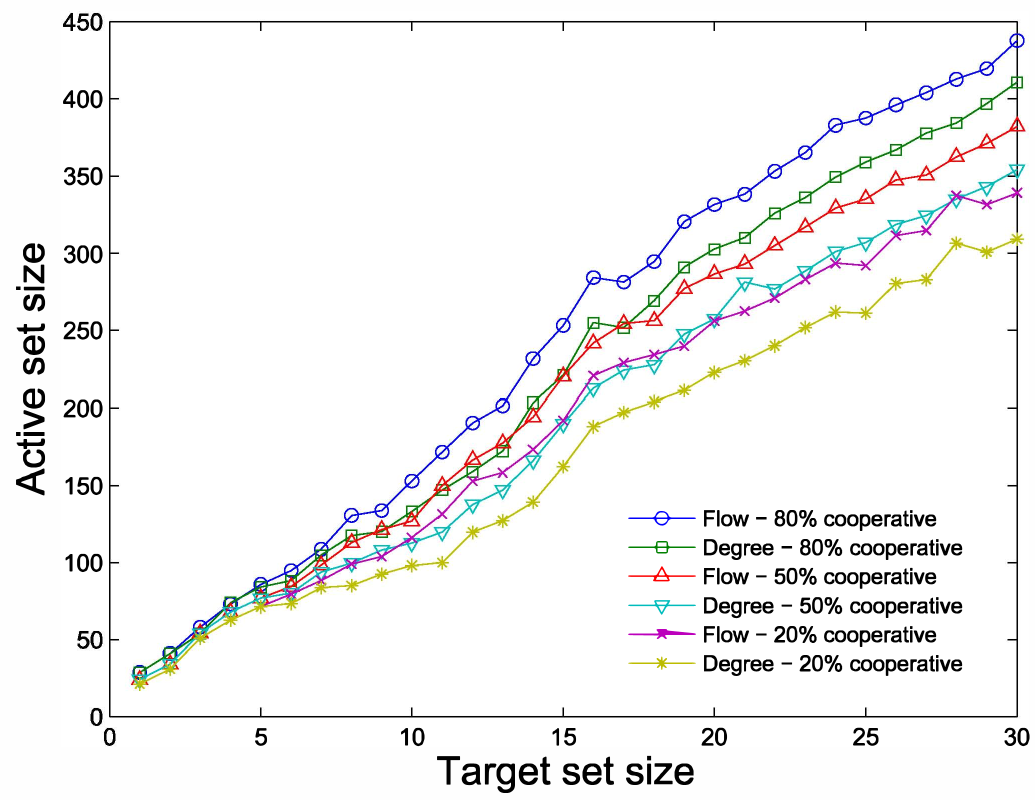 Figure 2: Performance comparison showing the Flow-based metric's superiority across different target set sizes.
Critical Insights & Future Directions
Takeaway for Practitioners
If you are running an ad campaign, don't just look for "influencers" with high counts. Look for nodes that have diverse, cooperative pathways into their communities. The "redundant" paths in a network flow model act as a safety net against the non-cooperation of specific individuals.
Limitations
The current model assumes a static cooperativeness level. In reality, is dynamic—it changes based on the source of the message, the time of day, or the diminishing novelty of the information.
The Next Frontier
The paper opens the door for Incentive-Aware IM. If we can quantify exactly how much flow is lost at each node, we can calculate the exact "Incentive ROI" needed to increase at key bottleneck nodes to maximize total network saturation.
Summary: By bridging the gap between graph theory and behavioral economics, Yang et al. provide a toolset for navigating the friction of real-world social networks.