
Decoding Influence Maximization: From Monte Carlo Simulations to Near-Linear Efficiency
Influence Maximization on Social Graphs: A Survey
This survey provides a comprehensive synthesis of Influence Maximization (IM) on social graphs, covering classical diffusion models (IC, LT, TR, CT) and a fine-grained taxonomy of algorithms. It highlights the shift from simulation-based methods to state-of-the-art Sketch-based approaches like IMM, which achieve near-linear time complexity with a (1-1/e-ε) approximation ratio.
TL;DR
Influence Maximization (IM) — the task of finding seeds to maximize "viral" spread in a network — has evolved from slow, simulation-heavy methods to high-speed Sketch-based algorithms. This survey maps out the landscape of IM, moving from the #P-hard complexity of influence evaluation to the modern SOTA like IMM that handles billion-scale graphs in near-linear time.
Background & Motivation
The "Word-of-Mouth" effect is powerful, but computationally expensive to model. Since the seminal 2003 paper by Kempe et al., researchers have struggled with two core issues:
- NP-Hardness: Selecting the optimal nodes is a combinatorial explosion problem.
- #P-Hardness: Simply calculating how many people a specific set of users will influence is harder than polynomial time.
The breakthrough insight was that while the problem is hard, the influence functions of major models (Independent Cascade, Linear Threshold) are monotone and submodular, allowing a greedy approach to capture at least of the optimal spread.
Methodology: The Three Pillars of IM Algorithms
The survey introduces a precise taxonomy of how researchers have bypassed the #P-hard bottleneck:
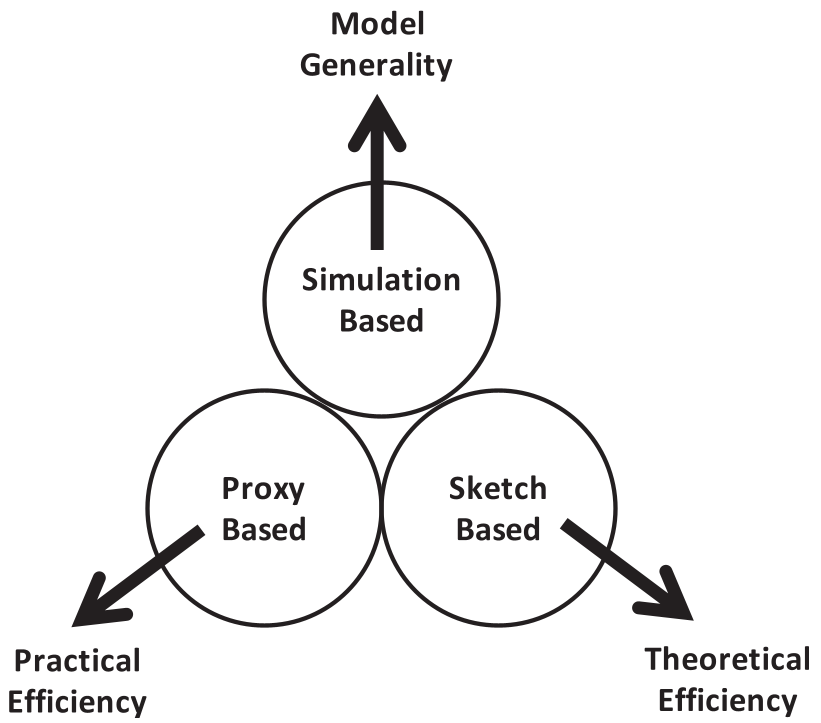
1. Simulation-Based (The Baseline)
Relies on massive Monte-Carlo (MC) simulations. While generalizable to any model, it is painfully slow.
- Key Work: CELF (Cost-Effective Lazy Forwarding) uses submodularity to skip redundant simulations.
2. Proxy-Based (The Speed Demons)
These replace the complex diffusion process with simpler proxies like PageRank or "Shortest Paths."
- Pros: Incredible practical speed.
- Cons: No theoretical guarantee; they often fail or become "unstable" on specific graph topologies.
3. Sketch-Based (The Gold Standard)
This is the modern frontier. Instead of simulating "Forward," these methods use Reverse Reachable (RR) Sets.
- Intuition: Pick a random user . Look at all paths that could reach . If your seed set covers many of these "Reverse" sets, it naturally has high influence.
- Key Work: IMM (Influence Maximization in near-linear time) uses Martingale theory to determine exactly how many samples are needed for a guarantee.
Experiments & Results: Accuracy vs. Scale
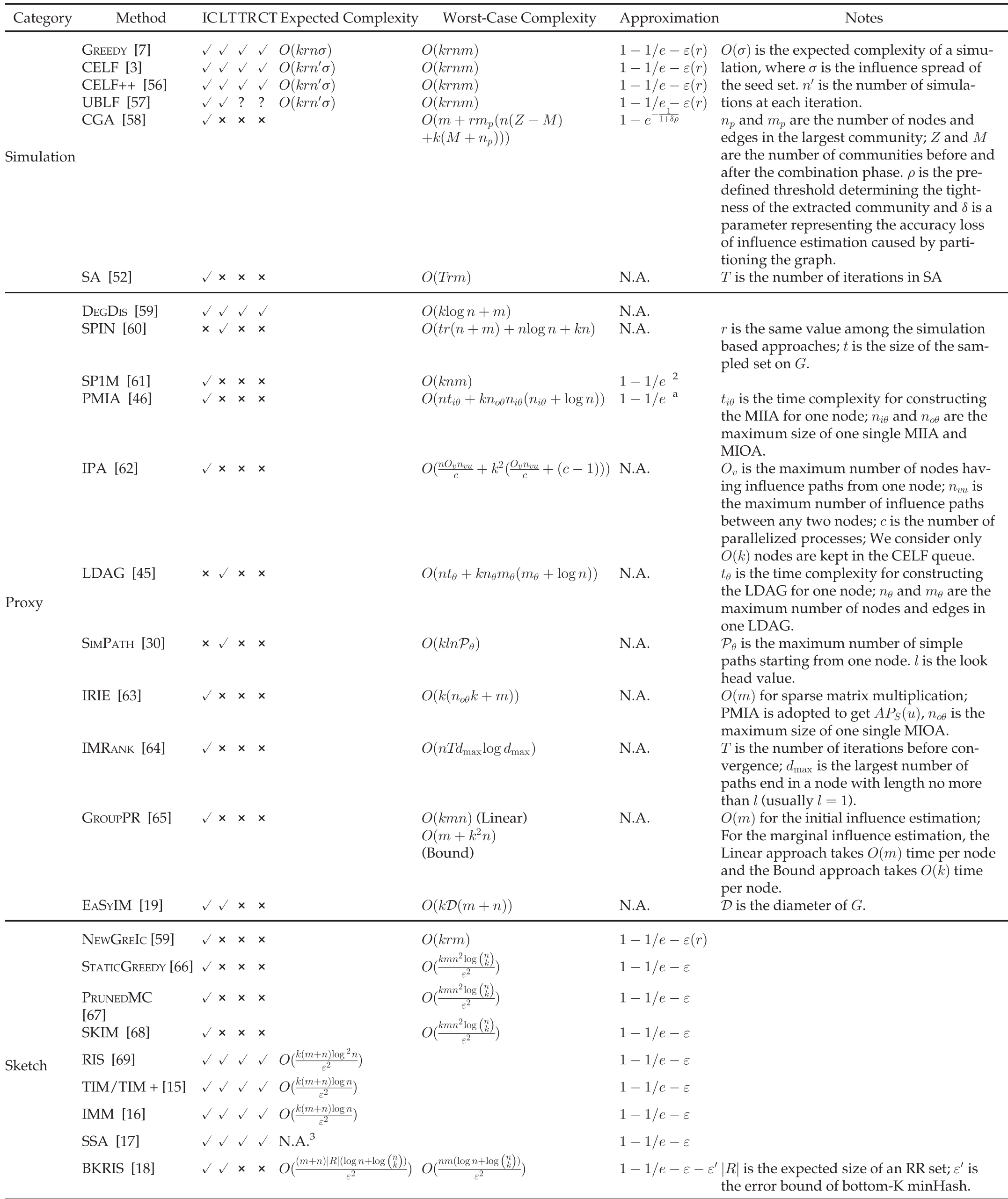
The survey provides a rigorous theoretical comparison (Table 1). The transition from FI-Sketch (Forward Influence) to RR-Sketch (Reverse Reachable) represents a leap from quadratic/cubic complexities toward .
- Scalability: Methods like TIM/TIM+ and IMM are the only ones capable of processing billion-scale graphs within a reasonable time-frame while maintaining an approximation bound.
- Context-Awareness: The survey details how IM is no longer just "vanilla" spread—it now accounts for Topic (relevant items), Location (geo-social marketing), and Time (critical deadlines).
Critical Insight & Future Directions
The paper identifies three major gaps for future researchers:
- Stability: How do we prevent the "seed set" from changing drastically if 1% of the graph edges change?
- Beyond Submodularity: Can we maximize influence for "Opinion Models" where people can flip from positive to negative? These functions aren't submodular, meaning the "Greedy" logic fails.
- Group Norms: Moving beyond peer-to-peer influence to "Conformity" (how groups of similar people move together).
Conclusion
This survey is a definitive guide for anyone building viral marketing tools or social recommendation systems. If you are starting today, RR-Sketch is your starting point for efficiency, but Context-Awareness is where the real-world value is applied.