
IRM: Refining Influence Ranking through Dynamic Pruning and Weighted K-Shell Logic
Influence Ranking Model for Social Networks Users
The paper introduces the Influence Ranking Model (IRM), a novel approach to identify influential social network users based on their contribution to content dissemination. By extending the classical K-shell decomposition to weighted, directed graphs and employing a node-pruning simulation, IRM achieves a near-optimal ranking distinction compared to traditional methods.
TL;DR
The Influence Ranking Model (IRM) is a sophisticated framework designed to identify the "true" spreaders in social networks. Moving beyond simple follower counts, it analyzes short-term interaction weights and uses a node-pruning simulation inspired by K-shell decomposition. It achieves a near-unique ranking (ASL ~1.2) and demonstrates superior information diffusion capabilities, making it a powerful tool for viral marketing and opinion monitoring.
The "Follower" Fallacy: Why Static Metrics Fail
In the world of Social Network Analysis (SNA), we often mistake popularity for influence. Prior works like basic PageRank or standard K-shell decomposition treat the network as a static map of long-term relationships.
However, the authors of IRM argue that:
- Rigid Relationships are Misleading: Just because you follow someone doesn't mean you interact with their specific niche content.
- K-Shell Granularity is Weak: Standard K-shell decomposition groups hundreds of users into the same "tier," offering no way to rank individuals within those tiers.
IRM addresses this by focusing on short-term, dynamic interactions—the "retweets" and "likes" that signal actual content flow.
Methodology: The Logic of Pruning
The core innovation of IRM lies in its three-phase approach, which transforms a coarse decomposition technique into a high-precision ranking engine.
1. Influence Weight (IW) Calculation
Instead of just counting edges, IRM uses a balanced parameter to weigh the number of interactions against the frequency (weight) of those interactions:
2. The Pruning Simulation
While traditional K-shell removes nodes to find "layers," IRM performs a virtual pruning. It calculates the "Total Graph Weight" that remains after a specific node's influence is removed. If the total weight drops significantly, that node is a critical influencer.

Experimental Showdown: Precision & Coverage
The researchers tested IRM against the Weighted K-shell (WKs) benchmark using two real-world datasets: Advogato (a trust network) and Bitcoin Alpha.
High-Resolution Ranking (ASL)
The paper introduces Average Shell Load (ASL). An ASL of 1 means every node has a unique rank.
- WKs: Resulted in an ASL of 284.84, meaning hundreds of users were stuck in the same rank.
- IRM: Achieved an ASL of 1.19, providing almost perfect distinction between top-tier users.
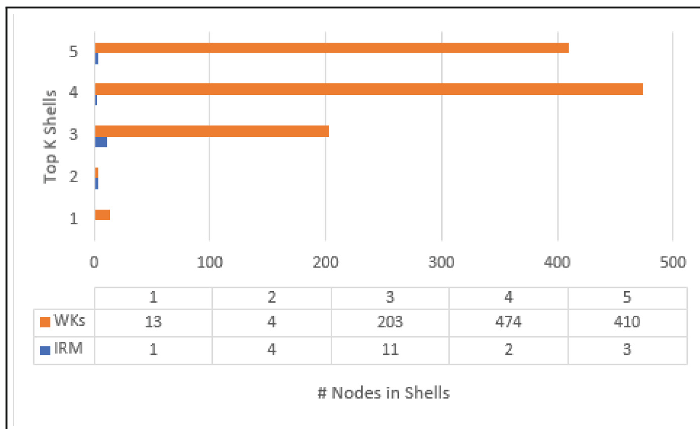 Figure: Note how IRM (blue) keeps node counts per shell near 1, while WKs (red) groups hundreds together.
Information Diffusion
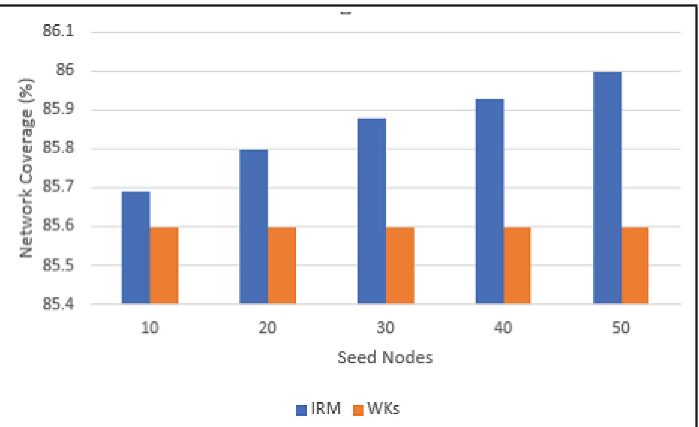
Using the Independent Cascade (IC) model, the authors verified if these high-ranked users actually spread information better. IRM-ranked seeds covered 86% of the Bitcoin Alpha network, proving that the model doesn't just rank nodes uniquely—it ranks the right nodes.
Critical Insight & Conclusion
IRM represents a shift from topological importance to functional influence. By simulating the removal of influence rather than just looking at network skeletons, it bridges the gap between graph theory and real-world microblogging behavior.
Takeaway for Practitioners: When building influencer discovery tools, prioritize interaction-based weights and use pruning-impact metrics to break "ties" in ranking lists.
Limitations: The computational complexity is due to the per-node pruning simulation. While the authors suggest parallel execution, large-scale networks with millions of nodes may require further optimization through approximate algorithms or graph sampling.