
Beyond the Screen: How Virtual Socializing Reshapes Real-World Behavior
The Influence of Social Experience in Online Games
This study investigates the impact of four social behaviors in MMORPGs—chatting, making friends, role-playing, and teamwork—on real-world social conduct and game retention. Utilizing regression analysis on survey data from 101 participants, it establishes that in-game social experiences significantly predit real-life social behavioral changes and total playing time.
TL;DR
Is time spent in MMORPGs just "lost time," or is it a transformative social experience? This study by Qin et al. proves that in-game social behaviors—specifically chatting and role-playing—are not only the primary drivers for game longevity but also significantly alter how players communicate and lead their lives in the real world. By analyzing data from college-aged gamers, the research reveals that the virtual world acts as a functional extension of society rather than a mere escape.
The "Virtual vs. Real" Motivation
For years, academia focused on the "dark side" of gaming: addiction, isolation, and depression. However, the authors of this study argue that this perspective ignores the fundamental nature of Massively-Multiplayer Online Role-Playing Games (MMORPGs). They suggest that these games are actually "social engines" where the collaborative nature of quests and the narrative depth of role-playing create a unique brand of social experience. The core question shifts from if games are addictive to how specific social interactions inside the game impact the player's life outside of it.
Methodology: The Four Pillars of Virtual Sociality
The researchers identified four key social behaviors that bridge the virtual and the real:
- Chatting: The primary tool for sharing expertise and building rapport.
- Teamwork: Collaborative efforts to achieve goals that are impossible for a single player.
- Role-Playing: Acting out a persona, which facilitates improvised storytelling.
- Making Friends: Using the game as a medium to form and maintain long-term relationships.
They then measured these against Behavior Repetition (average daily playtime) and Real-World Social Behavior (communication styles and lifestyle).
The Core Architecture of Influence
The study utilized regression models to determine the "weight" of each virtual behavior on real-world outcomes.

Insights from the Data:
- Playtime Dynamics: If you want to keep players engaged, focus on Chatting (Beta: 0.827) and Role-Playing (Beta: 0.609). These elements create the strongest "behavior repetition."
- The Friend-Making Paradox: Interestingly, the more emphasis a player placed on "Making Friends," the lower their average daily playtime became (Beta: -0.569). This suggests that deep social connections might move communication to other platforms or reduce the need for constant "grinding" to meet people.
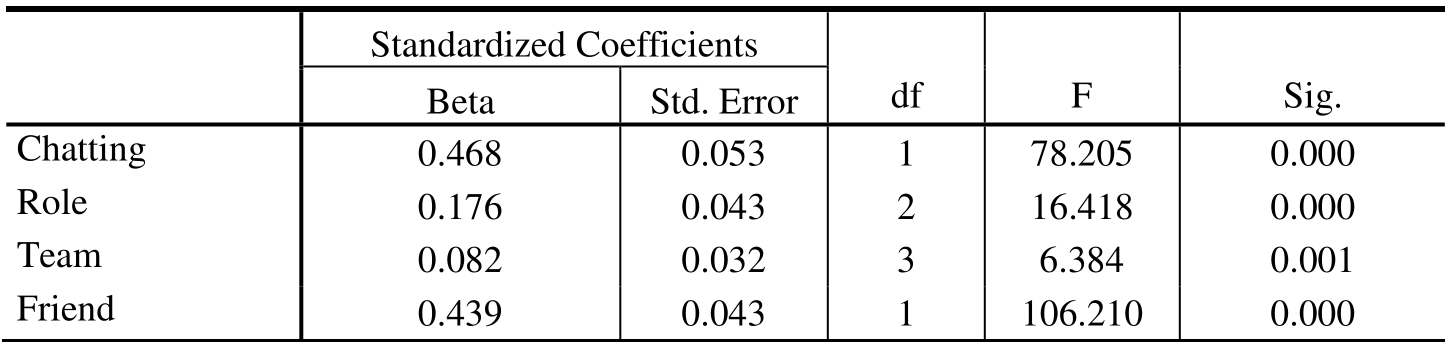
- Real-World Spillover: In-game social experience is a massive predictor of real-world social change (Adjusted R² = 0.896). Chatting and Making Friends in-game are the most transferable skills, directly impacting how players interact in their physical lives.
Deep Insight: The Task-Oriented Social Shift
The paper highlights a critical nuance: social behaviors in games are often task-oriented. Because players must cooperate to succeed in difficult quests, they develop a pragmatic, support-seeking communication style. The study finds that this "workaround" and "external support" seeking behavior successfully migrates into the real world.
The virtual world, therefore, serves as a high-stakes training ground for social coordination. This disrupts the stereotype of the "lonely gamer"; instead, it presents the gamer as a highly social agent who is merely operating across different dimensions.
Conclusion & Future Outlook
Qin et al. provide empirical evidence that the boundary between "virtual" and "real" sociality is increasingly porous.
- For Developers: The data shows that role-playing and chat systems are far more important for "stickiness" than pure teamwork mechanics.
- For Psychologists: The negative correlation between friend-making and playtime suggests that social depth, rather than time-sink mechanics, might be a healthier way to design online spaces.
Limitations: The study focuses primarily on young male college students (a demographic majority in 2010), but future research should examine if these "spillover effects" hold true for more diverse populations and newer, more immersive social platforms like VR.