
Beyond Static Graphs: Detecting Communities via Probabilistic Influence Spreading
Influence Spreading Model Used to Community Detection in Social Networks
The paper introduces a novel community detection algorithm based on a probabilistic Influence Spreading Model that treats nodes as both sources and targets of influence. By computing local maxima of a directional influence measure, the method successfully identifies community structures and sub-factions in directed or weighted social networks.
TL;DR
Understanding how a community splits or forms requires more than just looking at "who is connected to whom." This paper proposes a dynamic Influence Spreading Model that uses the logic of information flow—modeled via path-based probabilities—to identify social factions. By treating communities as sets of nodes that exert maximum mutual influence, the algorithm successfully re-calculates the famous Zachary’s Karate Club split and dolphin social fissions with remarkable accuracy.
Background: The Limits of Static Clustering
In the world of Graph Theory, community detection is often treated as a "cutting" problem: where can we cut the edges to minimize cross-group connections? Methods like Modularity Maximization have ruled the field. However, these methods often ignore the physics of influence. In a real social network, Influence is:
- Directional: Node A might influence Node B more than vice versa.
- Temporal: Influence takes time to travel through multi-step paths.
- Weighted: Certain links (like family) are stronger than others (like acquaintances).
The author, Vesa Kuikka, argues that a community is essentially a group where influence spreading is maximized internally across both source and target roles.
Methodology: The "Influence" Metric
The core of the paper is the measure —the probability that a source node influences target node .
1. Probabilistic Path Modeling
Instead of just counting edges, the model looks at all possible paths (excluding loops) between nodes. It uses a Poisson distribution to model the probability of information successfully traversing a path of length within time :
2. The Objective Function
The algorithm seeks to partition the network ( and its complement ) to maximize the following measure:
This formula accounts for both the outward influence (source role) and inward influence (target role) of every node within its respective faction.

Experiments: Validating with "The Classics"
Zachary’s Karate Club
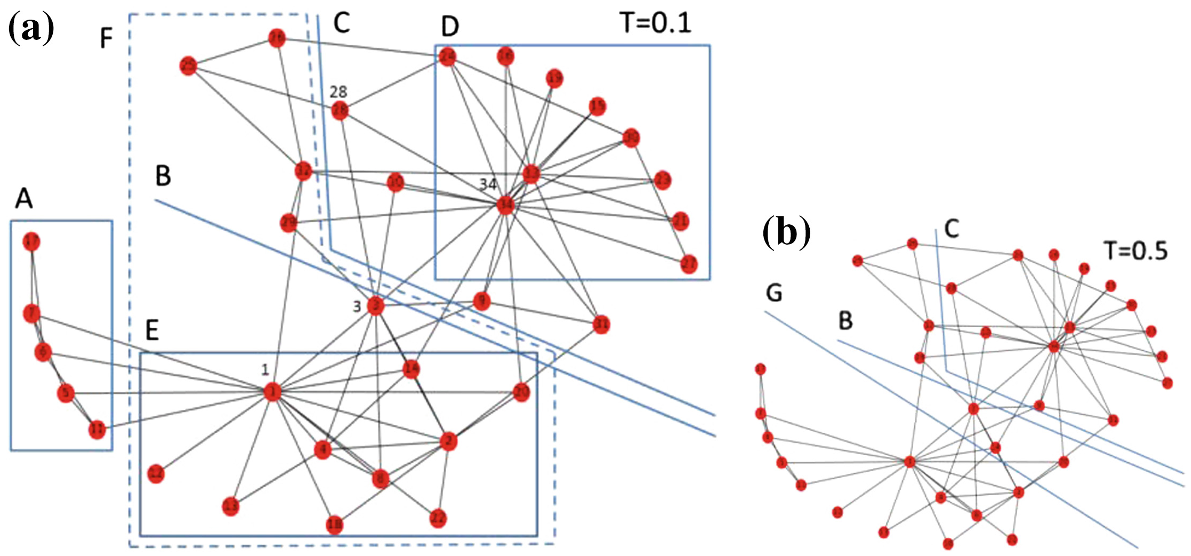
The paper tests the model on the gold standard of social network analysis: the Karate Club split. The algorithm finds several local maxima, labeled A through F.
- Division B (the second highest value) perfectly matches the actual historical split between the instructor and the administrator.
- Temporal Sensitivity: Interestingly, at very small time , the model identifies smaller sub-groups. As increases (representing stronger social cohesion), these sub-groups merge until only the primary split remains.
The Dolphin Network
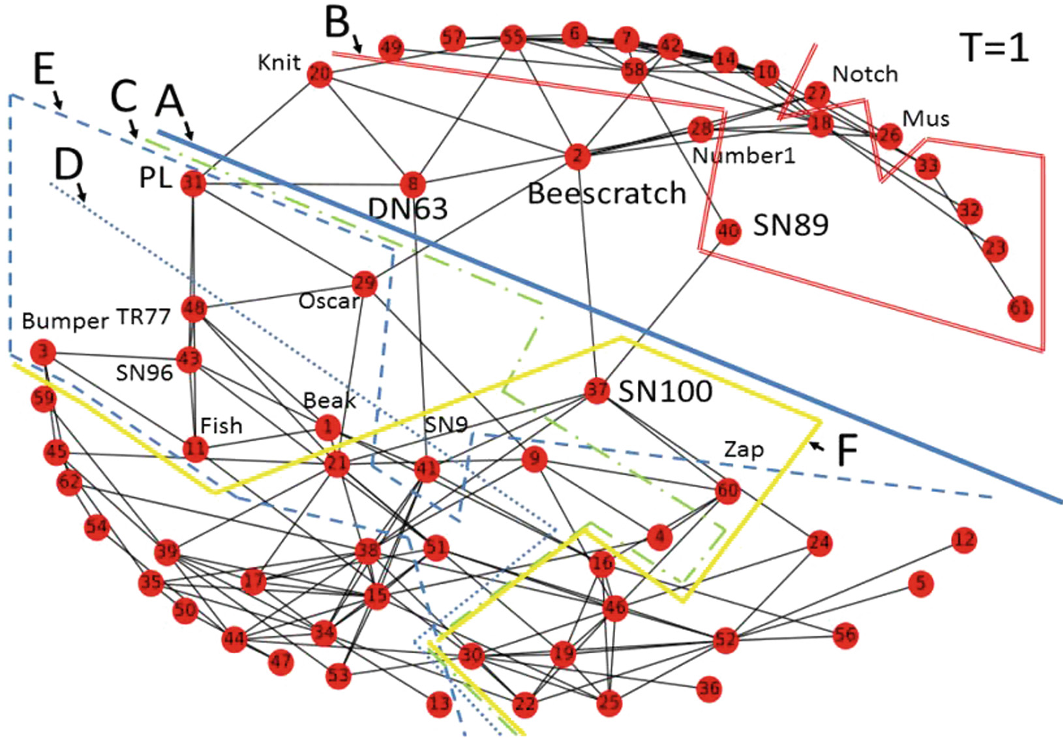
Analyzing 62 bottlenose dolphins, the model identifies the fission that occurred when a key individual (SN100) disappeared. The model’s "Division A" correctly assigned almost every dolphin to its observed real-life subgroup.
Critical Insight: Influence vs. Betweenness
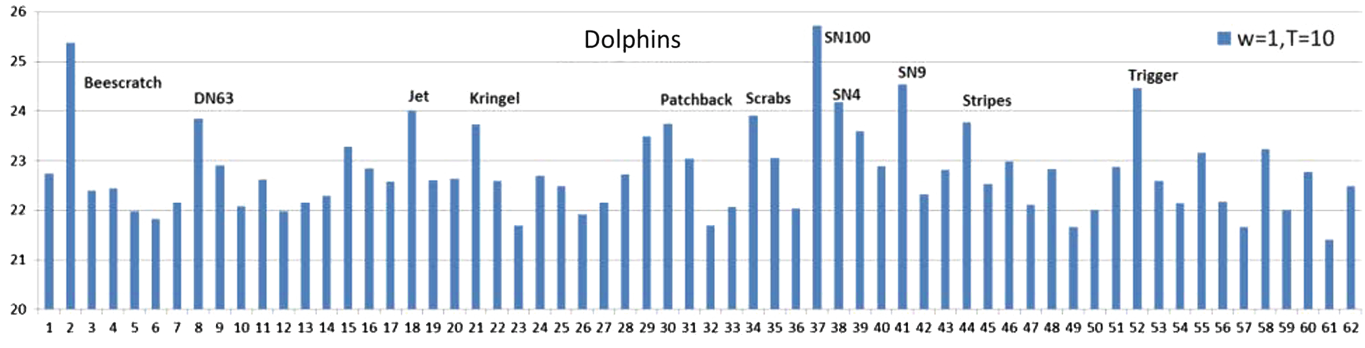
The paper also introduces a new Betweenness Centrality measure based on influence spreading. By "removing" a node and calculating the average drop in total network influence, we can identify "Brokers."
- Result: In the dolphin network, SN100 displayed the highest influence-based betweenness, explaining why its departure caused the entire community to collapse into two pieces.
Conclusion & Future Outlook
Kuikka’s model moves community detection from a static topological exercise to a dynamic simulation.
- Key Takeaway: Community boundaries are fluid and depend on the strength of interactions () and the time horizon ().
- Limitation: The computational complexity involved in calculating all paths makes this specific version difficult to scale to "Big Data" (millions of nodes) without aggressive path-length pruning.
- Future Work: Applying this to directed graphs in professional networks (like LinkedIn) where "Expertise Influence" is heavily one-way could yield far more accurate functional groups than traditional clustering.