
Influences of Influential Users: Decoding Music Propagation in Social Networks
Influences of Influential Users: An Empirical Study of Music Social Network
This paper explores the identification and impact of influential users in music social networks using an empirical study on Last.fm data. The authors introduce the Music Diffusion Graph (MDG) and a heuristic influence measurement method, demonstrating that top influencers significantly drive song adoption trends.
TL;DR
In the era of streaming, how does a song go viral? This study investigates the "hidden stars" of music social networks—influential users. By analyzing 1,000 popular tracks on Last.fm, the researchers developed a Music Diffusion Graph (MDG) to track how songs jump from friend to friend. They discovered that while top influencers hold massive power (reaching 40%+ of a network), identifying them requires more than just counting their followers; it requires understanding their musical DNA.
Background & Motivation
Why do some songs explode in popularity while others fade? While platforms like Last.fm host billions of "scrobbles," the mechanism of music discovery is often driven by social influence. Most prior research on "influentials" focused on general social media (Twitter) or image sharing (Flickr). Music, however, is unique—it involves repetitive consumption, deep emotional loyalty to artists, and temporal patterns. The authors argue that current recommendation systems miss a massive opportunity by not identifying these local trendsetters.
Methodology: Mapping the Sound Waves
The authors propose two distinct graph models to study influence:
1. Music Diffusion Graph (MDG)
Unlike a static social network, the MDG is track-specific and time-aware. It only creates an edge between User A and User B if:
- They are friends.
- User A listened to the track.
- User B listened for the first time shortly after User A.
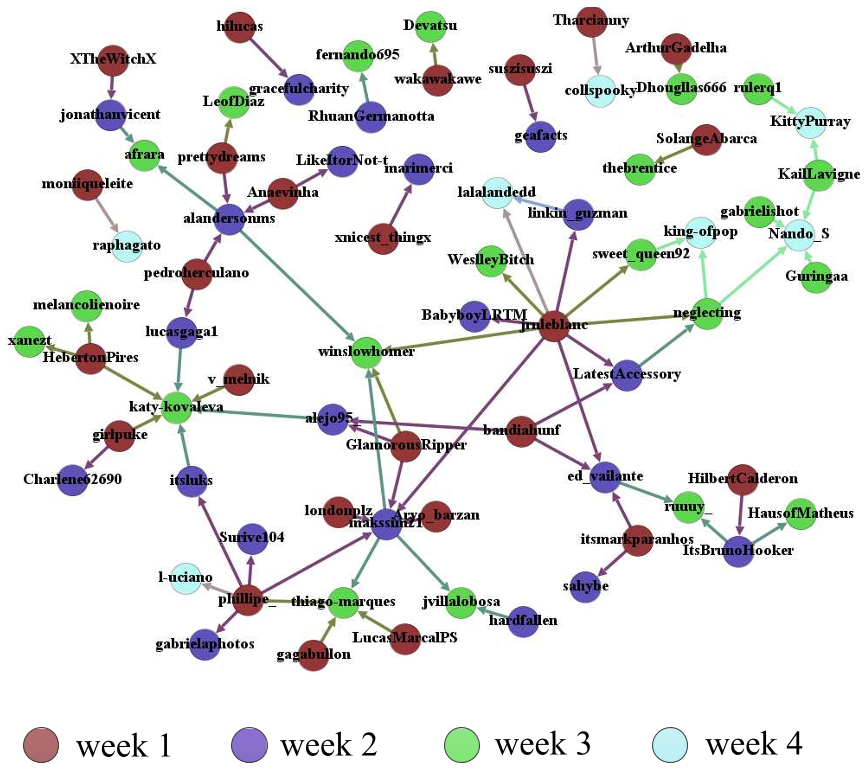 Figure 1: MDG of an Amy Winehouse track, showing how a single node can trigger cascading adoptions.
2. The Influence Formula
The team moved beyond simple "follower counts" by introducing a heuristic that accounts for:
- Multiple Influence (MI): If three friends all listen to a song, who gets the credit for influencing you?
- Cascading Influence (CI): Influence isn't just direct; it flows through the network. The formula uses an attenuation factor () to reward users whose influence spreads across multiple hops.
Experiments & Results
The study analyzed 40,000 users and their interactions with popular artists like Britney Spears and Amy Winehouse.
The "Power of Five"
The data revealed a staggering concentration of influence. As shown in the performance table below, the top 5 influential users within an MDG accounted for roughly 42% of the total track diffusion.
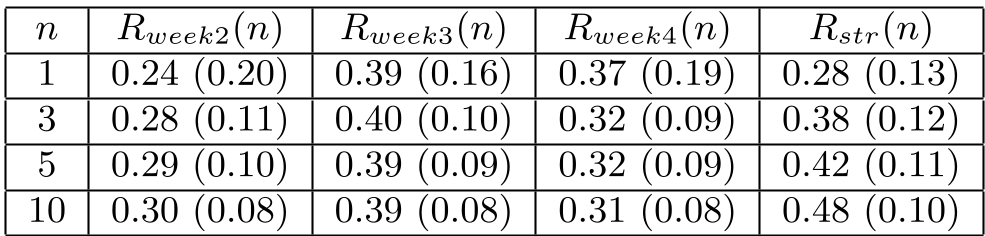 Table 1: Influence strength () and pattern () across weeks.
Why Social Structure Isn't Enough
A key finding was the failure of "Pure Social Network" methods. The researchers tested five standard centrality measures:
- Degree Centrality
- Betweenness Centrality
- Closeness Centrality
- Eigenvector Centrality
- Katz Centrality
The Result? Accuracy was poor. Standard centrality measures often flagged "popular" users who weren't actually the ones driving music adoption. True influencers weren't just the users with the most friends; they were the "early adopters" who had high artist loyalty and high taste similarity with their peers.
Critical Insights & Takeaways
What makes a Music Influencer?
The study highlights three pillars of influence:
- Social Connectivity: Having more friends builds potential, but isn't a guarantee.
- Listening Timing: Being in the "first batch" of listeners is critical for higher influence scores.
- Taste Homophily: A user's power is amplified if their friends share their specific demographic or artist preferences.
Future Outlook
This research suggests that future music recommendation engines should stop treating every user equally. By identifying the top 1% of influencers for a specific genre or artist, platforms could "seed" new releases to these users to trigger massive viral cascades.
Limitations: The study relies on a one-month snapshot. In the real world, influence is dynamic—a user who is influential for "Britney Spears" might be irrelevant for "Metallica." Future work should focus on cross-genre influence stability.
Conclusion
In the digital music landscape, influence is a combination of Network Position and Behavioral Authority. To find the real tastemakers, we must look past the follower counts and into the listening logs.