
Identifying the Gatekeepers: Solving the k-Mediators Problem in Social Networks
Finding influential mediators in social networks
This paper introduces the k-Mediators problem, a novel social network task aimed at identifying a set of bottleneck nodes that control influence propagation between specific source () and target () sets. The authors propose a three-step greedy heuristic involving graph pruning, a modified Steiner Tree algorithm (Mediation-Steiner), and proximity-based selection to achieve SOTA performance in identifying influential gateways.
TL;DR
While most social network research focuses on who can spread a message the furthest, this paper asks a more strategic question: who controls the path between a specific sender and receiver? By formalizing the k-Mediators problem, the authors introduce a scalable algorithm that identifies the "bottleneck" nodes essential for influence flow, outperforming traditional centrality measures in both accuracy and speed.
Background & Motivation: Beyond Influence Maximization
In the classic "Influence Maximization" paradigm (Kempe et al., 2003), the goal is to find seed nodes that trigger the largest cascade. However, real-world scenarios are often more targeted:
- Marketing: Which specific experts bridge the gap between a brand and a niche audience?
- Epidemiology: Which individuals act as the primary conduits for a virus moving from one community to another?
- Cybersecurity: Which gateways are the "choke points" for a virus targeting specific servers?
Existing tools like Betweenness Centrality are too slow for large-scale graphs and don't account for the probabilistic nature of human interaction. The authors argue that we need a method that respects both the structural connectivity and the influence probability of the edges.
Methodology: The Three-Step Pipeline
The authors propose a refined greedy heuristic to find these influential gateways without exhaustive search.
1. Reliable Subgraph Extraction
Large social networks are filled with noise. The first step involves pruning edges with low influence weights and removing components that do not bridge the source set and target set . This significantly reduces the search space for the subsequent steps.
2. The Mediation-Steiner Algorithm
To find the transmission backbone, the authors adapt the Steiner Tree problem. Traditional Steiner Trees minimize the sum of edge weights. However, in influence propagation (using the Independent Cascade model), the probability of success is the product of edge weights. The Mediation-Steiner algorithm iteratively builds a "Best Propagation Tree" (BPT) that maximizes the activation probability from to .
 Algorithm 1: THE k-Mediators Selection Pipeline
3. Proximity-based Node Selection
Once the BPT is constructed, how do we pick the best nodes? The authors use Random Walk with Restart (RWR) on the BPT. Nodes that are "structurally close" to both the sources and the targets within the propagation tree are selected as the top mediators.
Experimental Validation
Using a DBLP co-authorship network (6,616 nodes, 12,807 edges), the authors tested their method against common baselines.
Effectiveness
The metric used is the Normalized Decay of Activation Probability. If we "remove" a mediator (treat it as a sink), how much does the connection between and weaken? The results show that the proposed method is significantly more effective at decreasing the flow than random selection or even high-betweenness nodes, particularly when the budget is limited.
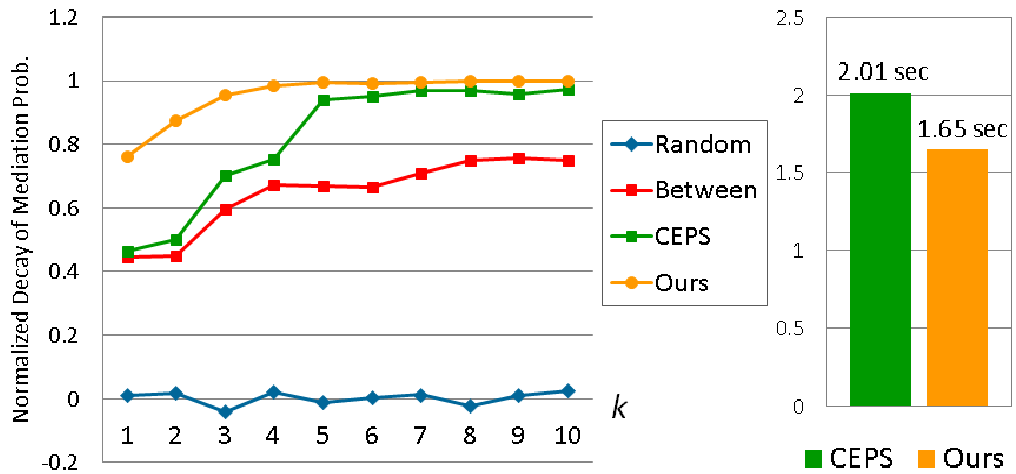 Figure 1: (a) Effectiveness comparison vs. alternatives; (b) Time efficiency comparison.
Efficiency
Traditional metrics like betweenness centrality are , making them unfeasible for massive networks. By using graph pruning and a greedy Steiner approach, this method achieves a much faster runtime than even CePS-AND, which was previously considered a strong contender for subgraph mining.
Critical Insight & Conclusion
The genius of this work lies in the Best Propagation Tree (BPT). By transforming a complex graph into a tree that represents the most likely "highways" of influence, the authors convert a NP-hard problem into a manageable greedy selection task.
Takeaway for Practitioners: If you are trying to intercept a process—whether it's a viral rumor or a pathogen—don't just look for the most popular people. Look for the mediators who specifically bridge the gap between the source and your target population. This paper provides the mathematical and algorithmic blueprint for doing exactly that.
Future Directions
While effective, the current model assumes a static network. Future research could explore how these "bottlenecks" shift in temporal networks where edges appear and disappear over time, or in multi-layer networks where a mediator might be influential on LinkedIn but invisible on Twitter.