
Selective Influence: How to Maximize Social Spread Using Only Your Neighbors
Influential Neighbours Selection for Information Diffusion in Online Social Networks
This paper investigates the Influential Neighbours Selection (INS) problem, a decentralized variant of influence maximization focused on online social networks. Using the Independent Cascade (IC) model, the authors demonstrate that selecting high-degree neighbors is optimal for short-term diffusion, while simple random selection is sufficient for long-term network coverage.
TL;DR
Most research on "viral marketing" assumes you have a god-like view of the entire internet. This paper, "Influential Neighbours Selection for Information Diffusion in Online Social Networks," brings it down to earth. From the perspective of a single user, it asks: If you can only pick your own friends to share a post, whom should you choose to ensure it reaches the most people? The surprising answer: Pick the "hubs" (high-degree friends) for speed, but don't sweat the complex math for the long haul.
The Reality Gap: Global vs. Local Influence
In classical Influence Maximization (IM) theory, we treat the network as a giant puzzle where we can place "seeds" anywhere. But in the real world of Facebook or Twitter, you don't control the whole network; you only control your own outbox.
The authors identify two fatal flaws in prior work:
- Centralized Control: You cannot force a celebrity 10 degrees away to post your content.
- Global Knowledge: Knowing the entire topology of the 2-billion-user Facebook graph is computationally and practically impossible for an individual.
The problem is thus redefined as Influential Neighbours Selection (INS): Selecting neighbors to maximize diffusion using only local information.
Methodology: Mining Local Connectivity
To bridge the gap between local intuition and global spread, the authors evaluated four strategies that vary in complexity and communication cost:
- Random Selection: No overhead.
- Degree Selection: Requires knowing how many friends your friends have.
- Volume Selection: Summing the degrees of everyone in a friend's -hop neighborhood.
- Weighted-Volume: A sophisticated metric that penalizes neighbors who belong to "tight circles" (high clustering) and prioritizes those who act as "hubs" between disconnected groups.
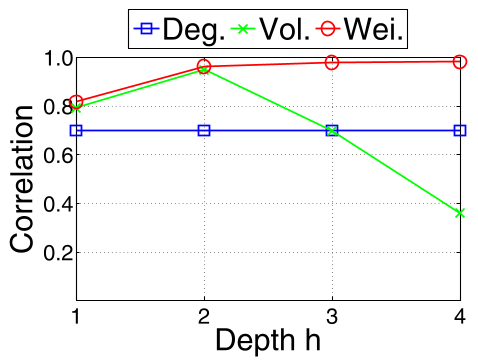 Fig 1. The core intuition: A node with low clustering (Right) is a better "bridge" for information diffusion than a node in a clique (Left).
Experiments: Strategy vs. Time
The study utilized datasets from PGP, Email networks, Political Blogs, and Facebook. They used the Independent Cascade (IC) model, where information flows like a virus with a probability .
1. The Short-Term Sprints
If your goal is a "flash mob" or immediate viral burst, the selection strategy matters immensely. The Degree Selection and Weighted-Volume methods vastly outperform random choice. High-degree neighbors act as immediate amplifiers, splashing the information into multiple clusters simultaneously.
2. The Long-Term Marathon
Interestingly, if you look at the "long-term" state (covering >50% of the network), the gap narrows. In large networks like Facebook, Random Selection eventually catches up. This suggests that the "small-world" nature of these networks eventually averages out the initial advantage of a specific seed node.
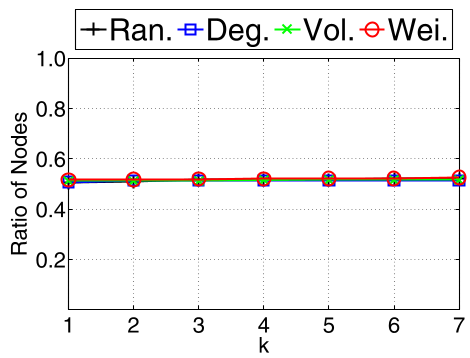 Fig 2. The impact of the number of initially activated neighbors () on total network coverage across different datasets.
Critical Analysis: Is "More Information" Worth the Cost?
The most valuable technical insight of this paper is the cost-benefit trade-off. While the "Weighted-Volume" metric is mathematically superior and correlates highly with global closeness centrality, it requires an communication cost—meaning you have to crawl deep into your friends' friend lists.
The data reveals that Degree Selection achieves nearly identical diffusion results for a fraction of the cost ().
Key Takeaways
- The Power of Hubs: For quick spread, the number of connections (degree) is the most cost-effective metric.
- Diminishing Returns of : Increasing the number of seeds () from 1 to 3 provides a massive boost, but the curve flattens significantly after .
- De-centralization is Feasible: You don't need a global map to be influential; local heuristics are "good enough" for most social diffusion tasks.
Conclusion and Future Outlook
The paper concludes that while sophisticated centrality measures look great on paper, the simple Degree Selection is the reigning champion for real-world application due to its balance of speed and efficiency.
Future research might look at Community-based Selection. If you have 5 friends, but 4 are in the same poker club, you're better off picking 1 from the club and 1 from your work office, even if the work friend has a lower degree. Diversifying the "social silos" may be the next frontier in decentralized influence.