
Scaling Social Influence: Turning Stochastic Diffusion into Graph Percolation
Extracting influential nodes on a social network for information diffusion
This paper introduces an accelerated greedy algorithm for the Influence Maximization (IM) problem in social networks under Independent Cascade (IC) and Linear Threshold (LT) models. By mapping these stochastic diffusion processes to bond percolation, the authors propose an efficient estimation method that leverages Strongly Connected Components (SCC) to compute marginal influence gains. The resulting method achieves a massive speedup, reaching up to 4,600x faster execution than the baseline simulation-based greedy approach.
TL;DR
Researchers have cracked the speed bottleneck of the Influence Maximization (IM) problem. By shifting from repetitive, "brute-force" Monte Carlo simulations to a clever combination of Bond Percolation and Strongly Connected Component (SCC) decomposition, they achieved a staggering 4,600x speedup on real-world networks without sacrificing the mathematical guarantees of the greedy approach.
Background: The Viral Marketing Dilemma
In the early 2000s, Kempe et al. formalized the Influence Maximization problem: if you can only give "free samples" to people in a social network, which should you choose to trigger the largest possible cascade?
While they proved that a Greedy Algorithm provides a near-optimal solution (at least 63% of the global optimum), the "Cost of Curiosity" was high. To pick just one node, you had to simulate thousands of random cascades for every candidate node in the network. For a network of 10,000 nodes, picking 30 seeds would take days of computation.
The Insight: From Simulations to Samples
The authors of this paper realized that the Independent Cascade (IC) and Linear Threshold (LT) models are effectively Bond Percolation problems.
Instead of asking "What happens if we activate node ?" and running a simulation, we can ask: "In a world where only these specific links successfully transmit information, who can reach whom?"
By sampling a specific "edge-active" graph first, the problem of influence estimation transforms from a stochastic simulation into a deterministic reachability problem.
Methodology: The SCC Decomposition Speedup
The true brilliance of the proposed method lies in how it computes "Marginal Gain"—the extra influence you get by adding a new node to your current seed set .
The Workflow:
- Sample the Graph: Generate a sampled graph based on link probabilities.
- Prune the Seed Set: Identify all nodes already reachable from current seeds (the "already influenced" territory).
- SCC Decomposition: In the remaining graph, group nodes into Strongly Connected Components (SCCs).
- Batch Processing: Within an SCC, every node has the same reachability. If you know how many new people node can reach, you know it for the entire component.
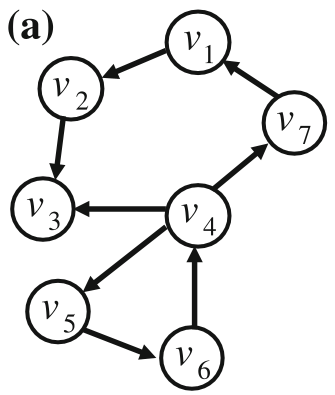 Figure: The algorithm reduces the graph to , focusing only on unexplored nodes to minimize compute.
Performance: Days to Minutes
The experimental results are transformative. By testing on blog trackback networks and Wikipedia co-occurrence graphs, the authors demonstrated that what used to take 2.5 days (the conventional simulation) now takes 1.5 minutes.
| Model | Conventional Method | Proposed Method | Speedup |
|---|---|---|---|
| IC (Independent Cascade) | ~60 hours | 2.5 minutes | 1,800x |
| LT (Linear Threshold) | ~64 hours | 1.5 minutes | 4,600x |
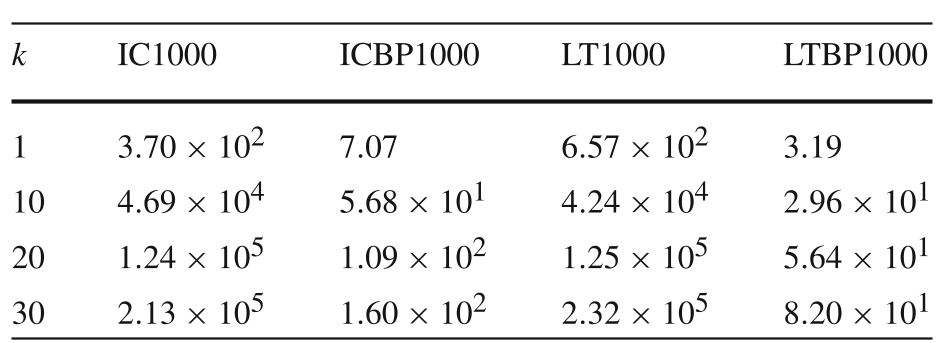 Table: Huge reduction in processing time for the Blog dataset while maintaining similar influence (sigma) levels.
Critical Insight & Limitations
Why does it work so much better? The conventional method is redundant. It restarts the diffusion process from the seed set for every single candidate node . The proposed method processes the seed set's influence once per graph sample and focuses exclusively on the marginal "territories" reachable by .
Limitations:
- Memory Overhead: Building and storing multiple graph samples can be memory-intensive.
- Static vs. Dynamic: The paper assumes a static graph structure, which may not reflect the ephemeral nature of modern social media interactions.
Conclusion
This paper is a masterclass in algorithmic refinement. It takes a theoretically sound but practically broken algorithm (Greedy IM) and makes it production-ready. By bridging the gap between statistical physics (percolation) and graph theory (reachability/SCC), the authors opened the door for real-time viral marketing analysis on a standard PC.