
IM-LPA: Leveraging Label Propagation to Unlock Influence in Community-Structured Networks
Identification of influential nodes in social networks with community structure based on label propagation
This paper introduces IM-LPA, a novel influence maximization algorithm specifically designed for social networks with community structures. By leveraging a modified label propagation process and a two-phase seeding strategy, the method identifies influential nodes that serve as the "cores" of distinct communities, achieving competitive performance compared to greedy algorithms with significantly lower overhead.
TL;DR
The "Influence Maximization" (IM) problem—finding the most influential nodes to trigger a massive information cascade—has long been a battle between accuracy (greedy algorithms) and scalability (centrality measures). This paper introduces IM-LPA, a method that uses the physics of label propagation to find community "cores." It achieves the accuracy of state-of-the-art greedy methods while maintaining the near-linear speed of simple heuristics.
Problem & Motivation: The Community Blind Spot
In real-world social networks, people aren't just a random collection of nodes; they are organized into communities—dense clusters of friends, colleagues, or hobbyists.
Current state-of-the-art methods like the Greedy Algorithm are effective but computationally "expensive" because they rely on thousands of Monte-Carlo simulations to predict spread. On the other hand, simple metrics like Degree Centrality often pick nodes that are too close to each other, wasting "influence budget" on the same social circle. The authors realized that to maximize global spread, one must pick the commanders of different social armies.
Methodology: The Two-Step Dance of IM-LPA
The core insight of the IM-LPA (Influence Maximization based on Label Propagation) algorithm is that a community's most influential node is the one whose "label" would naturally dominate the group in a consensus process.
Phase 1: Seeding
Instead of starting with every node, the algorithm identifies a set of Seed Nodes. It iteratively picks the highest-degree nodes while ensuring no two seeds are immediate neighbors. This ensures the initial "labels" are spread out across the network's topology.
Phase 2: Label Propagation & Centrality
Unlike standard community detection where nodes pick one label, IM-LPA allows nodes to hold multiple labels if there is a "tie" in frequency.
- Each seed starts with a unique label.
- Labels spread to neighbors.
- Over time, "weak" labels from peripheral nodes are overwhelmed and disappear, while "strong" labels from core nodes expand.
- Label Centrality is measured by the maximum number of nodes a seed's label successfully occupies during the process.
 The general workflow of influence maximization in social networks.
Experiments & Results: Performance at Scale
The authors tested the algorithm against the gold-standard CELF Greedy and traditional measures like K-Shell and PageRank.
1. Accuracy (Influence Spread)
On synthetic LFR benchmarks (which mimic real power-law networks), IM-LPA consistently matched the influence spread of the Greedy algorithm. In some scenarios, like the Linear Threshold (LT) model on networks with large communities, IM-LPA actually outperformed the Greedy method by avoiding local optima.
2. Efficiency (The Speed Demon)
While a Greedy algorithm might take hours to process a large graph due to Monte-Carlo iterations, IM-LPA operates in near-linear time .
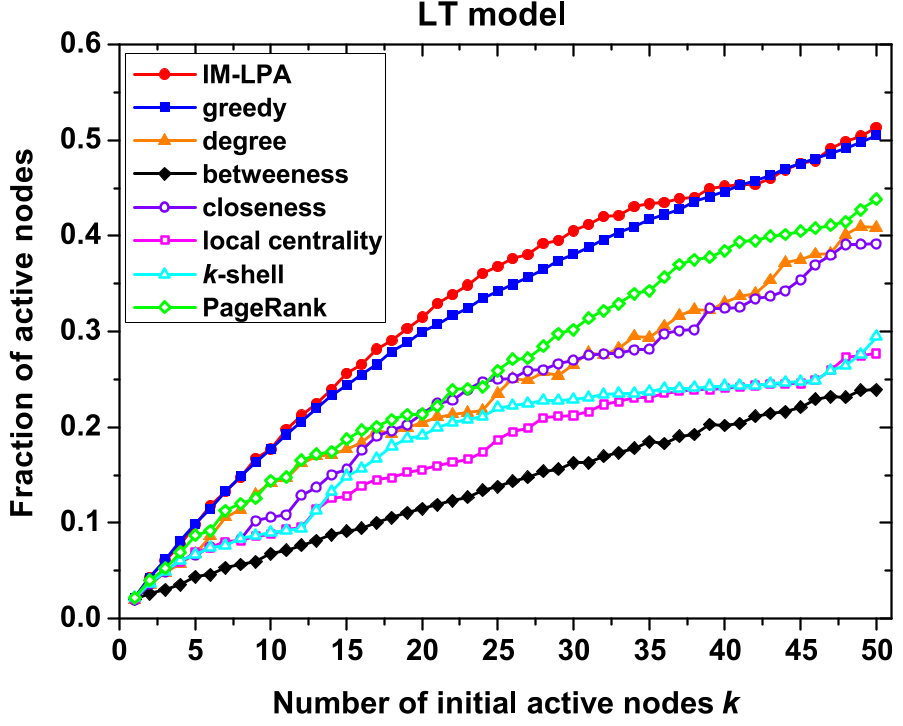 Experimental results showing the fraction of active nodes (Influence) across different seed set sizes (k).
 Summary of real-world datasets used, showing high modularity (community strength).
Critical Analysis & Conclusion
Takeaway: IM-LPA is a game-changer for viral marketing and epidemic modeling on a budget. It proves that we don't need to simulate a thousand "what-if" cascades if we understand the underlying community architecture.
Limitations: The method relies heavily on the existence of a clear community structure (Modularity ). In "Email Networks" or very "noisy" graphs where communities are indistinct, its performance naturally reverts to that of standard degree centrality.
Future Outlook: Integrating this with machine learning to predict edge weights (influence probabilities) could create a truly autonomous system for identifying social leaders in real-time streaming graphs.