
Beyond Objectivity: Why Emotional Reviews Rule the Web
Are influential writers more objective?: an analysis of emotionality in review comments
This paper investigates the relationship between emotionality and social influence in online reviews. Using text mining and the Geneva Emotion Wheel (GEW) model, the authors analyze over 68,000 hotel reviews to determine if "influential" writers (those with high helpfulness scores) are more objective or emotional.
TL;DR
In a world where we rely on online reviews to make every purchase decision, we often assume that the most "objective" and "neutral" voice is the most trustworthy. However, research from EPFL published at WWW '14 reveals a surprising truth: Influential writers are not objective—they are highly emotional. In fact, helpful reviews contain over double the emotional markers of their ignored counterparts.
The "Objectivity" Myth
We often expect influential reviewers to act like clinical reporters, sticking to the facts to provide an unbiased view. The researchers initially hypothesized that influential writers would refrain from expressing personal sentiments to achieve a "perceived objectivity."
The problem with this assumption is that it ignores the social nature of reviews. A review isn't just a list of specs; it is a shared human experience. Purely factual reviews often fail to resonate or "bore" the reader by lacking the idiosyncratic spark that signals a genuine encounter.
Methodology: Mapping the Human Heart in Text
To move beyond simple "positive vs. negative" sentiment analysis, the team adopted the Geneva Emotion Wheel (GEW). This model maps 20 distinct emotions across two axes: Valence (pleasure/displeasure) and Control (high/low power).
The Technical Pipeline
- Lexicon Matching: Using the GALC (Geneva Affect Label Code) dictionary to identify emotional roots.
- Negation Handling: Recognizing that "not happy" is a flip in emotion, not just a missing word.
- Intensity Weighting: Scaling the impact of an emotion word if it is preceded by modifiers like "extremely" or "slightly."
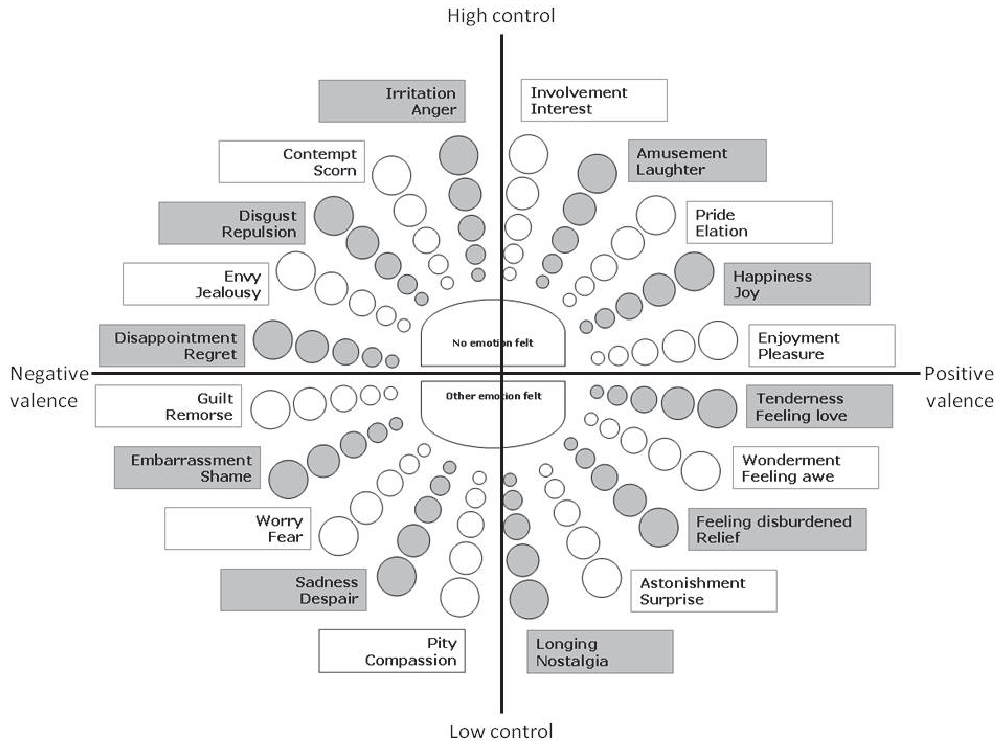 The GEW model used to categorize high-granularity emotions.
The Results: Passion is Persuasive
The findings were a complete reversal of the researchers' expectations. By analyzing 68,049 hotel reviews from TripAdvisor and 229,908 restaurant reviews from Yelp, a clear pattern emerged:
- Emotional Density: Helpful reviews showed a 122% increase in emotional terms compared to non-helpful ones.
- Variety and Intensity: Influential writers don't just use "happy" more; they use a wider variety of specific emotions and express them with higher intensity.
- The Negative Edge: In negative reviews, influential writers were significantly more expressive of Anger, Worry, and Regret, helping readers navigate potential pitfalls with more clarity.
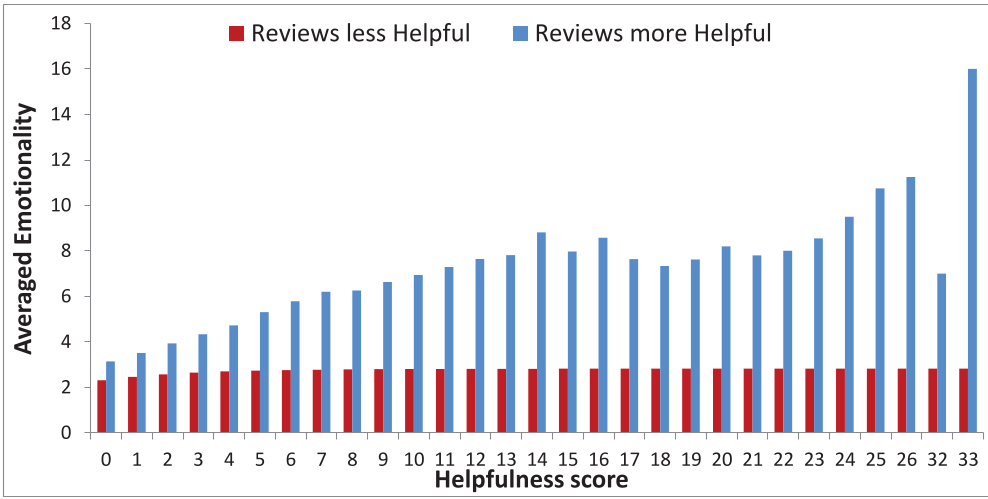 Graph showing that reviews with higher helpfulness scores across the board contain more emotional words (blue bars).
Deep Insights: Not All Emotions are Created Equal
The study also looked at Review Titles. While the body of a helpful review is emotional, titles are more nuanced. Influential negative reviews use descriptive emotional titles (e.g., involving "Regret"), but overly "sappy" or love-related titles in positive reviews sometimes made readers suspicious of exaggeration, leading to lower helpfulness scores.
Why This Works
From a psychological perspective, emotions evoke feelings in others and drive decision-making. A reader isn't just looking for the Wi-Fi speed at a hotel; they are looking for the relief of a comfortable bed or the frustration of poor service. Influential writers effectively "transfer" their experience to the reader through affective language.
Conclusion & Future Outlook
This work provides a foundational argument for building "Helpfulness Prediction" algorithms that don't just count words, but measure the emotional pulse of a text.
Key Takeaways:
- For Platforms: Search algorithms should prioritize reviews that show high emotional richness, as these are statistically more useful to the community.
- For Writers: If you want your review to be helpful, don't hold back. Shares your joys and frustrations; they are what make your review human and, ultimately, influential.
Future research will likely focus on domain-specific lexicons (e.g., how the "emotion" of a tech gadget review differs from a hotel stay) and the use of Large Language Models (LLMs) to better capture sarcasm and contextual nuance.