
ICMT: Solving the Cache Bottleneck in Opportunistic Social Networks via Collaborative Intelligence
Information cache management and data transmission algorithm in opportunistic social networks
This paper introduces the Information Cache Management and Transmission (ICMT) algorithm, a novel framework designed for opportunistic social networks to optimize data delivery in environments with intermittent connectivity. ICMT utilizes node recognition through assessment probability and neighbor node cooperation to manage limited cache space, ultimately achieving state-of-the-art performance in delivery ratios and latency.
TL;DR
The Information Cache Management and Transmission (ICMT) algorithm addresses the "intermittent connectivity" and "limited buffer" problems in opportunistic social networks. By treating nearby mobile devices as cooperative storage partners and using social-attribute-based probability to prioritize messages, ICMT boosts data delivery by 82% while slashing latency by 74%.
Problem & Motivation: The "Waiting" Game in Mobile Networks
In an opportunistic social network, nodes (people with mobile devices) move and communicate via Bluetooth or WiFi. Because an end-to-end path rarely exists at any single snapshot in time, nodes must "store-carry-and-forward" data.
The crisis arises when dealing with big data:
- Cache Overflow: Devices run out of memory, causing new, vital information to be dropped.
- Selfishness: Nodes often prioritize their own data, leading to a breakdown in network cooperation.
- Inefficient Deletion: Traditional FIFO methods discard packets without considering their "social value" or probability of reaching the destination.
Methodology: The ICMT Architecture
The ICMT algorithm shifts the paradigm from "individual storage" to "collaborative caching."
1. Information Importance Estimation
Instead of treating all packets equally, ICMT calculates a Diffusion Degree (S) and Message Importance (W). If a message is already widely spread within a community, its importance decreases, making it a candidate for replacement to save resources.
2. Node Recognition and Encounter Probability
The algorithm utilizes a sophisticated triple list List(A) = [ID, Meeting Time, Duration] to build an encounter matrix. It calculates:
- Node Activity (): How often a node interacts with the whole network.
- Relative Dependence (): How likely node is to meet destination .
3. Distributed Collaborative Cache Transfer
This is the core innovation. When a node's cache is full, it doesn't just delete data. It looks for "Cooperation Nodes" in its communication range to host the data temporarily.
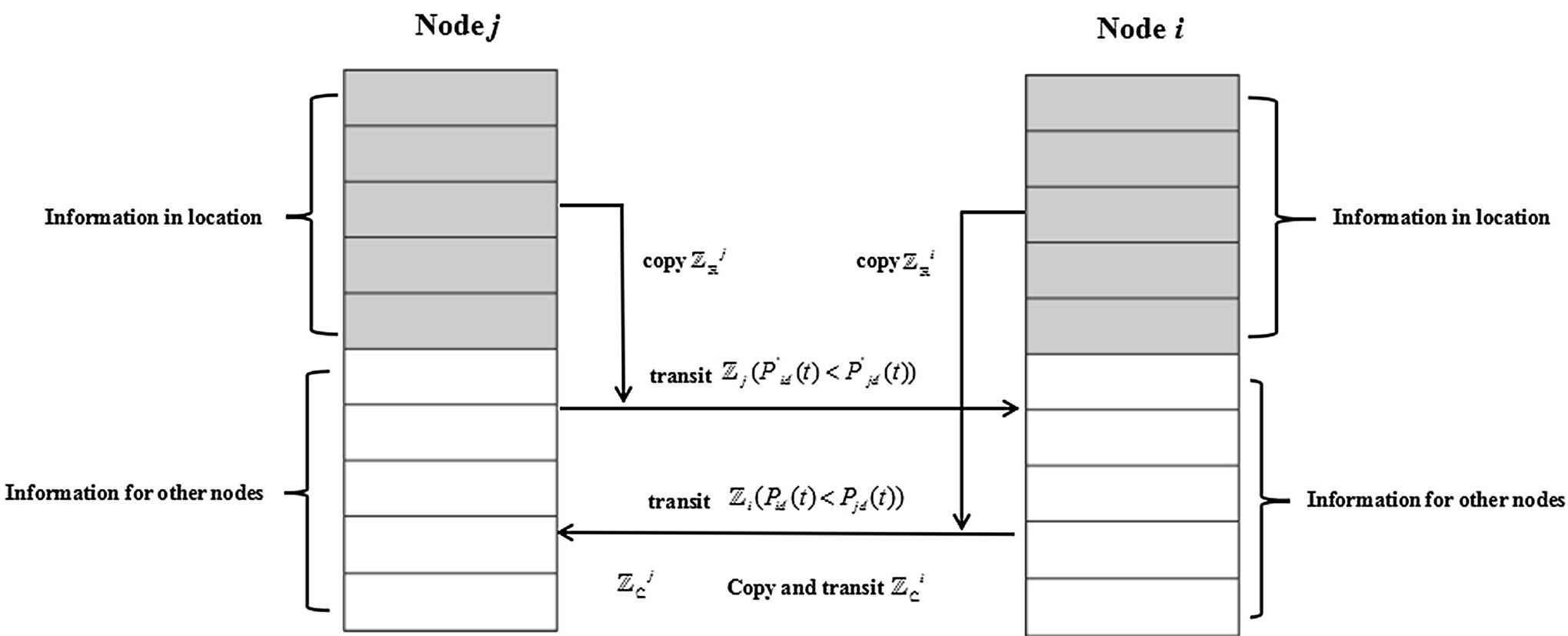 Fig 1: The dual-layer cache structure (Local vs. Cooperative) enables nodes to serve both their own needs and the network's data transit.
Experiments & Results: Crushing the Baselines
The authors compared ICMT against Epidemic, Spray-and-Wait, and EIMST using OMNeT++ simulations.
Delivery Ratio and Latency
ICMT outperformed all baselines. As cache sizes increased, ICMT approached a 93%+ delivery ratio, whereas traditional methods like Spray-and-Wait plateaued significantly lower due to message loss from over-flooding.
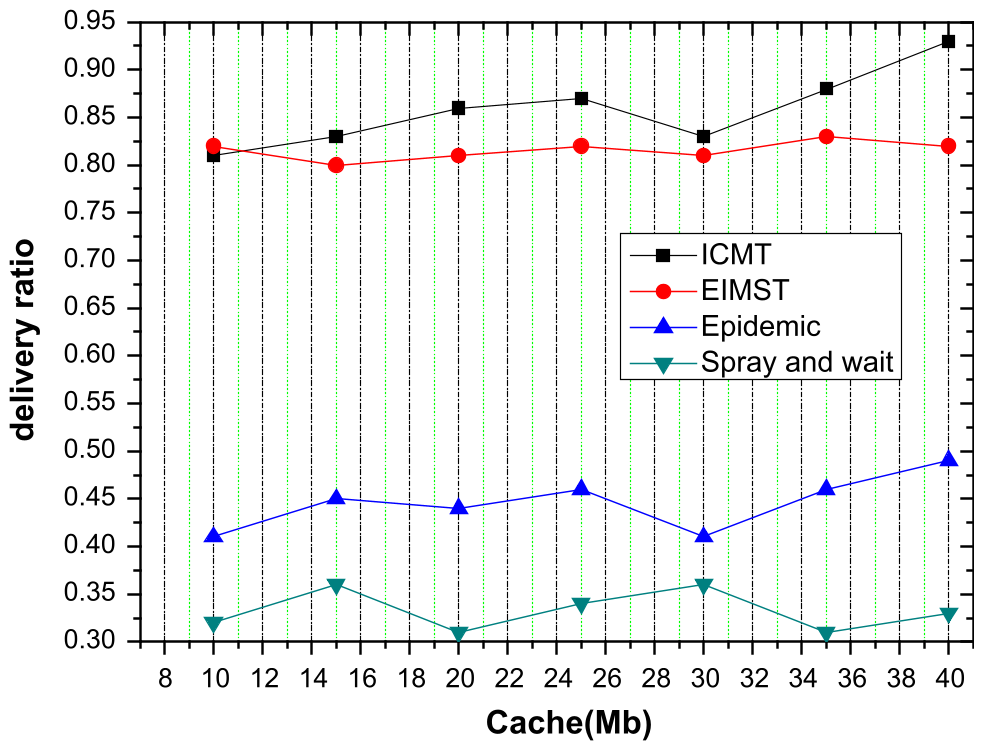 Fig 2: ICMT consistently maintains a higher delivery ratio by effectively utilizing the collective cache space of neighbors.
Energy Efficiency
By selecting accurate neighbors for transmission rather than broadcasting to everyone (as seen in the Epidemic model), ICMT minimizes redundant transmissions, preserving node battery life—a critical factor for mobile social devices.
Critical Insight & Conclusion
The genius of ICMT lies in its socially-aware selfishness. It recognizes that while nodes are inherently selfish (preferring their own data), the most "selfish" thing they can do to ensure their own data's delivery is to cooperate with others.
Limitations: The model assumes a degree of trust between nodes in a community. In highly adversarial environments, malicious nodes could exploit the "collaborative cache" to drop packets or perform DoS attacks.
Future Outlook: As we move toward 6G and massive IoT, decentralized cache management like ICMT will be pivotal in handling data in areas with poor infrastructure, such as disaster rescue zones or underdeveloped regions.