
Decoding Information Diffusion: From Viral Marketing to Rumor Tracing
Study on Information Diffusion Analysis in Social Networks and Its Applications
This paper provides a comprehensive review of information diffusion analysis in social networks, covering fundamental models (IC, LT, and Epidemic), authority evaluation methods, and critical applications such as Influence Maximization (IM) and Information Source Detection. It synthesizes state-of-the-art algorithms, including the transition from greedy heuristics to near-optimal reverse sampling techniques like IMM.
TL;DR
Information diffusion analysis is the "physics" of social networks, determining how ideas, diseases, and products spread. This comprehensive study by Chang et al. (USTC) maps the transition from classic epidemic models to high-scale algorithmic frameworks like Influence Maximization (IM) and Source Detection. The core value lies in moving beyond simple "What" (the spread) to the "How" (the mechanism) and "Who" (the source).
1. The Core Engines: Diffusion Models
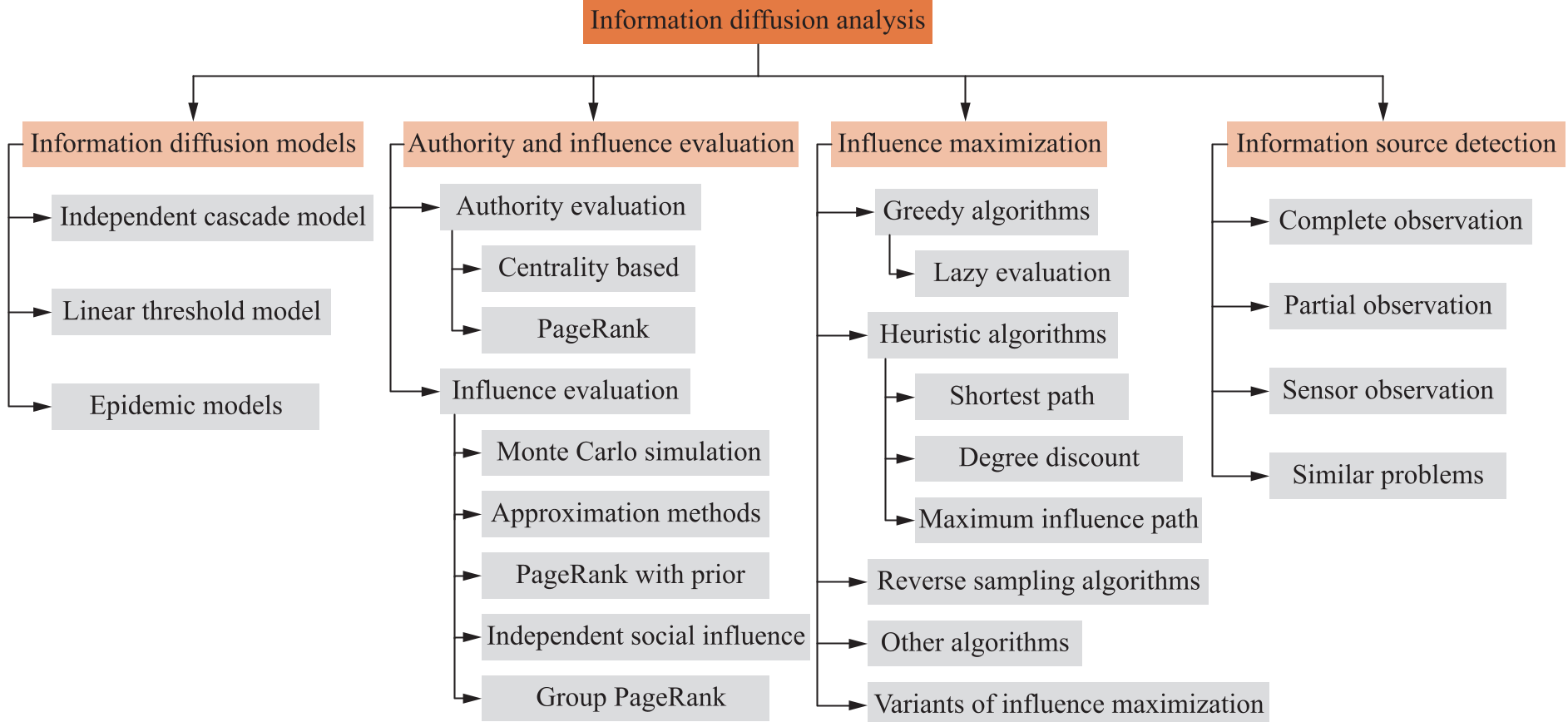
Before optimizing a network, we must model how it "inflames." The paper revisits three foundational paradigms:
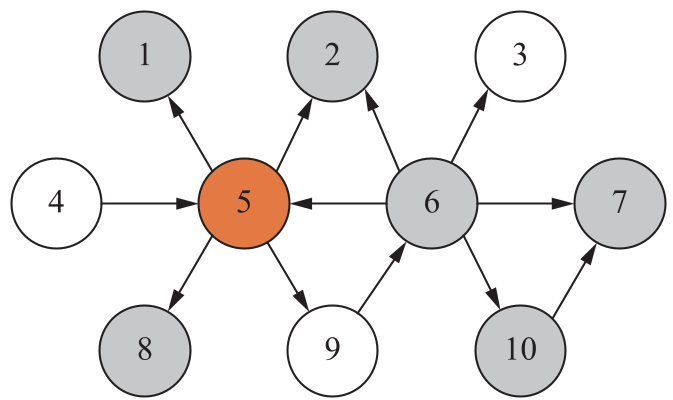
- Independent Cascade (IC): Think of it as a domino effect. Each active node gets one chance to trigger its neighbor with a fixed probability.
- Linear Threshold (LT): A "peer pressure" model. A node only activates if the collective influence of its active neighbors exceeds a specific threshold.
- Epidemic Models (SI/SIR): Borrowed from biology, these models track susceptible, infected, and recovered states, crucial for modeling long-term viral cycles.
2. Influence Maximization: The Billion-Scale Challenge
The Influence Maximization (IM) problem asks: If I can only pick K "seed" users, who will cause the largest outbreak?
From Greedy to RIS
The spread function is monotone and submodular, which allows for a greedy approach with a performance guarantee. However, standard greedy is slow.
- Lazy Evaluation (CELF): Exploits the "diminishing returns" property to skip redundant calculations, speeding up the process by orders of magnitude.
- The RIS Breakthrough: Borgs et al. revolutionized the field by using Reverse Influence Sampling. Instead of simulating forward, it samples "Reverse Reachable (RR)" sets to find nodes that frequently appear in potential spread paths. Modern algorithms like IMM (Influence Maximization via Martingales) finally brought this to trillion-edge scalability.
3. The "Patient Zero" Problem: Source Detection
While IM looks forward, Information Source Detection looks backward. Given a snapshot of infected nodes, who started it?
Geometric Centers of Influence
The authors detail several clever strategies to find the culprit:
- Rumor Center: On tree-like networks, the source is likely the node with the highest "rumor centrality"—essentially the node that could have produced the observed spread through the highest number of possible permutations.
- Jordan Center: When focus is on the most "central" node in terms of minimum distance to all infected participants, typically used in SIR model scenarios.
4. Academic Insight: Why This Matters
The real contribution of this survey is the categorization of Observation Types:
- Complete Observation: We see every infected/recovered node.
- Partial Observation: Only a fraction of the network's state is known.
- Sensor Observation: Time-stamped data from specific "listeners."
Each type requires a different mathematical toolset, from Eigenvector Centrality (to measure dynamic importance) to DMP (Dynamic Message Passing) to handle the uncertainty of unobserved nodes.
5. Critical Analysis & Future Horizons
Despite the mathematical elegance of current models, the authors identify several "blind spots":
- External Influence: Social networks aren't closed systems; TV and news influence users outside of the graph's edges.
- Deep Learning: The next frontier involves GNNs (Graph Neural Networks) and Representation Learning to infer diffusion laws directly from raw temporal data, bypassing the need for pre-defined IC or LT laws.
- Competitive Diffusion: In the real world, multiple rumors or products compete for the same "mind-share" simultaneously.
Summary Table of Source Detection Methods
| Method Category | Model | Efficiency | Best Feature |
|---|---|---|---|
| Rumor Center | SI | $O( | V_I |
| Spectral (DI) | General | Captures dynamic age | |
| Bayesian (BP) | SIR | High Complexity | Robust to noise |
| Reverse Sampling | Any | Near-Linear | Scalability |
Conclusion
This paper serves as a roadmap for anyone looking to navigate the transition from traditional centrality-based social network analysis to modern, scalable, and probabilistic diffusion modeling. Whether you are building a viral marketing engine or a rumor detection system, understanding the balance between submodularity (for IM) and likelihood maximization (for Source Detection) is the key to mastering social influence.