
Beyond Friend Requests: A Precision Flow-Control Model for OSN Security
An Information-Flow Control Model for Online Social Networks Based on User-Attribute Credibility and Connection-Strength Factors
The paper introduces a hybrid Information-Flow Control (IFC) model for Online Social Networks (OSN) that differentiates between acquaintances and adversaries. It combines User-Attribute Credibility (V) and Connection-Strength factors (E) into a unified Total Sharing Probability (TSP) metric to prevent information leakage.
TL;DR
In the era of social engineering and automated bots, "friendship" is no longer a binary state. This paper presents a sophisticated Information-Flow Control (IFC) model that calculates the probability of trust by blending User-Attribute Credibility (Who are you?) with Connection-Strength Factors (How well do we know each other?). By using path-based probability instead of simple edge-cutting, it prevents information leakage to adversaries without disrupting valid social interactions.
The "Binary Trust" Fallacy
Most Online Social Networks (OSNs) treat privacy as a wall: you are either a "friend" or a "stranger." Previous academic attempts to solve this, such as the Min-Cut approach, are often too blunt—they stop leaks by severing edges, which frequently results in "collateral damage" where perfectly valid acquaintances lose access to information they should have seen.
The authors argue that the real problem is information leakage to unwanted entities (spammers, professional foes, or bots) who hide behind the mask of "Friend of a Friend" (FoaF).
Methodology: The Anatomy of Trust
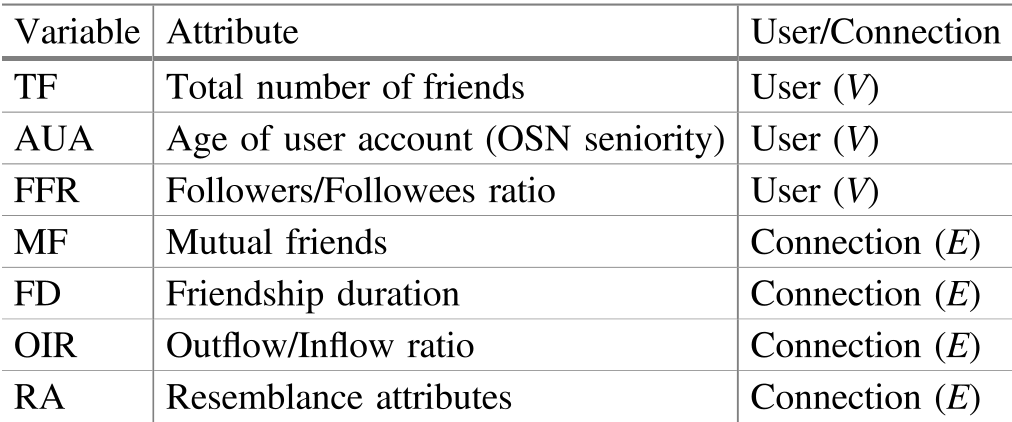
The core innovation lies in the mathematical decomposition of a social interaction into two distinct dimensions:
1. Vertex Credibility ()
Instead of trusting a node blindly, the model evaluates the entity itself using:
- TF (Total Friends): Bots often have extreme or very low friend counts.
- AUA (Age of Account): Newer accounts are statistically more likely to be malicious "throwaways."
- FFR (Followers/Followees Ratio): A classic signal for data-harvesting bots that follow thousands but are followed by few.
2. Edge Strength ()
This measures the "texture" of the relationship:
- MF (Mutual Friends): The social "glue" that validates a connection.
- FD (Friendship Duration): Longitudinal trust.
- RA (Resemblance Attributes): Do you share the same hometown, language, or city? Homophily is a strong indicator of genuine acquaintance.
The Algorithm: Path-Based Probability
The model calculates the Total Sharing Probability (TSP) for any path from an Ego-node (Source) to a Target. Unlike simple summation, it uses a product of probabilities:
This multiplicative approach ensures that if any single link in the chain—be it a suspicious user or a weak connection—is compromised, the overall trust score collapses.
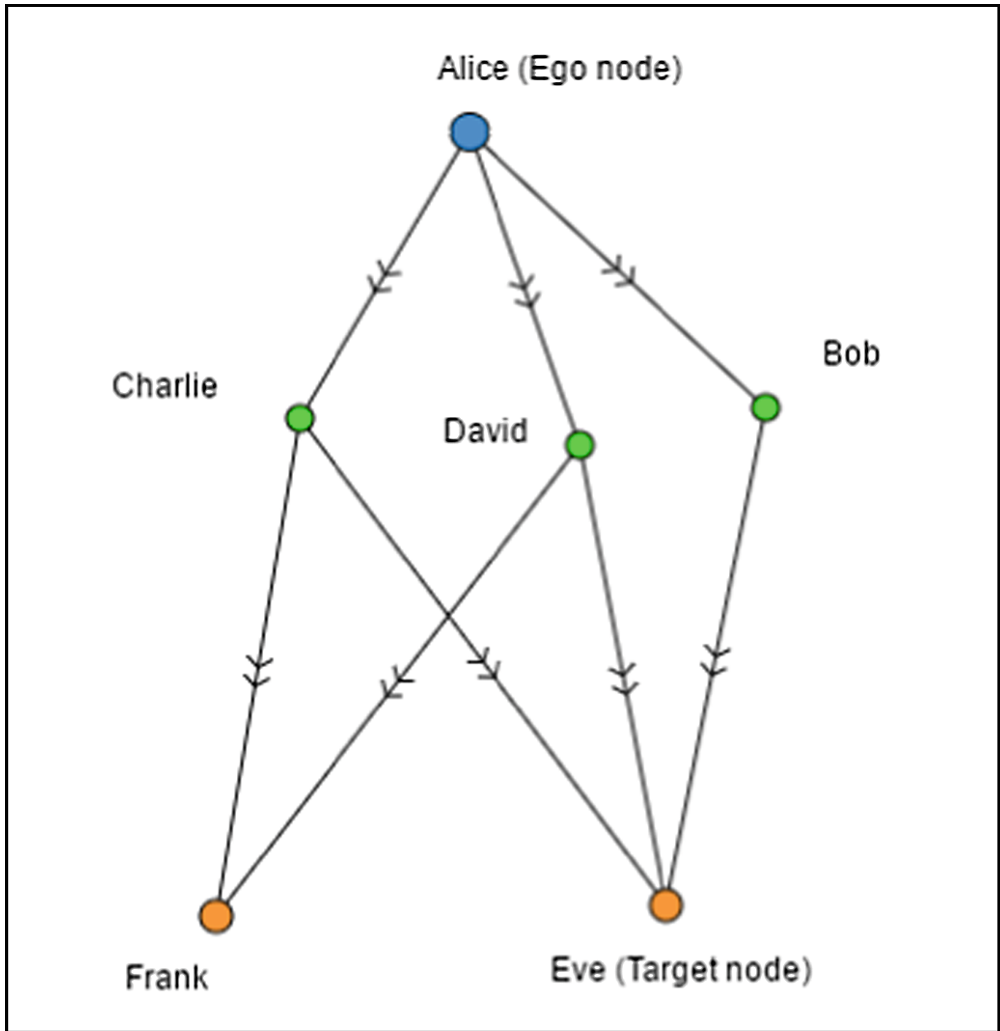 In this example, the model determines whether "Eve" is an acquaintance or an adversary by calculating TSPs across all paths from Alice.
Experiments & Results: Acquaintance vs. Adversary
The research utilizes a Minimum Sharing Probability (MSP) threshold (defaulting to 0.5).
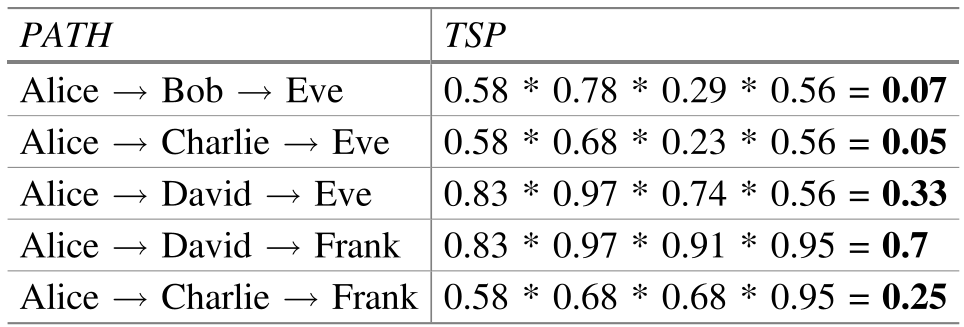
- The Findings: In a test case involving six users, "Frank" was correctly identified as an acquaintance via the path Alice → David → Frank (TSP 0.7), while "Eve" was flagged as an adversary because no path reached the 0.5 threshold (highest TSP was 0.33).
- Efficiency: By leveraging Dinic’s algorithm for pathfinding, the model scales at , making it feasible for real-time permissions in moderate-sized sub-graphs.
Critical Insight: Why This Matters
The fundamental shift here is moving from Access Control Lists (ACL) to Attribute-Based Flow Control. By labeling information with a "required trust score" and propagating it through the graph, the network becomes self-defending.
Limitations: The model assumes that users fill out their profile attributes (hometown, etc.). In an age of high privacy awareness, "null" attributes are common, which might penalize honest but private users. Future iterations will likely need to incorporate behavioral patterns (like "likes" or "mentions") to supplement missing static data.
Conclusion
This work provides a robust framework for OSN providers to automate privacy. Instead of putting the burden on the user to manage complex "Circles" or "Lists," the system uses the underlying physics of the social graph to calculate risk dynamically.