
Decoding Information Hubs: How Social Network Analysis Solves the Product Development Coordination Crisis
13613_Information Leaders in Product Development Organizational Networks Social Network Analysis of the Design Structure Matrix.
This paper proposes a framework to identify "Information Leaders" in Product Development (PD) by applying Social Network Analysis (SNA) metrics—specifically centrality and brokerage—to the Design Structure Matrix (DSM). It identifies a specialized "Information Leaders Team" (ILT) that controls critical technical information flow in large-scale engineering projects like aircraft engine design.
Executive Summary
Developing a modern aircraft engine involves thousands of specialists and tens of thousands of technical dependencies. In such environments, traditional project management (like PERT or Gantt charts) breaks down because engineering is fundamentally concurrent and iterative. This paper, Information Leaders in Product Development Organizational Networks, introduces a rigorous mathematical way to identify the "hubs" of information. By applying Social Network Analysis (SNA) to the Design Structure Matrix (DSM), the authors provide a blueprint for creating an Information Leaders Team (ILT)—a group that can either be the catalyst for system-wide innovation or the bottleneck that sinks a project.
The Problem: The Invisibility of Information Hubs
In large-scale Product Development (PD), teams are often structured based on the physical components of the product. However, information flow doesn't always follow the official hierarchy. Previous research suggested that PD networks are Scale-Free, meaning most teams have few connections, while a handful of "hubs" are connected to almost everyone.
The danger? If managers don't know who these hubs are, they cannot support them. These teams become "accidental integrators," overwhelmed by meetings and coordination tasks, causing their actual engineering quality to suffer and the project timeline to slip.
Methodology: From Matrix to Social Map
The authors bridge the gap between engineering management and sociology by using three primary centrality measures and a sophisticated "Brokerage" model:
- Degree Centrality: Who is the most "popular" node? This measures the immediate volume of information inflow and outflow.
- Closeness Centrality: Who can reach the rest of the network fastest? High closeness means a team can sense project-wide changes before anyone else.
- Betweenness Centrality: Who sits on the "shortest path" between two other teams? These are the Gatekeepers. If they fail to share a parameter, the whole system might be built on outdated data.
- Brokerage Roles: Identifying if a team acts as a Liaison (connecting different groups), a Gatekeeper, or an Internal Coordinator.
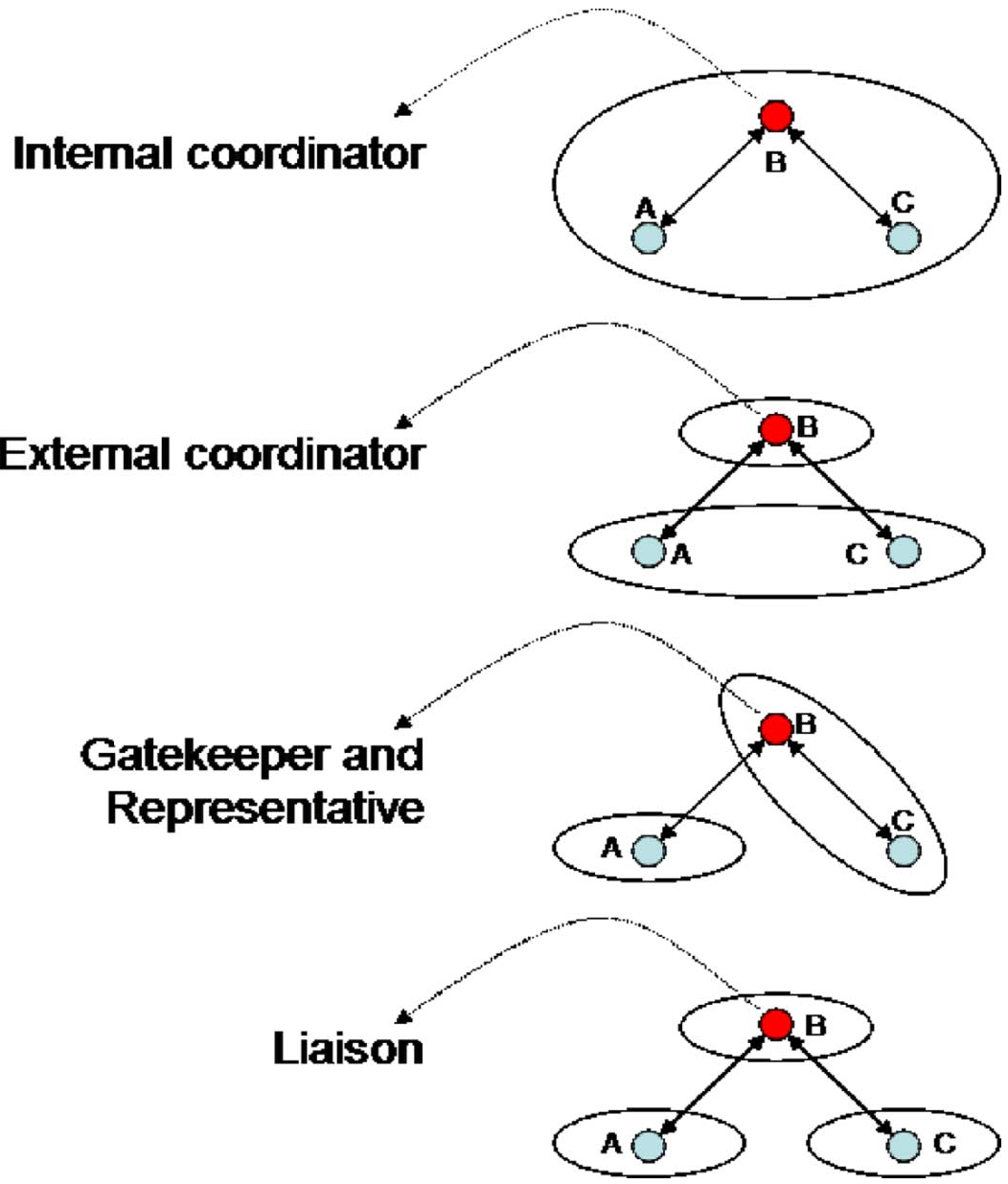 Figure: The five types of brokerage roles used to classify how teams mediate information.
Case Study: The Aircraft Engine
The researchers analyzed a real-world dataset from a large commercial aircraft engine project involving 54 design teams. By converting the asymmetric interaction data into a symmetric DSM, they calculated the influence scores for every team.
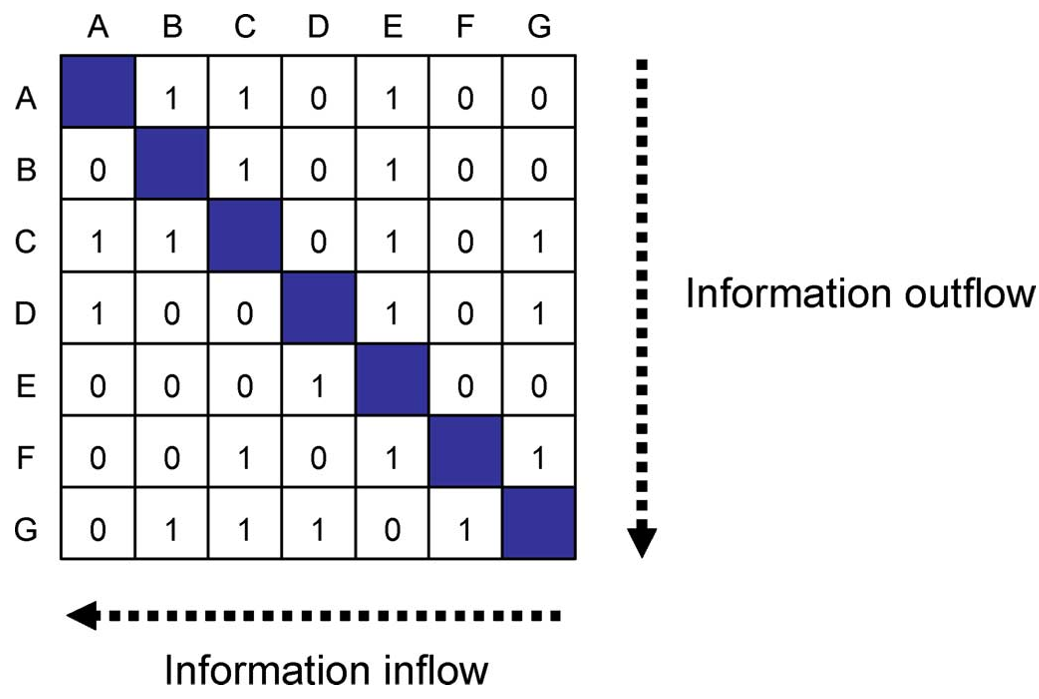 Figure: The transformation from a Design Structure Matrix (DSM) to a Social Network representation.
Key Findings
- The ILT emerges: Nine teams (e.g., G1: Main Shaft, H10: Electrical Controls) consistently scored in the top tier across all metrics.
- Modular Hubs: Surprisingly, 44% of information leaders were "modular" teams (e.g., Combustion Chamber), not just "integrative" teams. This proves that high-stakes information flow occurs deep within the component architecture, not just at the management level.
- The Power of Gatekeepers: 50% of the brokerage in the engine project was handled by Gatekeepers/Representatives, highlighting the risk of information "bottlenecking" if these roles aren't formalized.
The Innovation Cycle: Why ILTs Matter
The paper argues that the Information Leaders Team is not just about "fixing bugs"; it is the primary engine of Innovation Arbitrage. Because ILT members see information from heterogeneous sources across the project, they can:
- Synthesize new practices from unrelated teams.
- Transfer best practices across organizational silos.
- Identify Misalignments between the product's architecture and the organization's communication.
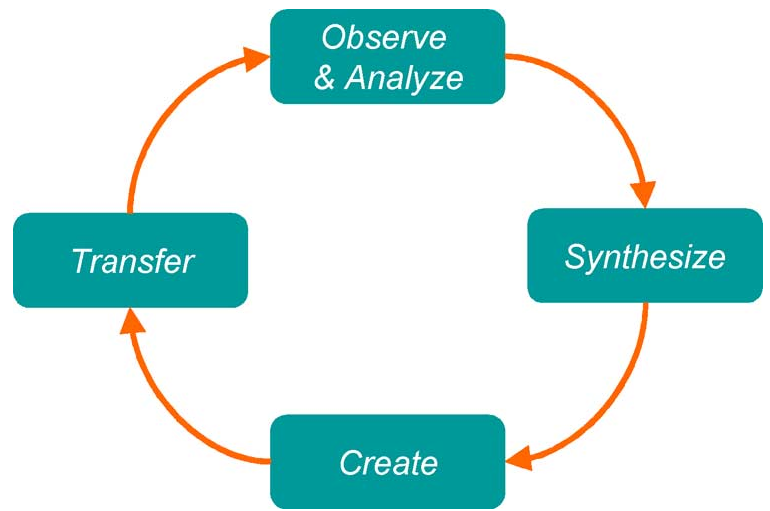 Figure: The proposed cycle of how Information Leaders drive innovation.
Managerial Insight: The "Zone Engineer"
The authors’ most practical recommendation is the creation of a Parallel Structure. Since Information Leaders are highly stressed by the "Coordination vs. Design" trade-off, companies should appoint Zone Engineers. These are specialists whose primary job is to handle the "Liaison" and "Gatekeeper" functions for hub teams, freeing up the designers to focus on engineering while ensuring the global network remains synchronized.
Conclusion
Large engineering projects are social networks in disguise. By using SNA to reveal the "Information Leaders," managers can move from reactive firefighting to proactive system integration. The future of PD management lies in recognizing that position in the network is as important as expertise in the task.
Limitations
- Static Assumption: The model assumes the DSM remains relatively stable during the project. In reality, dependencies can shift as designs mature.
- Information Decay: The study assumes indirect paths (passing info through 3rd parties) are efficient, but in the real world, "technical telephone" often leads to accuracy loss.