
Beyond the Noise: Rethinking Influence Maximization in the Age of Information Overload
Information Overload and Viral Marketing: Countermeasures and Strategies
This paper introduces the General Independent Cascade Model (GICM), an extension of the classic ICM designed to account for information overload in social networks like Digg.com. It explores how filter-based and cost-based countermeasures affect viral marketing effectiveness, specifically addressing the Influence Maximization (IM) problem.
TL;DR
In the hyper-saturated world of social media, more messages often lead to less influence. This paper challenges the traditional Independent Cascade Model (ICM) by introducing the General ICM (GICM), which accounts for human attention limits. By simulating countermeasures like content filtering and message costs, the researchers demonstrate that reducing "information noise" actually enhances viral marketing reach—provided you radically change who you target as your initial "seeds."
The "Attention Economy" Crisis
Traditional viral marketing theory operates on a simple assumption: if I tell you something, there is a fixed probability you will pass it on. However, in platforms like Twitter or Digg, users are bombarded with "batches" of updates. When a marketing message is buried 50 slots deep in a friend's feed, the probability of activation isn't just low—it's nearly zero.
The authors identify a critical inverted U-curve in information processing: up to a point, more information increases utility, but beyond that "sweet spot," anxiety and confusion cause engagement to plummet.
Methodology: The GICM Framework
The core innovation is the General Independent Cascade Model (GICM). Unlike the original ICM which tracks a single message, GICM allows multiple messages to compete for a user's limited attention span.
1. The Inverted U-Curve Logic
The authors model the probability of activation as a function of the message's rank and the total sequence length : This captures the "batching effect" where the intensity of information load () exponentially degrades the chance of a message being seen.
2. Strategic Countermeasures
The paper explores two primary ways to fix this overload:
- Filter-Based: Content-based filters that only allow messages matching a user’s "favorite categories" to pass.
- Cost-Based: Imposing a "non-monetary cost" (time/effort) on senders, forcing them to select specific recipients manually rather than using "send to all."
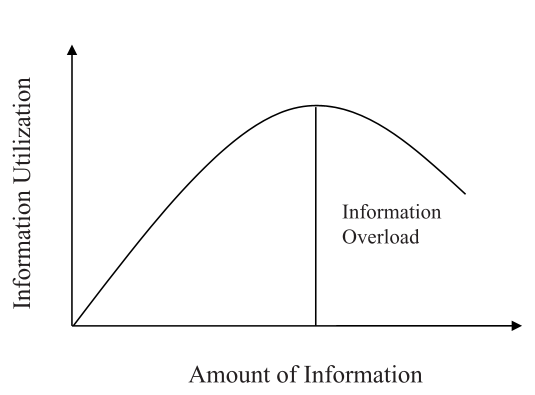 Fig 1: The mathematical representation of how attention drops as information volume exceeds recipient capacity.
Experiments: Why Your Seeding Strategy Is Wrong
Using data from Digg.com, the researchers ran influence maximization simulations using a greedy hill-climbing algorithm. Their findings suggest a massive shift in ROI depending on the environment:
- In a Filtered World: The best "seeds" are no longer just those with the most followers. Instead, the algorithm favors users who have a high concentration of "narrow-interest fans"—people whose filters are precisely tuned to the marketing topic.
- In a Cost-Regulated World: The focus shifts to "active communicators." Since sending messages now "costs" effort, the best targets are those who have historically demonstrated the willingness to manually curate and share content with their inner circle.
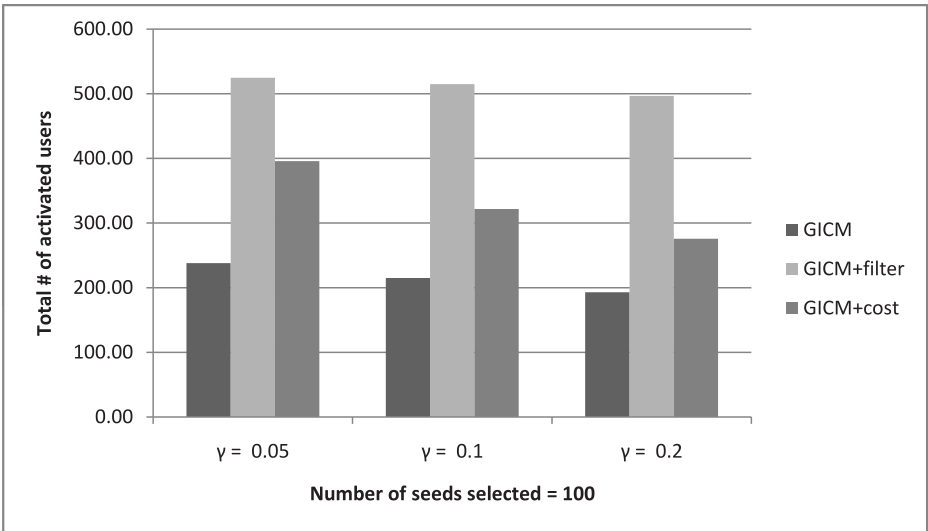 Fig 2: Performance comparison showing that influence spreads further when the network is "cleaned" by filters or cost constraints.
Critical Insights & Takeaways
The most profound takeaway is that Information Overload is a systemic inhibitor of viral growth.
- Platform Design Matters: Platforms that implement better noise-reduction (filters) or friction (costs for bulk sharing) actually create a more fertile ground for relevant marketing.
- Targeting Pivot: If you are launching a campaign in a noisy environment, stop looking for the "megaphones" (broad influencers) and start looking for the "specialists" (niche influencers with dedicated, filtered audiences).
Limitations
The study assumes a fixed "sending capacity" and a relatively static social graph. In contemporary platforms (like TikTok or Instagram), algorithmic feeds further complicate this by decoupling the "follower" relationship from the "content delivery" mechanism. Future research should apply GICM to Algorithmic Recommendation Engines where the "filter" is controlled by a black-box AI rather than user-defined categories.
Conclusion
This work serves as a bridge between management science and network theory. It proves that in an overloaded digital ecosystem, the marketer’s greatest enemy isn't the competition—it's the volume of the noise.