
Hierarchical Temporal-Spatial Preference Modeling: Decoding the "When" and "Where" of Human Consumption
Information Processing and Management
This paper introduces a two-stage hierarchical framework for predicting user consumption locations in Geo-Social Networks (GSNs) at a given future time. It combines a Temporal Base Model (TBM) for mining periodic intrinsic preferences from sentimental reviews and a Location Prediction Model (LPM) that integrates multi-modal contexts, achieving state-of-the-art performance on accuracy and ranking metrics across three real-world Yelp datasets.
TL;DR
Predicting where a user will spend their money at a specific future time is the "Holy Grail" for personalized marketing. This paper presents a two-stage framework that transforms noisy Geo-Social Network (GSN) data—reviews, social links, and check-ins—into a precise predictive engine. By aligning subjective sentiments with objective spatio-temporal cycles, the authors achieve a ~19% accuracy boost over previous SOTA models like LBSN2Vec.
Background & Motivation: Beyond "Next-Step" Prediction
Most mobility models solve the "next-step" problem: given you are at , where is ? However, real-world utility often requires given-time prediction: "Where will John be next Saturday at 8 PM?"
This task is significantly harder because the context is sparse. The authors argue that current solutions fail because they treat user preference as a "black box" vector. They propose that sentimental reviews (the "What" and "Why") are the missing link to understanding the periodic functionality of locations (e.g., a user likes "Asian Fusion" on Friday nights but "Quiet Cafes" on Monday mornings).
Methodology: The Two-Stage Deep Architecture
Stage 1: The Temporal Base Model (TBM)
The TBM's goal is to learn a representation of the user that changes based on 35 distinct time windows (7 days × 5 time slots).
- Sentiment Mapping: It uses HUAPA to turn reviews into vectors that encode both topic and sentiment.
- Hierarchical Attention: Not all reviews are equal. The model uses review-level attention to find important visits and window-level attention to aggregate global user behavior.
- Topic Guidance: To ensure these embeddings mean something, the model is trained to predict a ground-truth "Intrinsic Latent Representation" generated by a Temporal LDA (TLDA) model. This bridges the gap between traditional topic modeling and deep neural embeddings.
Stage 2: The Location Prediction Model (LPM)
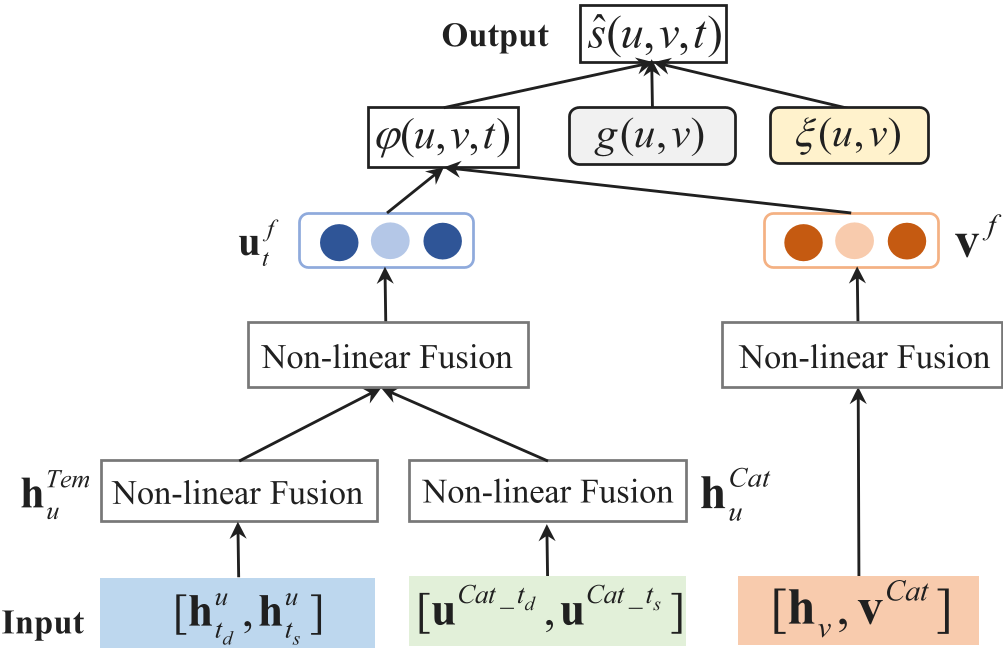
Once the time-sensitive preferences are learned, the LPM performs a "multi-modal fusion." It doesn't just look at the user; it looks at the target location's categories, the geographical distance (using Kernel Density Estimation), and what the user's social friends are doing.
The model uses non-linear fusion layers to merge these heterogeneous signals into a single probability score.
Experimental Battleground: Toronto, Phoenix, and Las Vegas
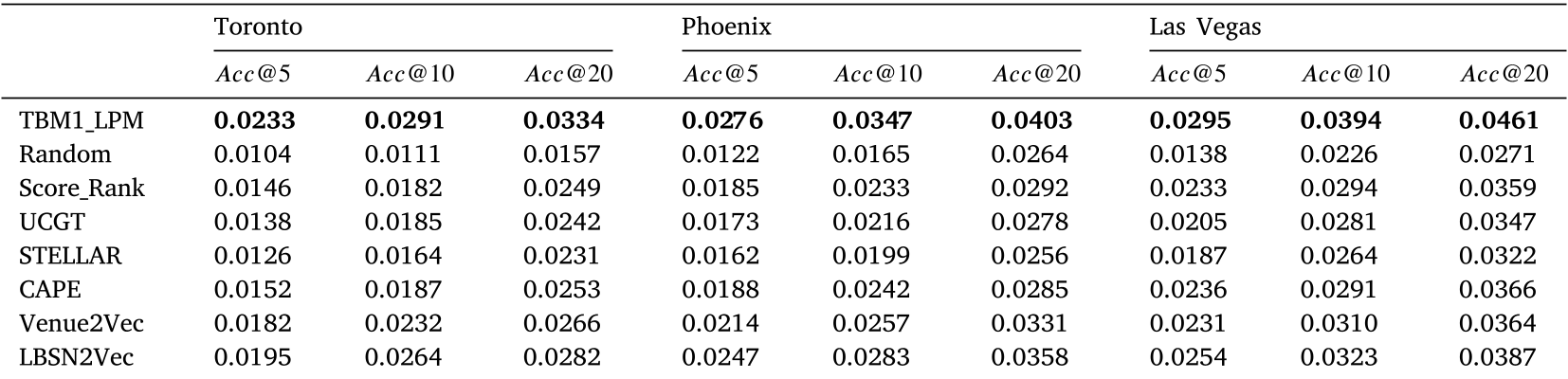
The researchers tested their framework against seven baselines using massive Yelp datasets.
Key Findings:
- Accuracy (Acc@K): The framework consistently outperformed LBSN2Vec and Venue2Vec. In Toronto, the Acc@5 improvement was nearly 20% over the best baseline.
- Ranking (APR): The model doesn't just guess right; it ranks the ground-truth location very high in the candidate list, which is vital for recommendation systems where screen real estate is limited.
- Ablation Success: Removing the "Geographical" and "Social" components significantly hurt performance, proving that mobility is never just about personal taste—it's about "convenience" (GP) and "influence" (Social).
Critical Insight & Conclusion
The genius of this paper lies in its hierarchical periodic approach. Instead of treating time as a continuous variable (which is often noisy), it discretizes time into "behavioral windows." By supervising the neural network with TLDA topic distributions, it prevents the model from overfitting on random check-ins and forces it to learn the logic behind the consumption.
Limitations: The model currently focuses on "in-town" mobility. It struggles when a user travels to a new city (the "cold-start" problem). Future research into cross-city transfer learning will be the next frontier for this architecture.
Final Takeaway: If you want to know where someone is going, listen to what they said (Reviews) and watch when they said it (Time Windows).