
I See It in Your Eyes: The Power of Minimalist CNNs for Real-Time Emotion and Pain Recognition
Information Processing and Management
This paper introduces a "shallowest-possible" CNN architecture for real-time, value- and time-continuous emotion and pain recognition from in-the-wild video chats. Utilizing Facial Action Units (FAUs) as inputs, the model achieves state-of-the-art performance on the SEWA corpus across German, Hungarian, and Chinese cultures, demonstrating high cross-cultural generalizability.
TL;DR
In the quest for "White-box AI" in healthcare, researchers have developed the shallowest possible Convolutional Neural Network (CNN) to detect emotions and pain from video. By stripping away the complexity of Recurrent Neural Networks (RNNs) and using a single 1D convolutional layer, this model achieves real-time performance on mobile hardware while remaining fully explainable through feature attribution.
Background: Why Complexity Isn't Always Better
In the academic world of affective computing, the trend has been toward deeper models and complex fusion of audio, text, and video. However, in sensitive fields like healthcare, "Explainability" is a prerequisite. A doctor needs to know why a system flags a patient as being in pain. Furthermore, for remote monitoring (via web-assisted video chats), systems must be robust against "in-the-wild" noise—bad lighting, frozen frames, and cultural differences in expression.
The "Shallow" Revolution: Methodology
The authors challenged the necessity of Recurrent Neural Networks (RNNs). While RNNs (like LSTMs or GRUs) are designed for sequences, they often suffer from vanishing gradients and lack parallelization.
1. From Deep to Shallow
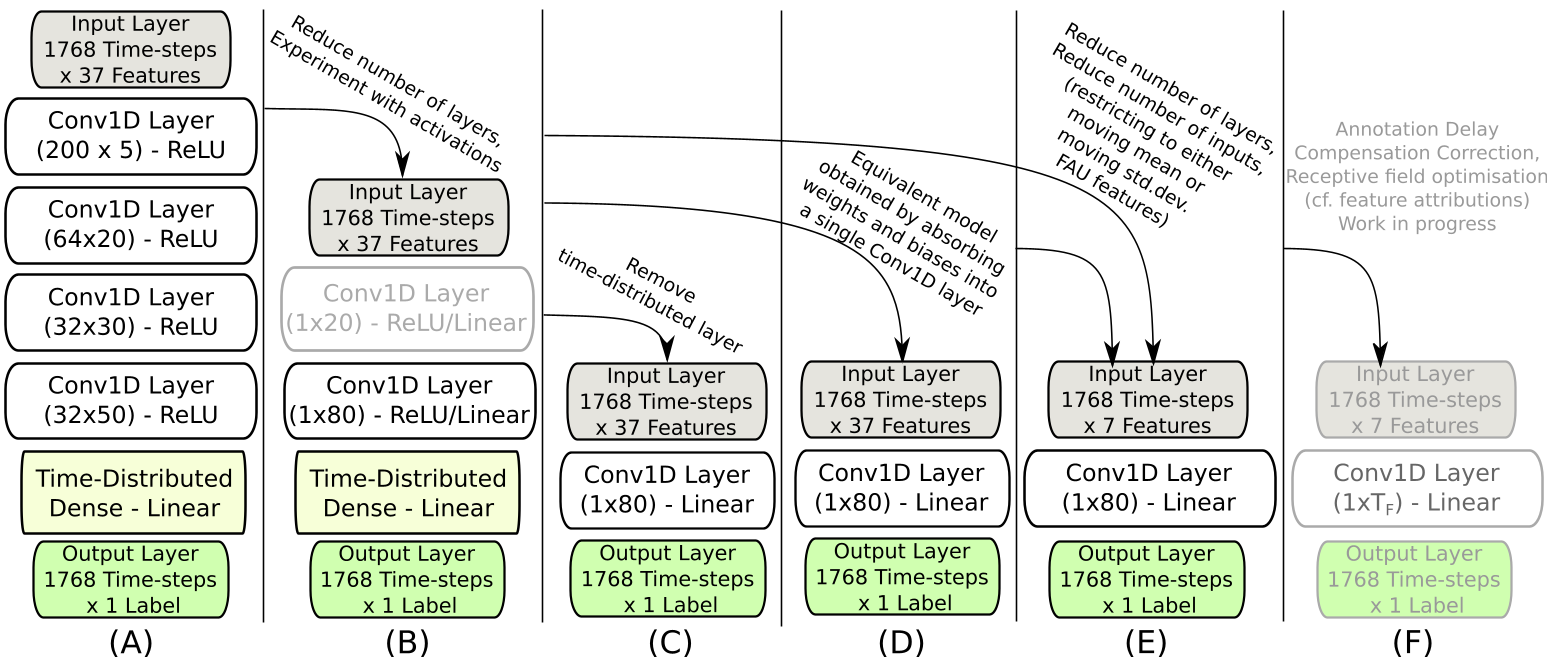
The research team evolved their architecture from a multi-layer deep CNN (Model A) down to a single 1D-Convolutional layer with linear activation (Model D).
- The Receptive Field: Designed to cover approximately 10 seconds of video context.
- The Input: 17 Facial Action Units (FAUs) extracted via OpenFace, representing specific muscle movements (e.g., brow raiser, lid tightener).
2. Feature Attribution: Breaking the Black Box
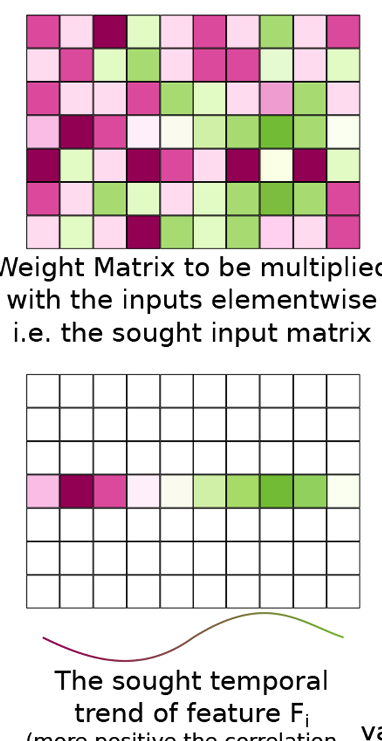
Because the model uses linear activations, the relationship between input and output is a direct weighted summation. This allowed the authors to calculate exactly which part of the face—at which specific second—contributed to a prediction.
Experiments and Results
The model was tested using the SEWA Corpus (cross-cultural: German, Hungarian, Chinese) and two major pain databases (UNBC-McMaster and BioVid).
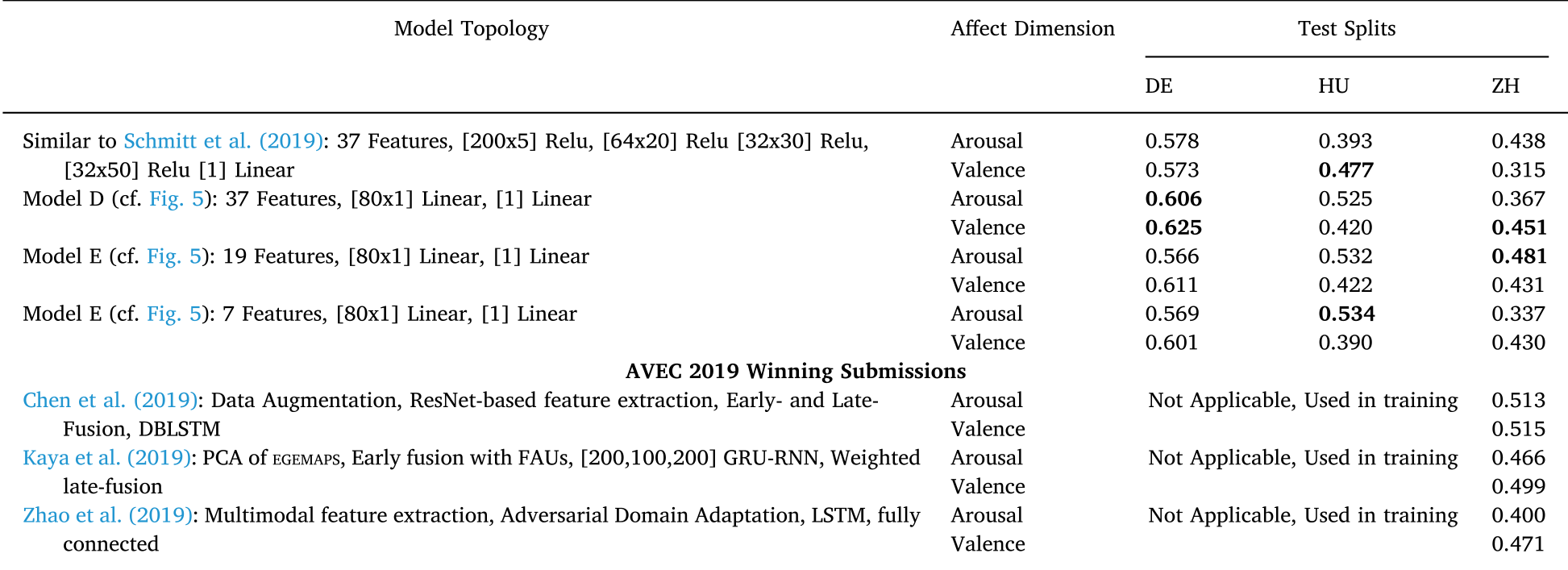
- Cross-Cultural Success: The model trained only on German data generalized remarkably well to Chinese and Hungarian subjects. This justifies the "universality" of FAUs in expressing human affect.
- Feature Selection: Through visualization, the authors discovered that only 7 out of 37 features were truly vital (mostly eye-related FAUs like AU01, AU02, and AU05).
- Quantitative Edge: On the SEWA dataset, the minimalist CNN achieved Concordance Correlation Coefficients (CCC) comparable to the winners of the AVEC 2019 challenge, despite having 95% fewer parameters.
Deep Insight: Is Deep Learning Overkill for Bio-Signals?
The most striking finding of this paper is that for specific physiological signals like facial muscles, Linearity is often enough. By using a linear 1D-CNN, the authors essentially created a dynamic, learnable statistical filter.
The visualization of filter weights (see below) reveals that the model effectively "corrects" for the delay in human annotators. It looks at a window of time and understands that an emotional expression in the video happens slightly before the label provided by the observer.
Critical Analysis & Conclusion
Takeaway
This work proves that for real-time healthcare monitoring, we don't need massive GPU clusters. A single-layer CNN can track a patient's pain intensity or emotional state with high accuracy and full transparency.
Limitations
The authors admit that while their 7-feature model is efficient, the under-utilization of other facial units might be a quirk of the specific datasets (entropy skew). Also, using a 1-second moving window might blur "micro-expressions" that are highly informative but very brief.
Future Outlook
This architecture is a perfect candidate for Edge AI. Integrating this shallow CNN into smart-glasses for the visually impaired or into CCTV for hospital wards could provide life-saving insights without compromising privacy or processing power.