
Social-Semantic Ad Recommendation: Bridging the Gap Between Users and Content
Information Processing and Management
The paper introduces a social-semantic recommender system for advertisements that integrates ontology-based knowledge modeling with social network dynamics. By mapping both user profiles and ad content to a shared Interest Ontology, the system achieves a state-of-the-art MAP@1 of 93.3% and an aggregated F-measure of 79.2%.
TL;DR
This paper presents a hybrid recommender framework that combines Semantic Web technologies with Social Network Analysis. By utilizing a shared OWL 2 ontology and Natural Language Processing (NLP), the system transforms messy social media interactions into precise interest vectors. The result? A significant leap in accuracy, reaching a 93.3% MAP@1, outperforming traditional collaborative filtering and syntactic matching.
The Core Challenge: Contextual Noise and Sparsity
Recommender systems in the Web 2.0 era face a paradox: there is more data than ever, yet it is harder to use.
- Data Heterogeneity: User interests are buried in informal text, emojis, and links.
- Volatility: What I liked yesterday isn't necessarily what I want to buy today.
- Sparsity: Most users have only interacted with a tiny fraction of available ads.
Previous SOTA methods often relied on Collaborative Filtering (users like what their friends like) or Content-Based Filtering (users like what they've clicked before). However, neither handles the meaning of the content well.
Methodology: The Social-Semantic Hybrid
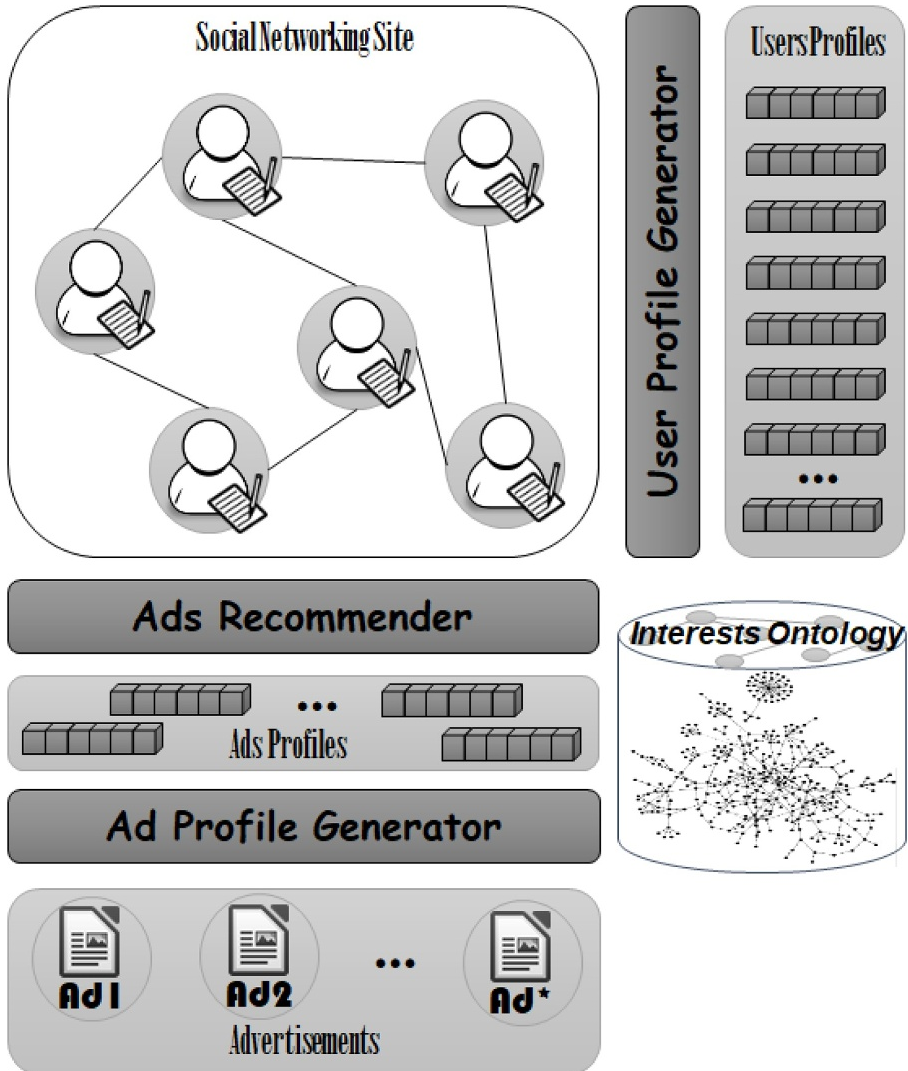
The authors propose a four-tier architecture: Interest Ontology, Ad Profile Generator, User Profile Generator, and the Ad Recommender.
1. The Shared Semantic Backbone
Instead of simple keywords, the system uses an Interest Ontology derived from the Curlie Web directory. This consists of 620 classes in a hierarchical taxonomy. This shared model ensures that when an ad is about "Mountain Bikes" and a user posts about "Cycling," the system recognizes the semantic proximity through ontological distance.
2. Ad and User Vectorization
Both ads and users are represented as vectors , where is the number of ontological concepts.
- Ads: Weights are calculated via TF-IDF over the ad description.
- Users: The profile is dynamic. It evolves using "mutation rates" () whenever a user posts a comment, clicks an ad, or adds a friend.
3. The Recommendation Logic
The system uses Cosine Similarity to match user vectors with ad vectors. Crucially, it subtracts a "recommendation frequency" penalty to ensure diversity and serendipity, preventing the same ad from being shown repeatedly.
Experimental Results
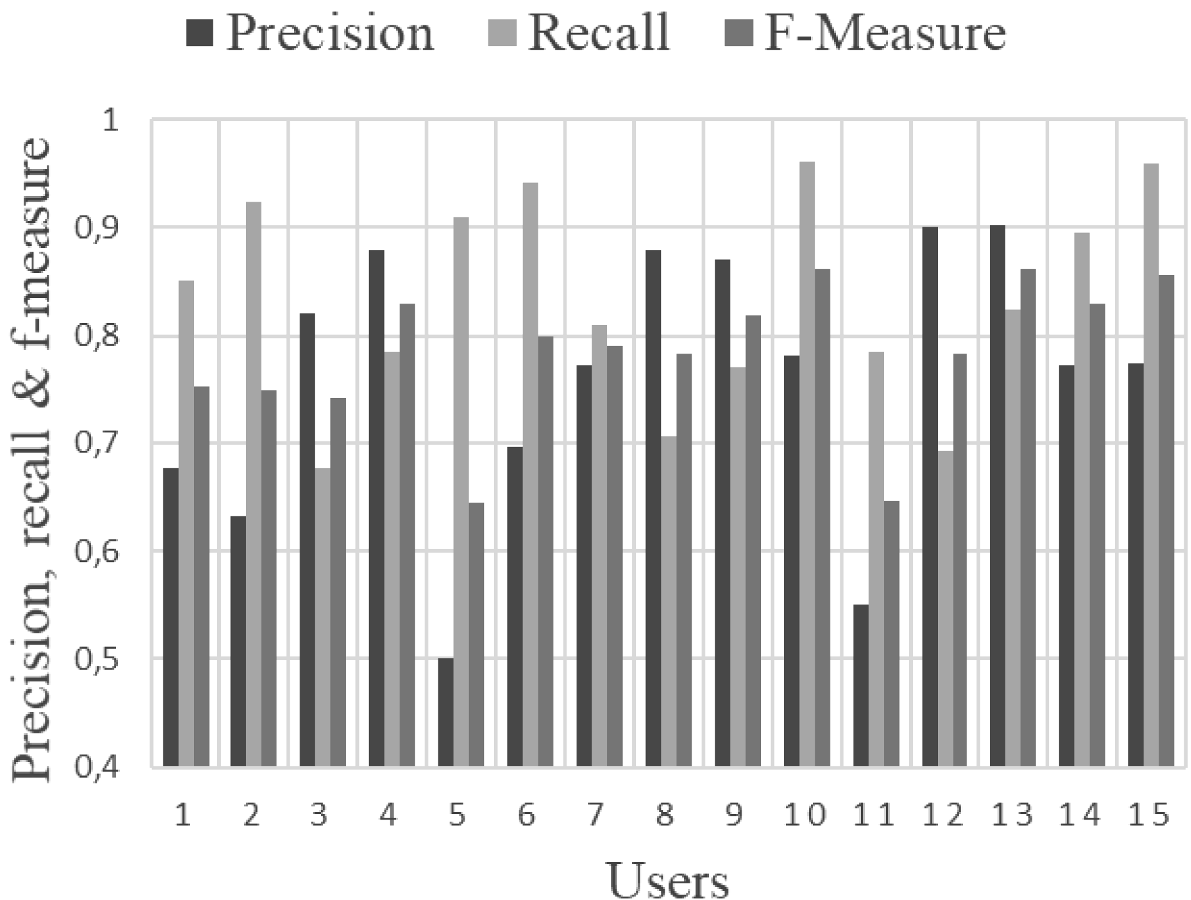
The framework was validated against 150 advertisements categorized by 15 high-level interests.
- High Precision: The MAP@1 reached 0.933, meaning the top-ranked ad was almost always correct.
- Optimal Mutation Rates: The study found that user posts () and ad clicks () were more indicative of interest than social connections (). This suggests that in advertising, what you do is more important than who you know.
Deep Insight: Why This Matters
The breakthrough here isn't just the use of ontologies, but the dynamic interaction between semantic layers and social behavioral changes. By using a taxonomic distance formula, the system performs a form of "knowledge expansion"—it knows that interest in a sub-category implies interest in the parent category, effectively solving the cold-start problem for new users with sparse histories.
Limitations & Future Work
While the results are impressive, the study was conducted in a simulated environment with 15 users. Scalability to millions of users remains a theoretical discussion. The authors also noted that multimedia content (images/videos) is currently ignored, which is a major data source in modern social platforms like Instagram or TikTok.
Conclusion
By moving from "keyword matching" to "ontology reasoning," this social-semantic approach provides a robust roadmap for the next generation of personalized advertising. It proves that a well-structured knowledge base is still the most powerful tool for making sense of chaotic social data.