
Meme-Hunter: Unleashing Multi-Modal Deep Learning to Trace the Evolution of Political Memes
Information Processing and Management
This paper introduces Meme-Hunter, a multi-modal deep learning framework designed to detect and cluster internet memes. By combining Vision (CNN), Text (LSTM), and Face Encodings, the system achieves state-of-the-art performance in meme classification and enables the mapping of "meme families" to study cultural evolution during political events like the 2018 US Midterms.
TL;DR
Researchers from Carnegie Mellon University have developed Meme-Hunter, a deep learning system that treats internet memes not just as images, but as evolving "cultural genes." By leveraging a multi-modal architecture (Vision + Text + Face detection), the system achieves a 96% accuracy rate and provides an 8x boost in recall over old-school template matching. This allows researchers to map out "meme families" and prove that memes spread across the web fundamentally differently than typical viral content.
The Problem: Why "Old School" Detection Fails
Internet memes are the "Selfish Genes" of the digital age. Most existing research relies on Template Matching—looking for a known background (like the "Distracted Boyfriend") and checking for text.
The Catch: In high-stakes environments like the 2018 US Midterm elections, political actors create "bespoke" memes or mutate existing ones so rapidly that template databases can't keep up. The authors found that template-based methods only caught 5% of the memes actually circulating. To fix this, they needed a system that understood the essence of a meme (the layout, the typography, and the faces) rather than just looking for a match in a library.
Methodology: The "Meme-Hunter" Architecture
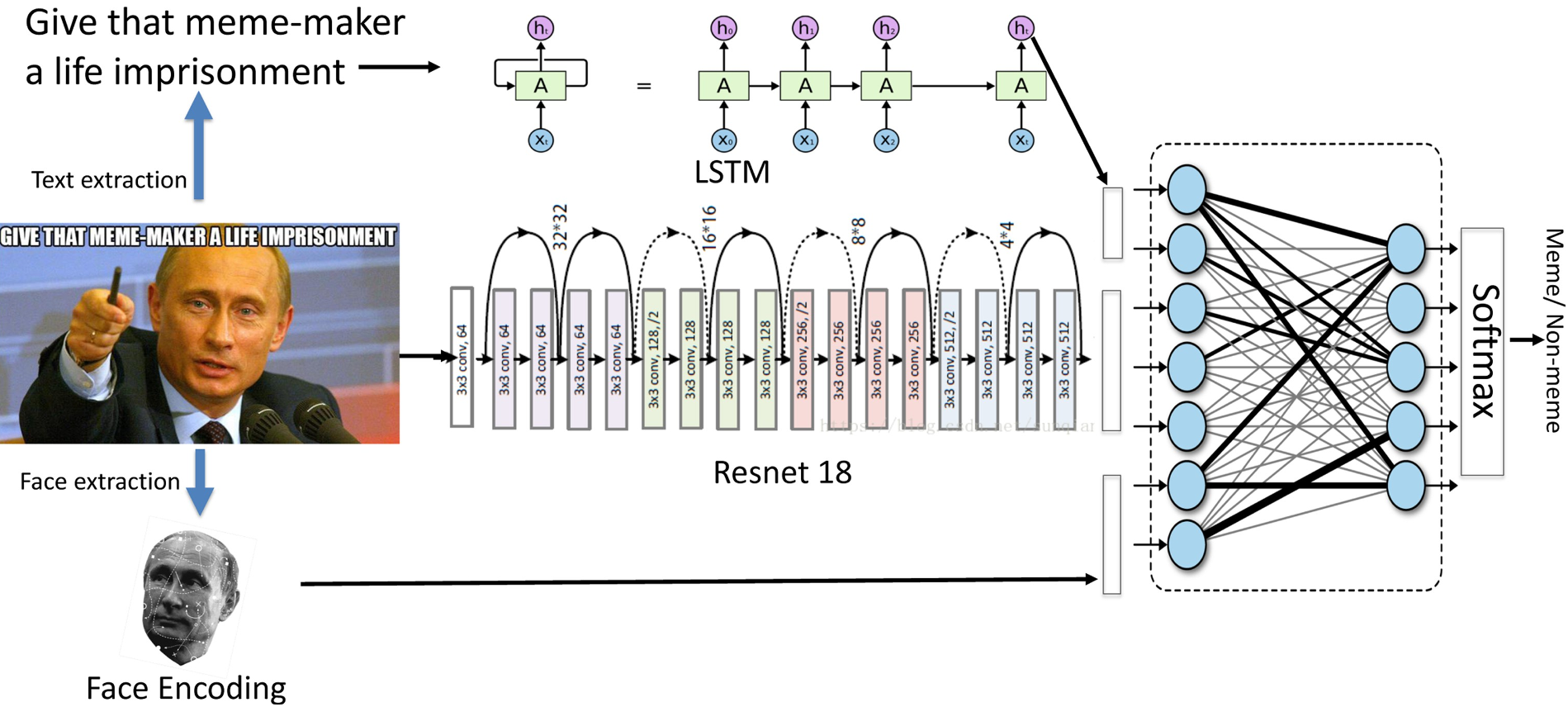
The core innovation lies in the Joint DNN model. Instead of relying on a single signal, it fuses three distinct streams of data:
- Vision (ResNet/Inception): Learns the visual "vibe" of a meme (e.g., the specific placement of text and high-contrast imagery).
- Text (LSTM + Specialized OCR): Standard OCR hates memes. The authors built a pipeline that inverts and binarizes images to read "Impact" font accurately, then processed that text via an LSTM.
- Face Encoding: Since political memes are often about specific people, the model explicitly extracts face vectors to identify key actors.
Mapping the "Meme Tree"
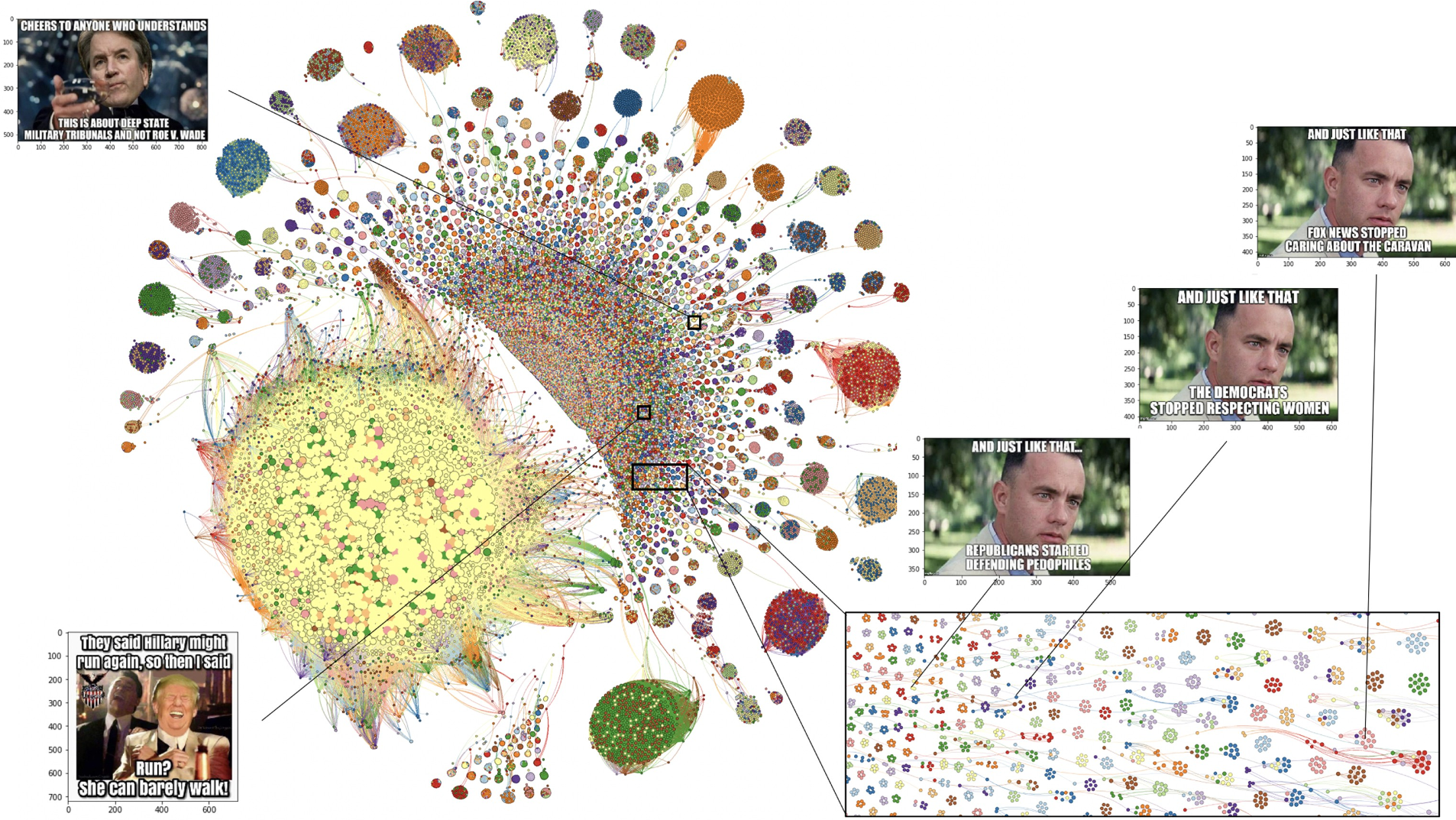
Beyond just detection, the authors used Fixed Radius Nearest Neighbors to group similar memes into "families." This allows us to see how a single image "mutates" over time as different users change the caption to serve different political agendas.
Experiments & Results
The researchers tested Meme-Hunter against massive datasets from the 2018 US and Swedish elections.
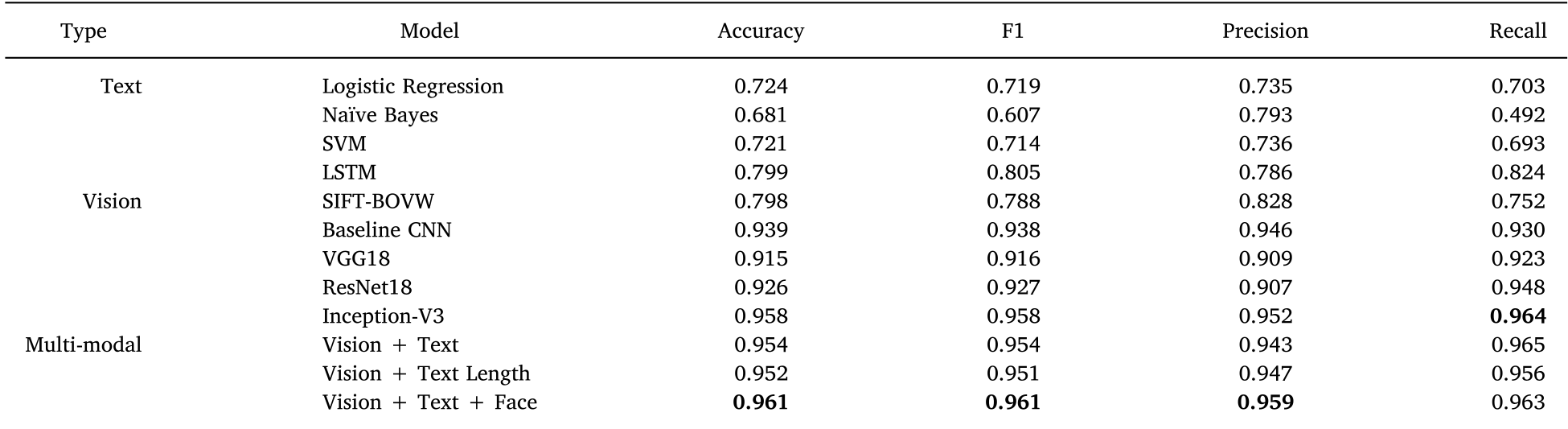
- Performance: The multi-modal approach reached an F1-score of 0.961, proving that text and faces provide the "extra edge" over pure computer vision.
- The "8x" Leap: When compared to previous SOTA (State of the Art) methods that used templates, Meme-Hunter's recall was 8 times higher, making it viable for actual social cybersecurity monitoring.
Insight: Memes are "Platform Hoppers"
One of the most fascinating findings is how memes travel. Unlike a viral video that gets millions of "likes" on one platform, memes are often liked and retweeted less, but they travel to 2x more unique domains. They "hop" from 4chan to Reddit to Twitter, mutating at every step to survive and thrive in new cultural niches.
Critical Analysis & Conclusion
Takeaway
Meme-Hunter proves that memes are not just "funny pictures"—they are structured, multi-modal artifacts. By treating them as such, we can finally begin to track the "Shadow CV" of political discourse that text-only analysis misses.
Limitations
The model still struggles with extremely sophisticated "high-effort" memes—those involving complex Photoshop workflows or vertical text. As meme-making tools become more advanced (and AI-generated), detection models will need to incorporate even deeper semantic understanding.
Future Outlook
As we move into an era of "Information Operations" fueled by generative AI, the ability to trace the lineage of an image (who mutated what, and when) will be more critical than simply labeling it as a "meme." This work provides the mathematical foundation for that "Digital Forensics" of culture.