
The Mechanics of Public Discourse: Why We Reply to Others on Government Microblogs
Information Processing and Management
This study investigates user-to-user interaction mechanisms on government microblogs using an Exponential Random Graph Model (ERGM). Analyzing 2,461 users on Sina Weibo, it identifies reciprocity, transitivity, and interest-based homophily as the primary drivers for the formation of digital reply networks.
Executive Summary
TL;DR: Engagement on government social media is not random; it is a complex social dance dictated by structural reciprocity and "interest-based" attraction. This paper reveals that while we are drawn to influential figures and emotionally charged comments, the most impactful factor for deep interaction is shared interest similarity, not gender or mere proximity.
Background: Positioned at the intersection of Digital Governance and Network Science, this work moves beyond simple "like" counts to explore the topology of conversation. It identifies the specific "Incentive Structures" that determine whether a government post becomes a ghost town or a thriving town hall.
Problem & Motivation: Beyond the Post Level
Most government agencies treat microblogs (like Sina Weibo or X) as one-way megaphones. Existing literature has long focused on what the government should post, but has largely ignored how users interact with each other in the comments section.
The authors argue that the "health" of a public community depends on user-to-user (U2U) interaction. The bottleneck? We don't know why users choose to reply to specific individuals. Is it because they share a gender? Because the other person is a celebrity? Or because they share a niche interest in policy?
Methodology: Mapping the Conversation
The researchers utilized a dataset of 3,937 replies across 10 representative Chinese government accounts. To analyze this, they employed the Exponential Random Graph Model (ERGM), a statistical framework that allows researchers to determine if certain network patterns (like triangles or mutual links) occur more often than chance.
Key Innovation: Interest over Identity
Instead of just looking at profiles, the authors calculated Interest Similarity by analyzing the TF-IDF (Term Frequency-Inverse Document Frequency) vectors of users' last 10 posts. This captures the "semantic fingerprint" of a user's interests.
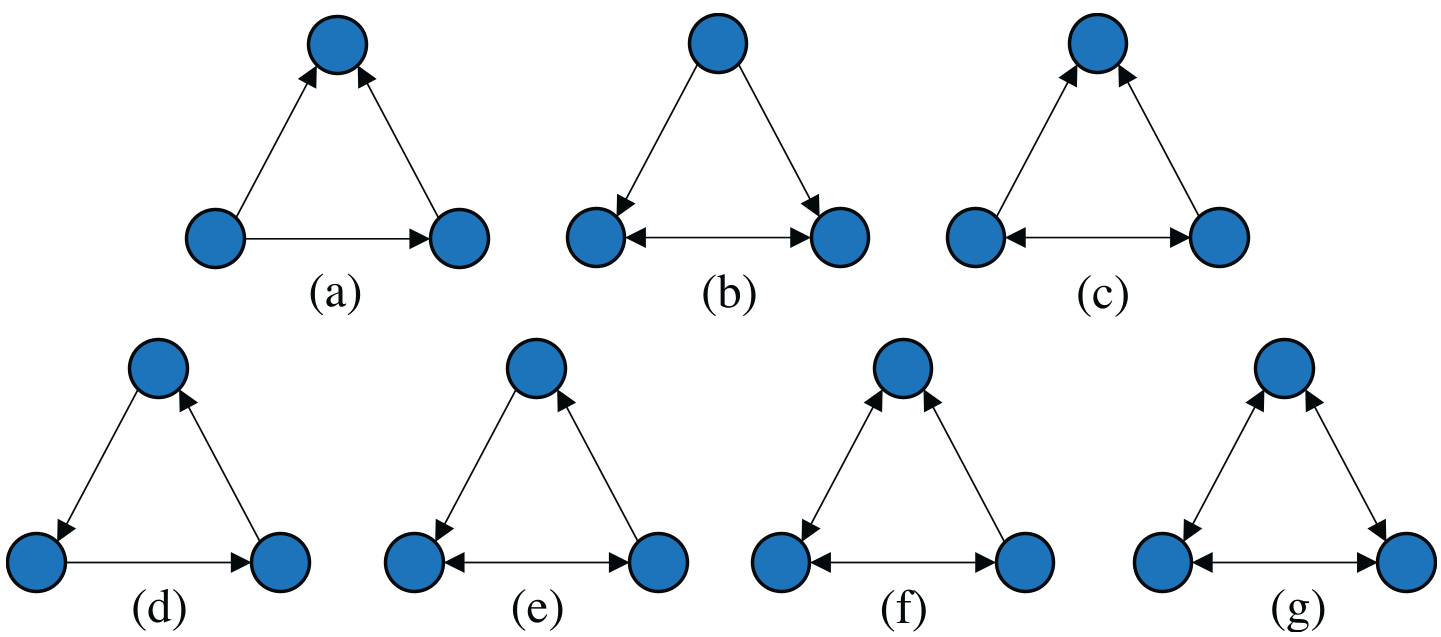 Fig 2: The triangle structures in the directed graph representing Transitivity.
Findings: The Social Laws of the Digital Town Square
1. The Power of "Lishang Wanglai" (Reciprocity)
The study confirmed that reciprocity () and transitivity () are dominant. If User A replies to User B, User B is highly likely to return the favor. Furthermore, "cliques" form naturally; friends of friends become interactors.
2. Homophily: Interests > Gender
One of the most striking findings was that gender homophily (H3a) was insignificant. Users don't care if they are replying to a man or a woman. However, Interest Similarity (H3b) was a massive predictor. We reply to those who "talk like us."
3. The Influence-Emotion Paradox
- The Magnet Effect: Users with more followers and those expressing extreme emotions (very positive or very negative) act as magnets for replies.
- The Bottleneck: Paradoxically, these influential users and "emotional drivers" are less likely to reply to others. They consume attention but rarely redistribute it back into the community.
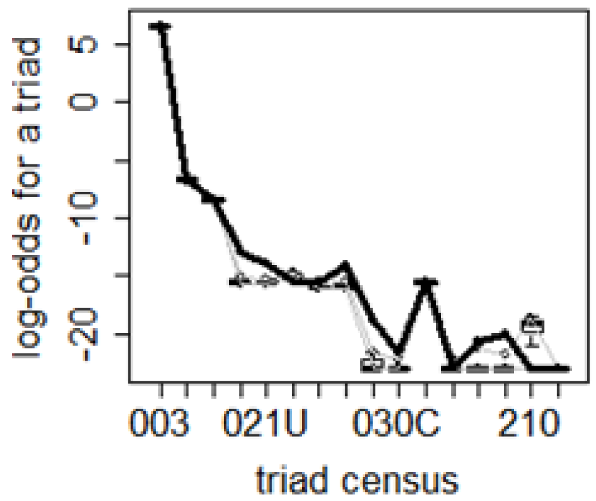 Fig 6: Goodness-of-Fit test showing the ERGM's high accuracy in simulating the real-world network.
Critical Insight & Perspectives
Takeaway: For government social media managers, "virality" is a trap if it doesn't lead to "community."
Deep Insight: The finding that high-influence users don't reply back suggests that government platforms are currently dominated by "hub-and-spoke" dynamics rather than true "mesh" networks. To fix this, governments should not just chase influencers; they should facilitate niche interest-based groups where common users feel empowered to talk to one another.
Limitations: The study is limited to Sina Weibo and specifically government accounts. The dynamics of "Reciprocity" might look very different in toxic political environments or purely commercial platforms where "trolling" replaces "interest similarity."
Future Outlook: Future research should investigate the "Quality" of these replies. Does a high transitivity score mean a constructive debate or just an echo chamber? As AI-driven moderation and sentiment analysis become standard, understanding these ERGM-based social structures will be the key to designing more resilient digital democracies.