
Beyond the Buzzword: An Integrated Framework for IT-Enabled Crowdsourcing
Information Processing and Management
2010-01-01
Summary
Problem
Method
Results
Takeaways
Abstract
This paper presents a comprehensive conceptual framework for IT-enabled crowdsourcing, synthesizing a decade of dispersed literature. It categorizes crowdsourcing as an IT artifact and a legitimate problem-solving mechanism structured around four fundamental dimensions: Who, Why, What, and How.
## TL;DR
Crowdsourcing is moving from an organizational experiment to a rigorous IT-enabled problem-solving paradigm. This paper provides a much-needed **conceptual framework** that structures crowdsourcing into four critical dimensions: **Who** (Initiators and the Crowd), **Why** (Motivations), **What** (Task characteristics), and **How** (Technological platforms). By synthesizing a decade of research, it offers a roadmap for turning "the masses" into a precise engine for innovation.
## The Need for a "Unified Theory" of Crowdsourcing
While terms like "Collective Intelligence" and "Wisdom of Crowds" are frequently tossed around in boardrooms, the Information Systems (IS) community has struggled with a fragmented understanding of the phenomenon. Existing research often lives in silos—some focus purely on why people participate (incentives), while others focus on the algorithms or the platforms.
The authors argue that crowdsourcing is not just "outsourcing to the internet"; it is a dynamic **IT artifact** that breaks traditional organizational boundaries. The core gap identified is the lack of a model that accounts for the **interdependencies** between these elements.
## The Framework: The "Who-Why-What-How" Matrix
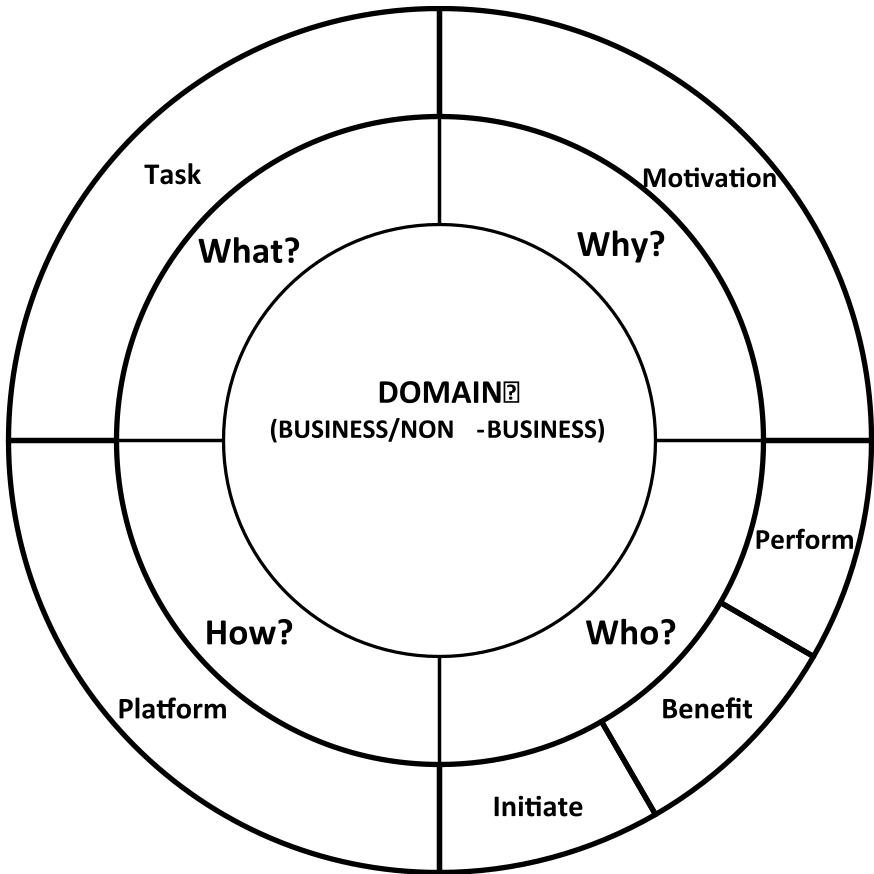
To solve this, the study integrates the **I-model** (focused on Domain, People, Info, Tech) with the **CI Genome** concept. This allows us to see a crowdsourcing project as a combination of "genes" that can be recombined depending on the goal.
### 1. The "Who": More Than Just a Crowd
The framework breaks down "Who" into three entities:
* **The Initiator**: For-profit, non-profit, or individuals.
* **The Beneficiary**: Who actually gains value? (Sometimes it's the community, like in *Wikipedia*).
* **The Crowd**: Subdivided by **source** (General vs. Specialized) and **skill level** (General, Specialized, or Situational).
### 2. The "What": Defining the Task Complexity
The paper argues that task characteristics shape every other component.
* **Functions**: Crowd Creation (Design), Crowd Wisdom (Cognition), Crowd Labor (Microtasks), or Crowdfunding.
* **Complexity**: Analyzability is key. Simple tasks (Tagging) vs. Complex tasks (R&D problem solving).
* **Participation Mode**: **Integrative** (pooling many small inputs) vs. **Selective** (picking the one best solution).
## Strategic Alignment: Incentives and Technology
One of the most profound insights of the paper is the **interrelationship between task complexity and motivation (The "Why")**.
* **For Simple Tasks**: Incentives can be micro-payments or purely intrinsic (fun/altruism).
* **For Complex Tasks**: Participants require a "sweet spot" of **extrinsic rewards** (monetary) and **intrinsic rewards** (recognition, mastery, or "flow").
Regarding the **"How" (Technology)**, the authors lean on **Media Richness Theory**. A platform for simple data entry doesn't need high interactivity; however, complex consulting tasks (like the *X-Culture* project) require high media richness—synchronous communication, video, and collaborative tools—to succeed.
## Empirical Evidence: Kaggle to Starbucks
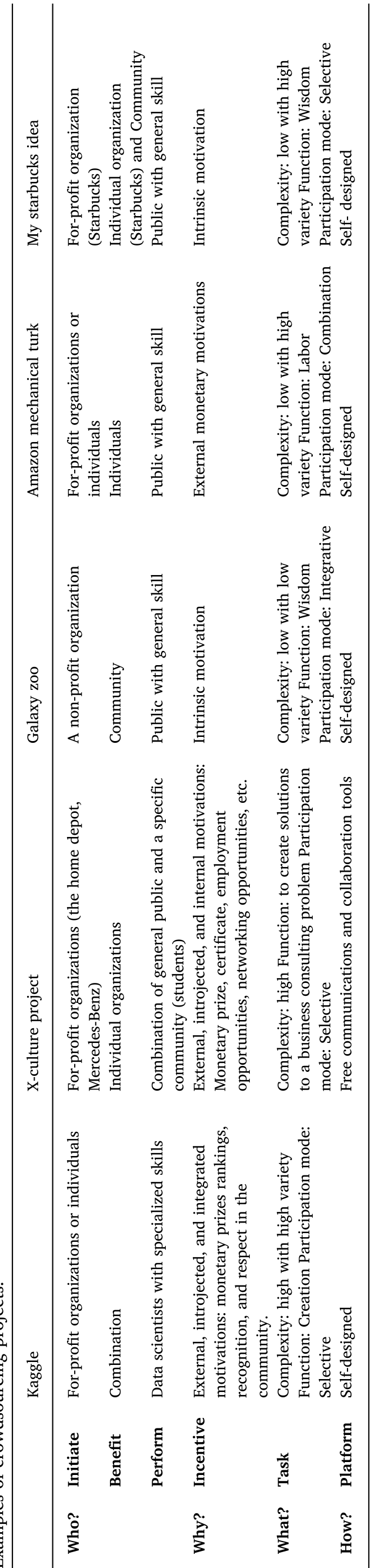
The authors apply their framework to several "SOTA" crowdsourcing examples to demonstrate its utility:
| Feature | Kaggle | Galaxy Zoo | My Starbucks Idea |
| :--- | :--- | :--- | :--- |
| **Function** | Crowd Creation | Crowd Wisdom | Crowd Wisdom |
| **Task Complexity** | High | Low | Low |
| **Participation** | Selective | Integrative | Selective |
| **Incentive** | Monetary + Rank | Intrinsic | Intrinsic |
## Critical Insights & Future Outlook
The framework’s primary strength is its **bi-directional perspective**. Unlike the linear "Input-Process-Output" models, this model understands that a change in "Task" (What) necessitates a change in "Incentive" (Why) and "Platform" (How).
**Limitations**: The paper identifies that **ethics**—specifically the "digital sweatshop" concern surrounding low-pay platforms like Amazon Mechanical Turk—remains a secondary consideration in the current framework and deserves a dedicated "gene" in future research.
**Final Takeaway**: For researchers and managers alike, this paper moves crowdsourcing from a "black box" of internet activity to a manageable, modular system. Success isn't just about "getting a crowd"; it's about the precision-engineered fit between the crowd's skills, the task's complexity, and the platform's capabilities.