
Questioner over Question: Decoding Response Rates in Social Q&A on Sina Weibo
Information Processing and Management
This study investigates the low response rates in Social Q&A on Sina Weibo by analyzing 17 extrinsic factors. The researchers developed a prediction model using 62,106 real-world questions, identifying that a question's likelihood of being answered is primarily driven by the questioner's profile rather than the question's content, achieving a 74% prediction accuracy.
TL;DR
Why do some questions on social media get hundreds of replies while others vanish into the digital void? By analyzing over 60,000 questions on Sina Weibo, researchers Liu and Jansen discovered a striking truth: Who you are matters significantly more than what you ask. While content matters, the questioner's historical social engagement and "social capital" are the ultimate gatekeepers of information seeking success.
The Social Q&A Paradox
Social networking sites (SNS) are theoretically perfect for Q&A—they offer trust, personalization, and a "one-to-many" reach. However, they suffer from a "low response rate" crisis. On Twitter, only about 18% of questions receive an answer, a fraction of the success seen on sites like Stack Overflow.
The researchers sought to move beyond "why people help" (intrinsic) to "what markers predict help" (extrinsic). Their focus was Sina Weibo, where logographic Chinese characters allow for more detailed queries within the same 140-character limit than English.
Methodology: The 17 Levers of Engagement
The study engineered 17 features split into two main buckets:
1. The Question (The "What")
- Informativeness: Length and uniqueness (measured via TF-IDF).
- Attractiveness: Use of @-mentions, hashtags, and emojis.
- Urgency & Politeness: Signal words like "Urgent" or "Thanks."
- Context: Posting time and topical category (e.g., Technology vs. Life).
2. The Questioner (The "Who")
- Activeness: Follower count and posting frequency.
- Style: Propensity to retweet vs. share URLs.
- Social Capital: Historical rates of retweets and comments received on past posts.
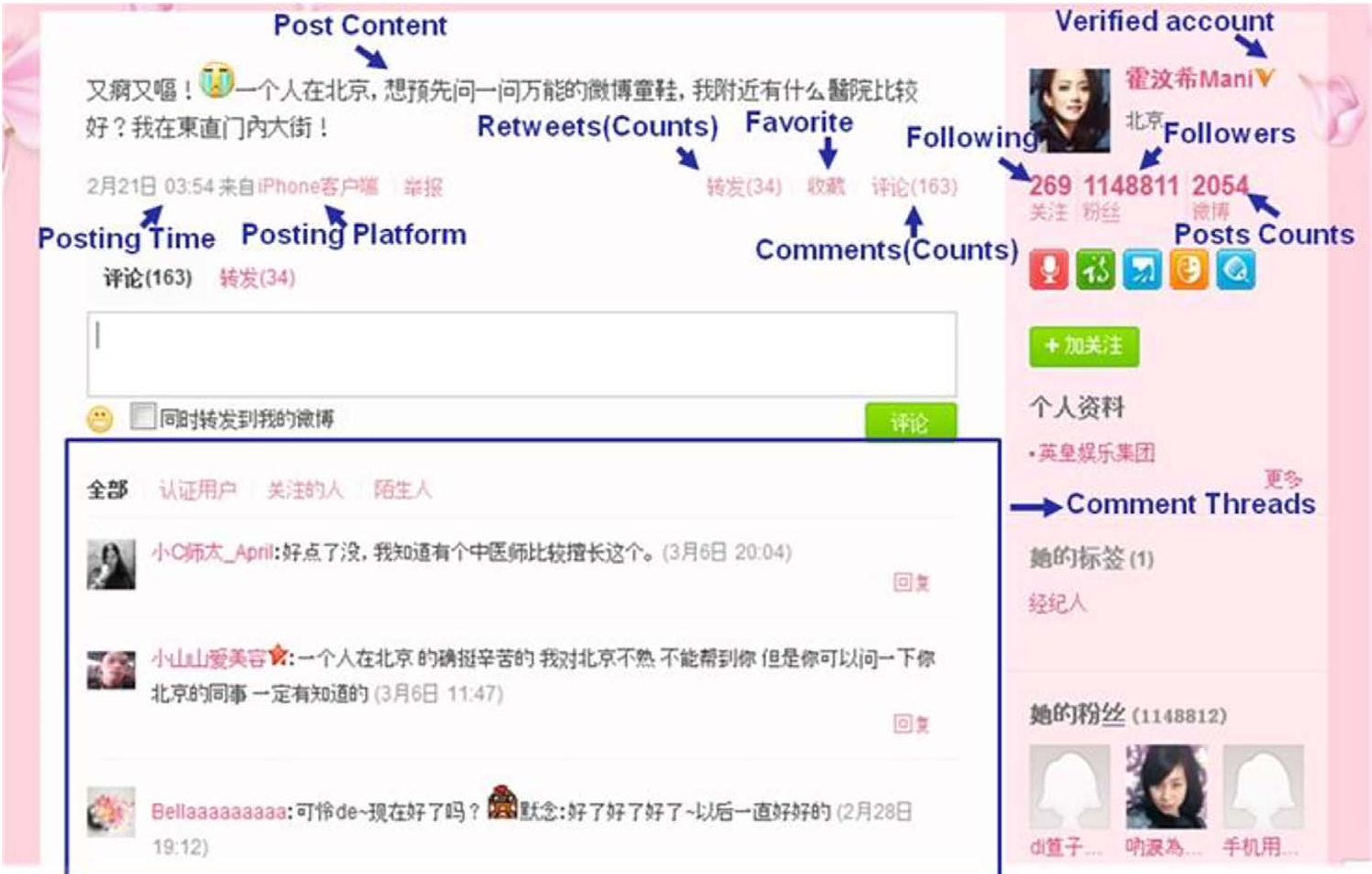 Figure 1: The threaded interface of Weibo, which facilitates social dialogue more effectively than linear feeds.
Key Insights: Surprise in the Data
The "Who" Trumped the "What"
The most profound finding was that Questioner-based features provided significantly more predictive power than the content of the question itself. Specifically, the "Percentage of posts receiving comments" was the strongest indicator. If your followers usually talk to you, they will likely answer your questions.
The Hashtag Backfire
In a counter-intuitive twist, hashtags actually decreased the chance of a response. While hashtags help with "discoverability," in the Q&A context, they often signal spam or marketing campaigns, leading users to scroll past. Similarly, sharing too many URLs in your history makes you look like a "distributor" rather than a "peer," lowering your response rate.
Emojis as Social Lubricants
The use of "Appreciation" emojis (like a smile or a heart) significantly boosted success. Interestingly, "Frustration" emojis were common but less effective at securing a quality answer than showing gratitude upfront.
 Figure 2: Performance comparison showing that Questioner-based features alone dramatically outperform Question-based features in predicting success.
Critical Analysis & Future Outlook
This research highlights a fundamental structural flaw in modern SNS: The Timeline Problem. Questions posted during peak hours (6 PM - Midnight) actually had lower response rates because they were buried too quickly.
Takeaway for Designers:
- Question Routing: Platforms should identify "unanswered" questions from users with low social capital and route them to relevant experts.
- UI Signaling: Highlighting "Information-Seeking" intents in the UI could prevent questions from being lost in a sea of memes and status updates.
Limitations: The study used a keyword-based approach, which might miss "natural language" questions that don't use cues like "Can anyone recommend." Furthermore, as social algorithms move toward "Interest Graphs" (like TikTok), the "Follower-based" capital explored here may evolve into "Content-based" capital.
Conclusion
Social Q&A isn't just about the information; it's a social transaction. To get an answer on Weibo, you don't just need a clear question—you need a history of being a social, interactive citizen of the platform.