
Information Provenance: Mapping the DNA of Social Media Content
Information Provenance in Social Media
This paper introduces a theoretical framework for "Information Provenance" specifically tailored for the social media landscape. It proposes the concept of "Provenance Paths" within a directed graph to track the origins, custody, and ownership of information where centralized metadata stores are absent.
TL;DR
In an era of viral rumors and decentralized news, knowing who said what first is nearly impossible. This seminal paper by Barbier and Liu proposes a shift from centralized tracking to graph-based provenance mining, introducing a theoretical framework to reconstruct the "Provenance Path" of information across disparate social platforms.
Academic Position: This work serves as a foundational theoretical bridge between traditional database provenance and modern social media data mining.
The "Centralized Store" Trap
Traditional data provenance (common in scientific workflows) works because there is a central authority recording every transformation. Social media is the opposite:
- Decentralized: Anyone can post; information jumps between Twitter, blogs, and news sites.
- Dynamic: Content is generated at a scale of millions of messages per hour.
- Lack of Metadata: Most social platforms do not export history or custody data when a user "copy-pastes" or screenshots.
The authors argue that we cannot wait for platforms to provide provenance; we must derive it from the social data itself.
Methodology: The Provenance Path
The authors define the social media ecosystem as a directed graph , where represents users and represents explicit transmissions.
1. Classifying the Actors
To navigate this graph, they categorize users into specific subsets:
- Accepted (): Trusted sources.
- Discarded (): Known bad actors or unreliable sources.
- Undecided (): The vast majority of social media users.
2. Path Types
The core of the paper is the definition of the Provenance Path: a unique sequence of nodes that a piece of information travels from the source to the recipient.
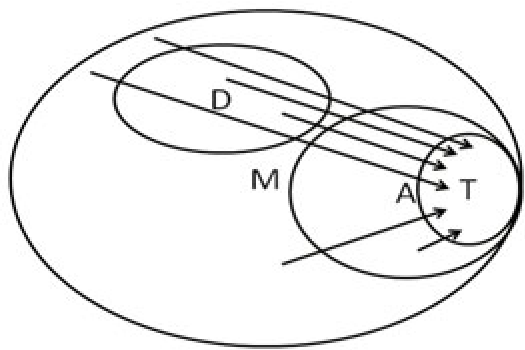 Figure 1: Relationship between Accepted, Discarded, and Undecided nodes in a Provenance Path.
- Complete Path: Every hop from origin to recipient is known.
- Incomplete Path: The most common scenario where segments of the chain are missing.
- Conflicting Paths: When two different chains of custody provide contradictory information.
Case Study: The Justice Roberts Rumor
In 2010, a false rumor about Supreme Court Justice John Roberts retiring spread through social media. By mapping this as a provenance path, the authors show how a professor's classroom hypothetical (Node ) was misinterpreted by a student () and sent to a blog ().
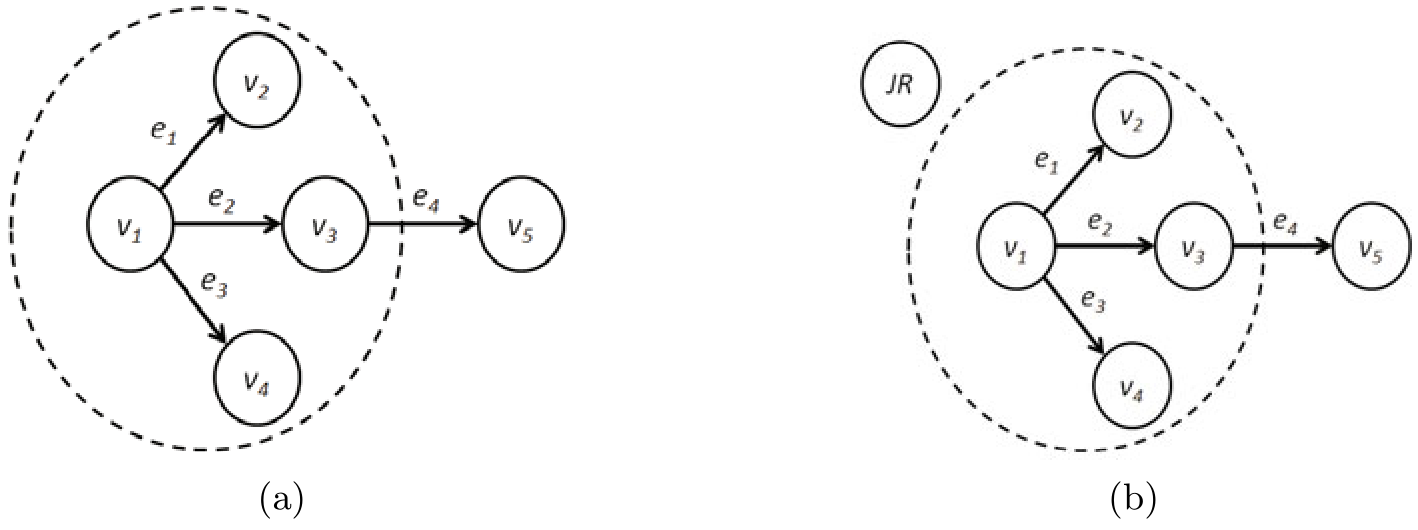 Figure 2: (a) The actual path of a rumor. (b) The "missing link" to the official source (JR) that would have validated the information.
The intuition here is simple: if the path to the "final recipient" doesn't include the "Subject Node" (Justice Roberts), the confidence value of the information should plummet.
Critical Insight: Mining as the Solution
The paper’s most provocative claim is that we can handle Incomplete Paths using probabilistic mechanisms. When a link is missing, we can use "social distance" (how closely related two users are) or "group memberships" to calculate the likelihood that information moved from Point A to Point B.
Limitations & Future Scope
While the theory is robust, the paper remains largely conceptual:
- Scalability: How do we compute these paths in real-time across billions of nodes?
- Privacy: Does tracking provenance conflict with a user’s right to anonymity?
- Adversarial Noise: How do we handle "Sybil attacks" where one person controls many "Accepted" nodes?
Conclusion: A New Research Frontier
Barbier and Liu have successfully framed the "rumor problem" as a "data mining problem." By defining the mathematical structure of a Provenance Path, they paved the way for modern automated fact-checking systems and "Cyber Genetics"—the science of tracing digital information to its biological source.
Takeaway for Practitioners: When evaluating information integrity, don't just look at the content; look at the graph distance between the source and the subject.