
Deciphering the Emotional Syntax: How Rhetorical Questions Shape Our Online Expressions
Information-Seeking Questions and Rhetorical Questions in Emotion Expressions
This study investigates the linguistic interaction between emotions and question types (Information-Seeking vs. Rhetorical) in Chinese social media (Sina Weibo). By analyzing a corpus of over 8,500 posts, the researchers identify specific syntactic structures of Rhetorical Questions (RQs) that serve as strong indicators for primary emotions like anger, sadness, and happiness.
TL;DR
In the digital landscape of social media, not all questions are looking for answers. This research delves into the distinction between Information-Seeking Questions (IQ) and Rhetorical Questions (RQ), finding that RQs are 4x more likely to carry emotional weight than IQs. By mapping specific Chinese syntactic structures to psychological states, the authors provide a blueprint for more nuanced emotion detection in NLP.
The "Why" Behind the Question: Problem & Motivation
Most emotion classification models focus on keywords or emoticons. However, human language is layered. We often use questions not to learn something new, but to vent, persuade, or emphasize.
The core challenge lies in structural ambiguity. On the surface, "Is this how you treat people?" looks like a standard query. But in context, it is a potent expression of anger. Previous work had neglected these pragmatic nuances, leading to a bottleneck in identifying intense negative emotions like disgust or contempt which are frequently "hidden" within these figurative structures.
Methodology: Mapping Syntax to Sentiment
The researchers analyzed 8,529 Sina Weibo posts, categorizing questions into 14 distinct subtypes. They moved beyond the "What" and looked at the "How"—specifically how the arrangement of words signals an underlying emotion.
The Structural Hierarchy
The study breaks down RQs into:
- Closed Questions: A-not-A (e.g., 是不是), Particle questions (ending in 吗, 吧), and Echo questions.
- Open Questions: Wh-words like Why (为什么), How (怎么), and What (什么).
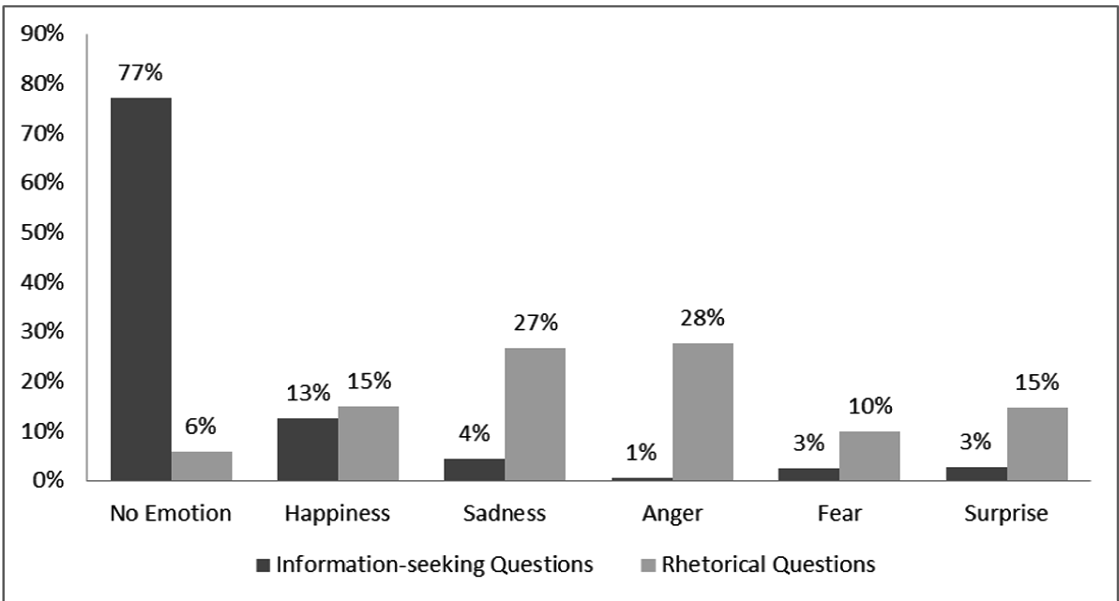 Above: The stark contrast in emotional distribution between IQ and RQ.
Key Insights: Which Structure Signals Which Emotion?
The study’s most significant contribution is the identification of "Syntactic Emotion Markers":
1. The "Anger" Clusters
- Series of Questions: Repeatedly asking the same question in different forms is a strategy to increase emotional intensity. Over 50% of "Question Series" were tagged as Anger.
- The "Isn't it" (不是...吗) Pattern: This structure emphasizes a fact the speaker believes the listener should already know, often used when expectations are not met.
2. The "Sadness" & "Fear" Markers
- The Self-Reflective "How" (我怎么...): When the subject of a "How" question is the first person ("I"), it is a strong indicator of Sadness or self-discontent.
- The "What to do" (怎么办) Dilemma: Interestingly, this pattern maps to both Sadness and Fear, requiring contextual local cues to differentiate the two.
3. The "Happiness" Affirmation
- A-not-A (是不是) with Positive Adjectives: Paradoxically, questions like "Didn't I lose weight?" followed by emoticons serve as self-confirmation and are associated with Happiness.
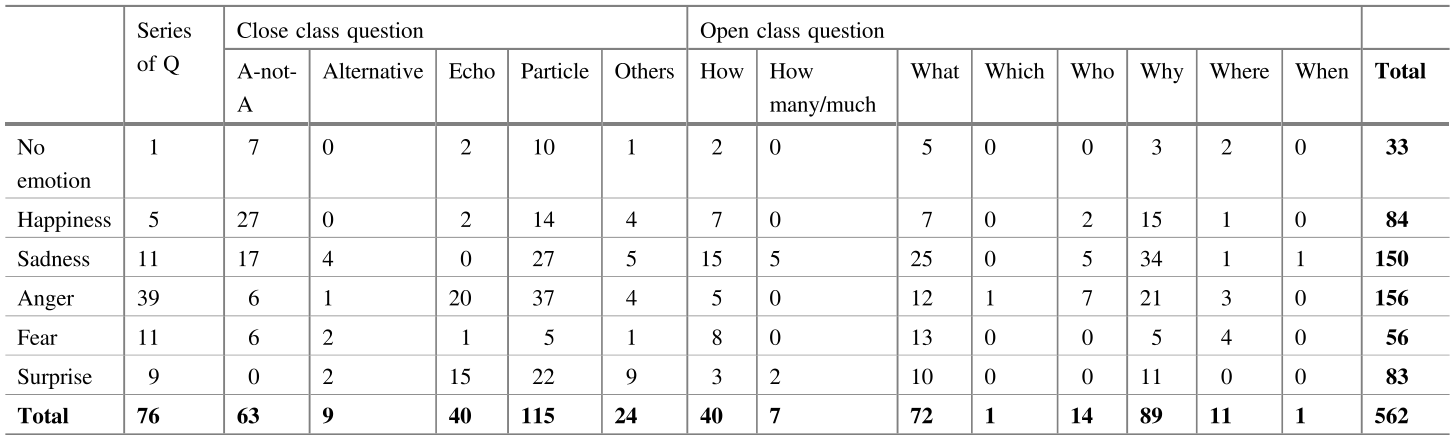 Above: Detailed breakdown showing how specific lexical choices (Who, Why, Particle) gravitate toward specific emotional states.
Critical Analysis & Conclusion
Takeaway for AI Developers
This research proves that syntax is sentiment. Relying on a bag-of-words approach will miss the subtle difference between a genuine query and a rhetorical jab. By integrating these specific syntactic patterns (like the "Why + Adj + Particle" for sadness), developers can build more robust emotion classifiers.
Limitations & Future Work
The study relies on a Chinese-specific corpus. Since rhetorical structures vary significantly across languages (e.g., the use of sarcasm in English vs. the use of particles in Chinese), these findings might not be directly portable without cross-linguistic adaptation. Furthermore, the role of emoticons—while noted—could be more deeply integrated into the syntactic analysis to see how they resolve ambiguities like the "Sadness vs. Fear" in "怎么办" questions.
Conclusion: By bridging the gap between linguistics and data science, this work shows that rhetorical questions are the "emotional engine" of social media discourse.