
Beyond the Database: Why Who You Know Matters More Than What You Know
Information seeking in social context: structural influences and receipt of information benefits
This paper investigates information seeking through a social network lens, identifying five distinct informational benefits: solutions, meta-knowledge, problem reformulation, validation, and legitimation. It examines how organizational and social structures influence which individuals are sought out for these specific benefits within a physically distributed pharmaceutical R&D organization.
TL;DR
In the world of high-stakes R&D, "knowledge management" is often mistaken for "database management." This study by Cross, Rice, and Parker reveals that information seeking is a deeply social act. By breaking down information into five distinct benefits—Solutions, Meta-knowledge, Problem Reformulation, Validation, and Legitimation—the authors prove that while task requirements get you in the door, it is trust and friendship that determine if you actually get the insights needed to solve complex problems.
Background: The Social Side of Knowledge
For decades, organizations poured millions into knowledge repositories—digital libraries intended to capture "lessons learned." However, these systems often fail because knowledge is not a static object; it is interpreted and created through social interaction. The authors argue that to understand how an organization actually learns, we must look at the informal networks that bypass the formal org chart.
The Five Informational Benefits
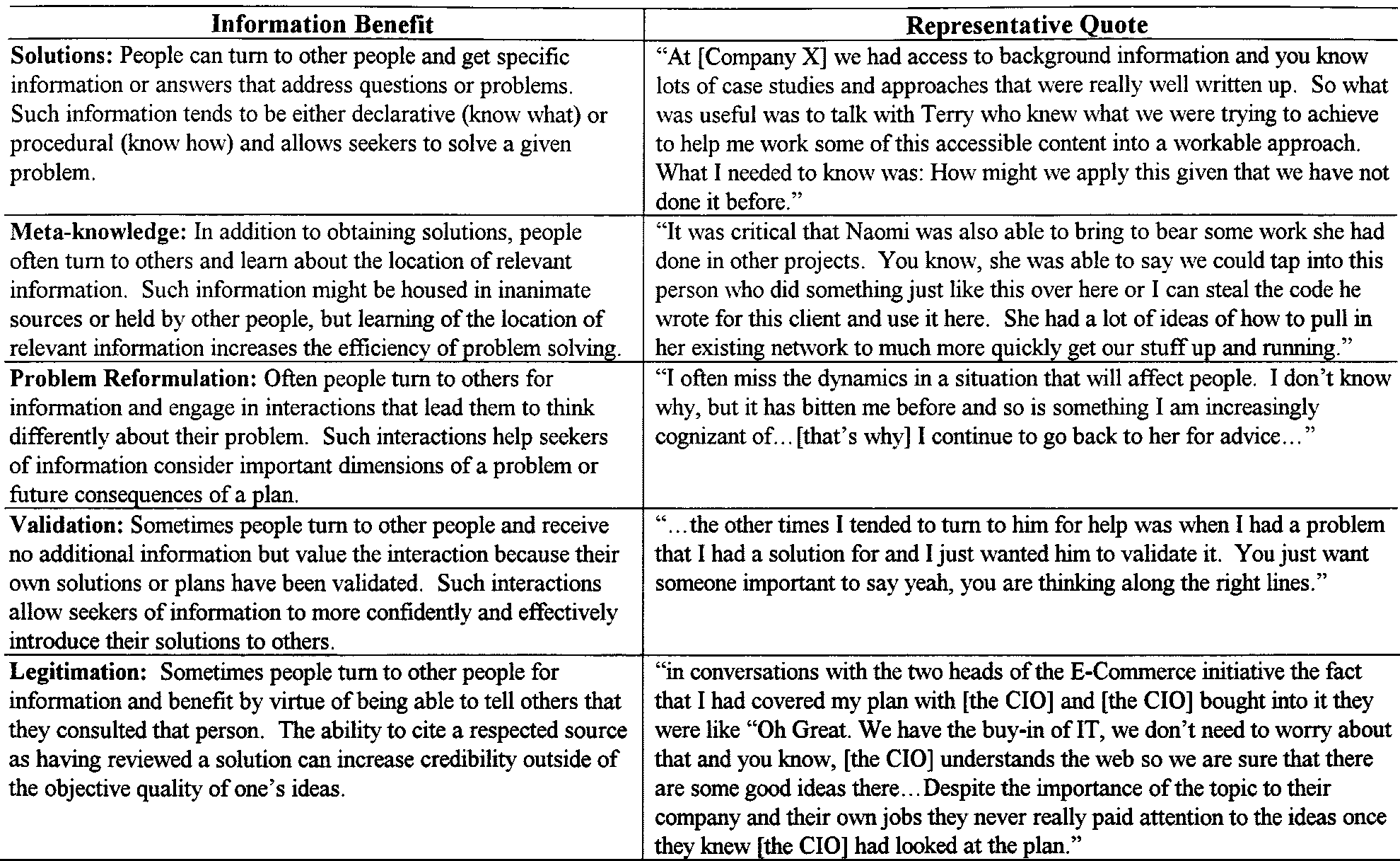
The core contribution of this work is the granular "unbundling" of what we get when we ask a colleague for help:
- Solutions: Direct answers (The "Know-What").
- Meta-knowledge: Pointers to other people or databases.
- Problem Reformulation: Help in reframing the problem space itself.
- Validation: Psychological and professional backing for a proposed plan.
- Legitimation: The "political" value of having a respected name associated with your work.
Methodology: Mapping the Invisible Web
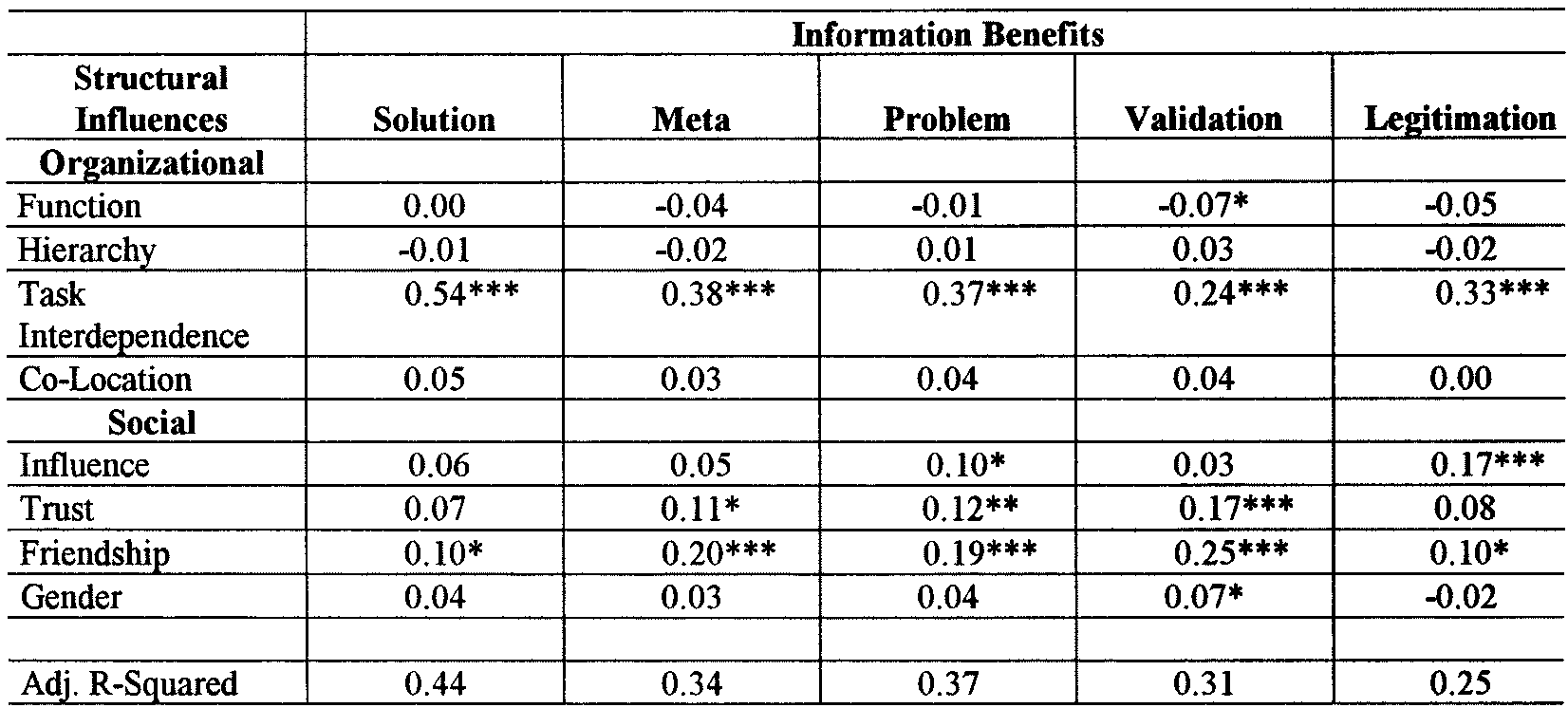
The researchers studied 34 information scientists in a global pharmaceutical firm. They used Quadratic Assignment Procedure (QAP), a specialized statistical method for dyadic (pair-based) data, to see how organizational structures (like being in the same office) compared against social structures (like friendship) in predicting these benefits.
Key Findings: Task vs. Social
- Task Interdependence is King: If your jobs are linked, you will share information. This was the strongest predictor across the board.
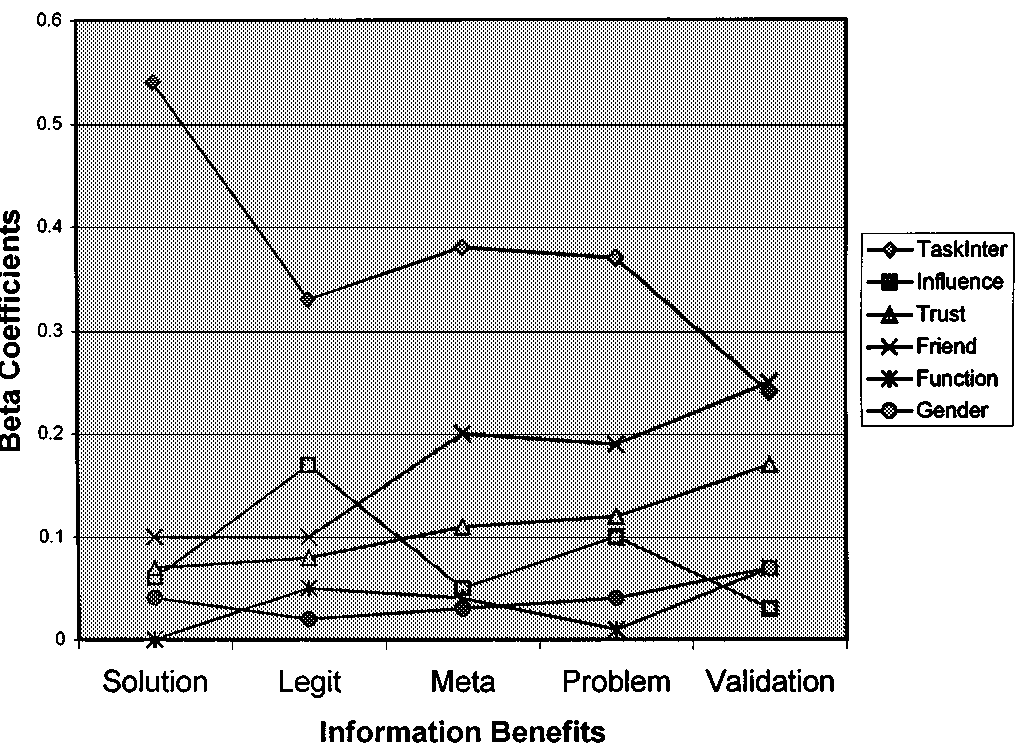
- The "Affective" Shift: As the benefit moves from a simple "Solution" to complex "Validation" or "Problem Reformulation," social relations—specifically trust and friendship—become much more influential.
- The Failure of Co-location: Interestingly, being in the same office did not significantly predict information receipt in this professional setting, suggesting that intentional search overrides accidental "water cooler" talk for high-level expertise.
Critical Insight: The "Social" in Social Capital
The study provides a striking visualization of its thesis. As the nature of the information sought moves from instrumental (Solutions) to representational/affective (Validation), the reliance on task-based structures drops, and the reliance on social bonds rises.
Why This Matters for Managers
- Trust is an Infrastructure: You cannot "engineer" problem reformulation without fostering trust. Trust reduces the "cost" of admitting ignorance.
- Friendship is Functional: Informal social bonds are not just "perks"; they are the pipelines for meta-knowledge and validation.
- Exploration vs. Exploitation: In "Exploration" tasks (new R&D), legitimation and validation are vital. If everyone agrees too much on who is the "expert" (high legitimation), the organization might actually stop learning and fall into "Groupthink."
Limitations and Future Outlook
While the study was limited to a single pharmaceutical group, its insights into "knowledge-intensive" work are universal. Future research should investigate how Computer-Mediated Communication (CMC)—tools like Slack or Microsoft Teams—might facilitate "solutions" but potentially hinder the deep "trust-based" interactions required for problem reformulation.
Conclusion
This paper serves as a reminder that the most valuable assets in a company aren't in the servers, but in the specific, high-trust relationships between employees. To improve organizational learning, don't just upgrade your software—upgrade your social culture.