
Information Sources as the Engine of Social Influence: Beyond the DeGroot Consensus
Information Sources Driving Social Influences: A New Model for Belief Learning in Social Networks
The paper introduces a novel non-Bayesian belief learning model that incorporates exogenous Information Sources as dynamic drivers of social influence. Unlike the traditional DeGroot model, it utilizes a feedback loop where agents update their beliefs and social weights based on the perceived credibility scores of external media or information intermediaries, achieving convergence without requiring consensus.
TL;DR
This paper challenges the long-standing assumption that connected social networks naturally gravitate toward a single consensus. By introducing Information Sources as dynamic intermediaries, the authors show that convergence can lead to stable, heterogeneous groups based on shared perceptions of media credibility, rather than a single unified truth.
Context: Why Traditional Models are Too Simple
In the realm of social network theory, the DeGroot model has been the baseline for decades. It suggests that if agents are "strongly connected," they will eventually reach a consensus by averaging their neighbors' beliefs. However, look at the real world: we are more connected than ever, yet more polarized.
The missing link? External information. Most models treat social influence as a static structural property. This paper argues that social influence is a function of information credibility. If you and I trust the same news source, we are more likely to influence each other.
The Core Innovation: The Information Score Feedback Loop
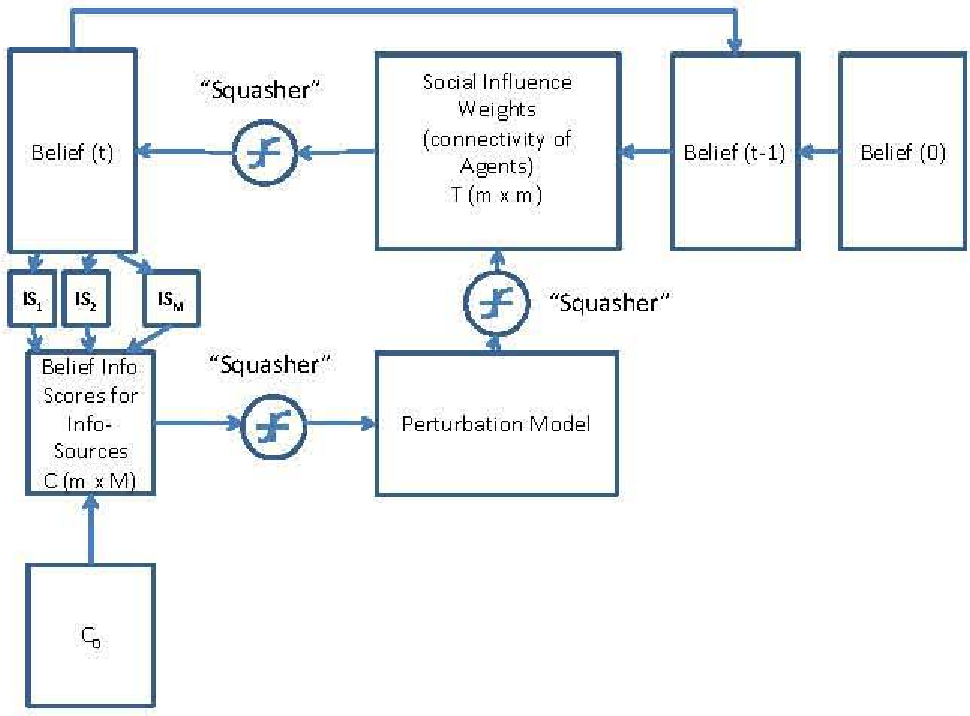
The authors break away from the "row-stochastic" constraint (where the sum of an agent's influence weights must equal 1). Instead, they treat social influence () as a dynamic matrix that evolves through a complex feedback loop.
1. The Credibility Score ()
Agents don't just see "the truth"; they see information through "sources" (Media A, Media B). Each agent maintains a credibility score for these sources.
2. The Alignment Mechanism ()
Influence is shifted based on an "angle measure" or dot product of credibility scores: If Agent and Agent view information sources similarly (high ), they increase the attention they pay to each other.
3. Non-Linear Update
To prevent infinite loops or exploding values, a "squashing" function is applied, keeping beliefs and weights bounded within .
Experiments: Grouping Without Consensus
The authors tested the model on a small, fully connected network. Even with unbiased initial conditions (everyone starts at 0.5), the introduction of two conflicting information sources caused the network to split.
- Finding 1: Agents 1 and 2 aligned with Source 1, while Agents 3, 4, and 5 aligned with Source 2.
- Finding 2: Despite being fully connected, the network never reached a single consensus. Instead, it reached a "stable divergence."
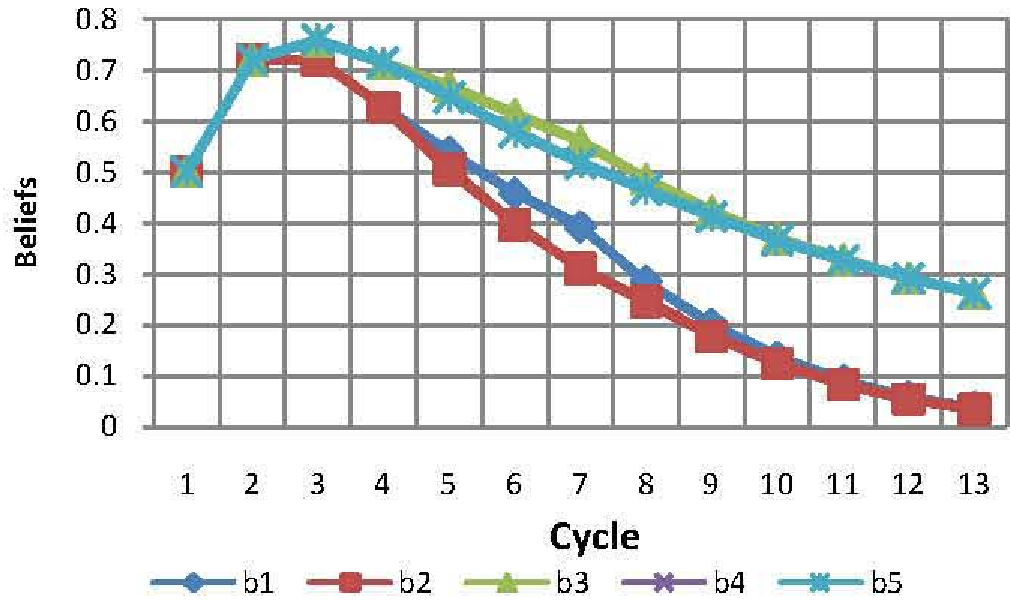
As shown in the figure above, the blue and red lines (Agents 1 & 2) converge to one value, while the other agents converge elsewhere. This perfectly mirrors the formation of "echo chambers."
Critical Insight: The "Un-learning" Process
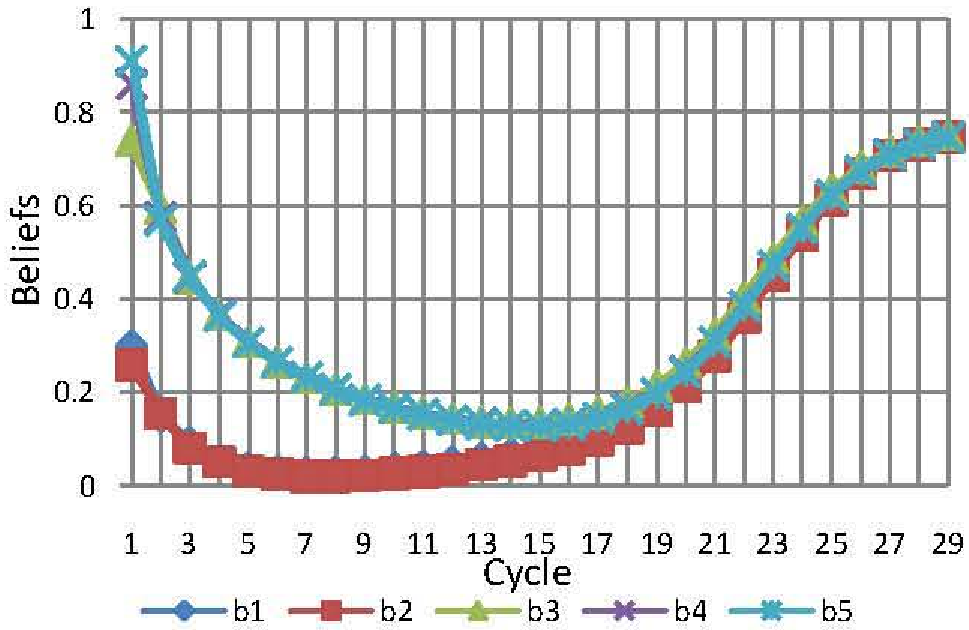
In a second experiment, the authors showed that if you start with polarized groups but introduce neutral, high-credibility information, the network can undergo a process of "un-learning."
Initially, the agents stay in their groups, but as the information source scores stabilize (as seen in the norm stabilization plots below), the agents eventually "re-arrange" their social influences to align with the source, potentially leading back to consensus.
Conclusion
This work is a significant step toward making social learning models more realistic. By acknowledging that credibility drives connectivity, the authors provide a mathematical framework for understanding why information—even when public—can divide us as much as it unites us.
Key Limitation: The current model assumes agents can accurately track the relationship between belief changes and source credibility over time, which might overestimate human cognitive capabilities in highly noisy environments.
Future Work: Expanding this to large-scale networks with "malicious" sources (bots or targeted propaganda) would be the next logical frontier for this research.