
Information Outbreaks: Using Explosive Percolation to Model Social Network Contagion
Information Spreading in Social Network Through Explosive Percolation Theory
This paper introduces an Information Spreading Model based on Explosive Percolation Theory and the SI (Susceptible-Infected) model. Using a 2D square lattice simulation, it identifies a critical point for sudden information outbreaks, demonstrating that large-scale "explosions" result from a mutation in network connectivity rather than a simple increase in infected nodes.
TL;DR
Why does some information linger in small circles for weeks only to take over the entire internet in a matter of hours? This paper explores this "stalling and then exploding" phenomenon (Information Outbreak) by applying Explosive Percolation Theory. It demonstrates that the sudden spread of information is a discrete phase transition—a structural mutation in how social groups connect—rather than a linear growth process.
Motivation: The Mystery of the Sudden Outbreak
Most existing studies use the SIR (Susceptible-Infected-Removed) models borrowed from biology. However, biological viruses spread based on proximity, while social information spreads based on deliberate selection rules within complex network structures.
The authors argue that the "explosiveness" of social media crises remains unexplained because classical models predict a smooth, gradual increase in reach. In reality, public opinion often has an incubation period where many people might know a "rumor," but it hasn't yet reached a "connected" state that creates a systemic crisis.
Methodology: The Smallest Cluster Rule
The core innovation lies in applying Explosive Percolation selection rules to a 2D lattice.
The Local Decision Rule:
- Random Selection: An individual starts spreading information.
- Observation: The individual checks four neighbors.
- Strategic Spread: The individual chooses to link with the neighbor belonging to the smallest existing cluster.
The Physics Intuition: By favoring the smallest clusters, the model prevents a single "giant component" from forming too early. Instead, the network becomes saturated with many medium-sized "infected" bubbles that are isolated from each other. When these bubbles finally touch, they merge into a massive network almost instantly—this is the Explosive Outbreak.
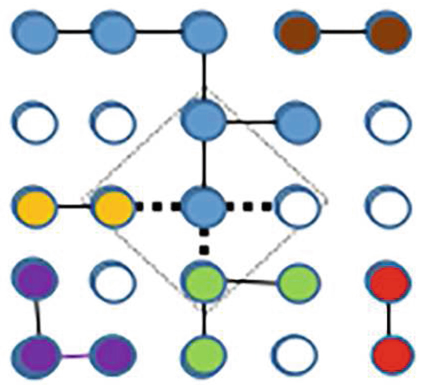 Figure 1: The selection strategy where only the smallest neighboring cluster is chosen to receive info.
Experiments & Results: The Critical Tipping Point
Through Netlogo simulations, the study observes the evolution of the Order Parameter (), which represents the relative size of the largest cluster.
1. The Incubation vs. The Outbreak
The growth curve reveals a "long tail" where the largest cluster stays near zero until .
- Incubation Period: Clusters are scattered and small.
- Critical Point (): A sudden "jump" occurs.
- Saturated State (): 90% of the network is connected.
2. The Propagation Rate Paradox
The paper uses Mean Field Theory to prove that the propagation rate is actually highest at the very beginning. As the information ages, its "infectiousness" (novelty) decreases. This leads to a fascinating insight: information is most dangerous when new, even if it hasn't "exploded" yet. The explosion is a result of network geometry, not increased excitement.
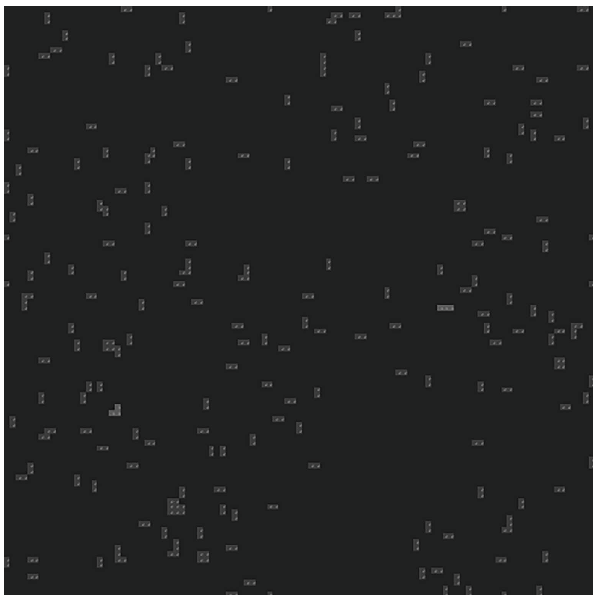 Figure 2: Evolution of the network from scattered clusters to a unified infected mass.
Critical Insight: Connectivity vs. Infection Count
The most striking takeaway is the distinction between Infected Population and Network Connectivity.
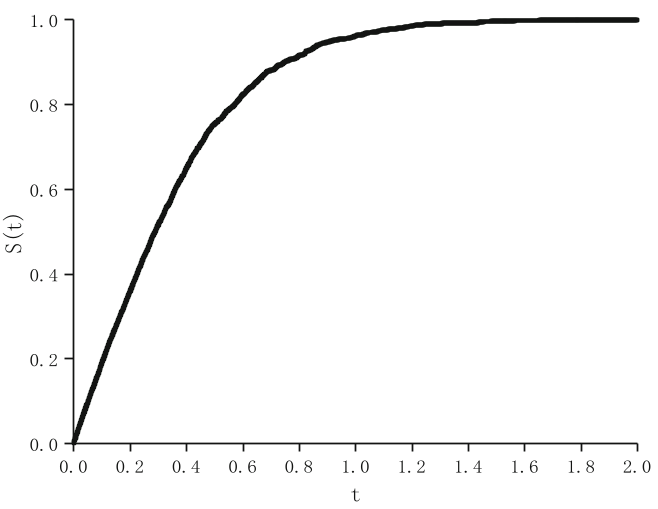 Figure 3: The infected population grows steadily, while the outbreak (connectivity) is delayed and then sharp.
As seen in the figure above, approximately 96% of the nodes can be "infected" (knowing the information) while the network is still in the incubation phase. The "Outbreak" only happens when these disparate groups link. This explains why some rumors are known by many but remain "underground" until a specific bridging event causes a total public opinion crisis.
Conclusion & Future Work
The paper successfully shifts the focus from "how many people know" to "how are those people connected." For policymakers and social media platforms, the message is clear: monitoring the connectivity mutation of clusters is a more effective warning sign for crises than simply tracking the number of mentions or hashtags.
Limitations: The model currently uses a 2D square lattice, which lacks the "scale-free" nature of real social networks (like Power Law distributions). Future work should apply these explosive rules to Barabási-Albert (BA) or Small-World (WS) graphs to better mimic platforms like X (Twitter).