
Beyond the Suggestion Box: Designing IS Architectures for Generative Co-creation
Towards an information systems perspective and research agenda on crowdsourcing for innovation
This paper examines "Crowdsourcing for Innovation" from an Information Systems (IS) perspective, proposing that IS should act as a "shaper" rather than a mere enabler. It introduces the concept of "Generative Co-creation" to shift crowdsourcing from simple autonomous ideation to collaborative knowledge evolution.
TL;DR
Crowdsourcing is often treated as a digital suggestion box, but this paper argues that's a waste of the "crowd." Authors Majchrzak and Malhotra contend that Information Systems (IS) must be redesigned to move beyond simple idea collection and toward Generative Co-creation—a process where diverse strangers don't just compete, but actually build upon each other’s thoughts to solve complex problems.
Strategic Position: This is a foundational "viewpoint" paper that shifts the crowdsourcing discourse from management theory (incentives) to IS design (affordances and architectures).
The Problem: The "Quantity Over Quality" Trap
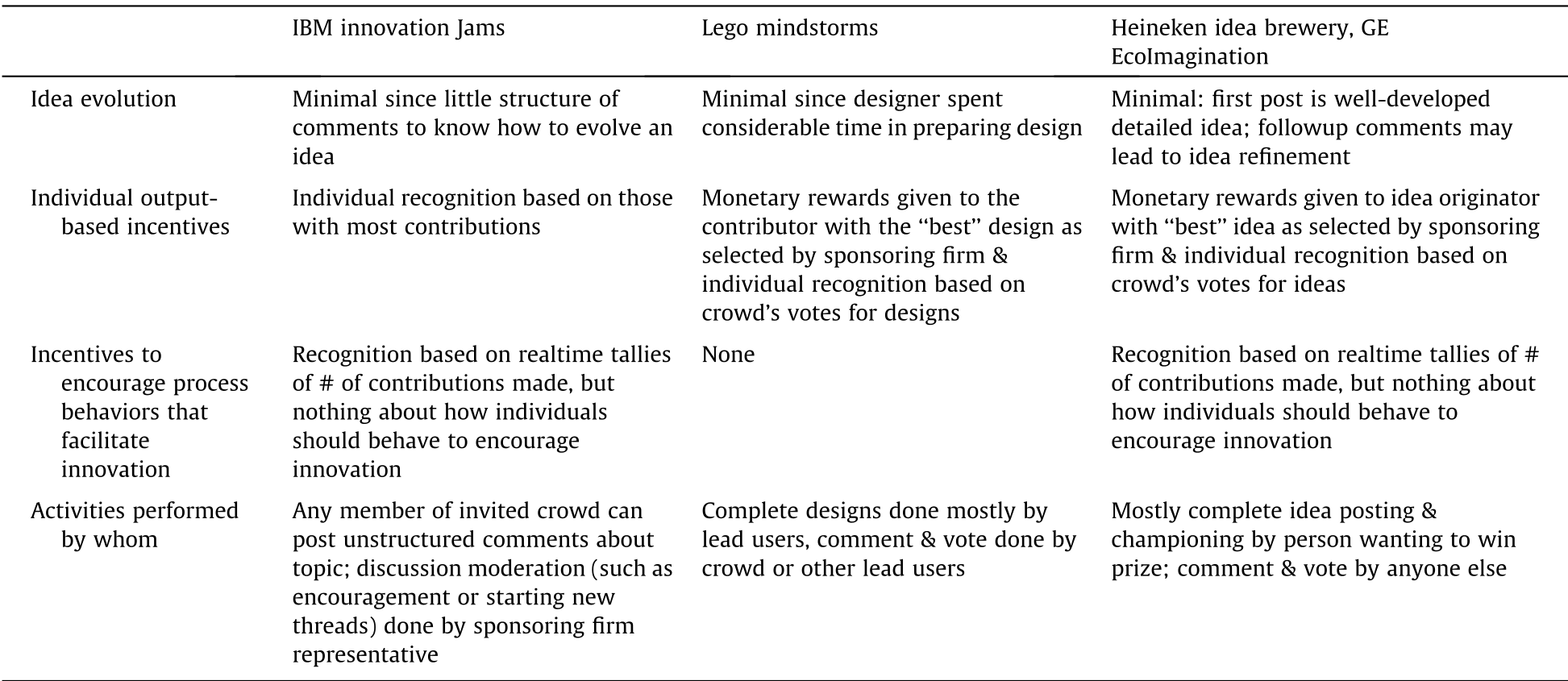
Current crowdsourcing efforts (like the early IBM Innovation Jams or Lego Mindstorms) suffer from a fundamental flaw: they encourage autonomous ideation. When thousands of individuals post "complete" ideas in a race for a prize, two things happen:
- Information Overload: Sponsors are buried under 40,000+ incremental, non-implementable ideas.
- Zero Recombination: Individuals rarely read or improve others' ideas, leading to "flash-in-the-pan" solutions that lack depth.
The authors argue that the "Diversity Trumps Ability" theorem only works if the architecture facilitates the interaction of that diversity.
Methodology: The Three Tensions of Participation Architecture
The core of the paper identifies three psychological and structural tensions that IS design must resolve to enable true innovation:
1. Competition vs. Collaboration
How do you make people work together when they are competing for the same prize? The authors suggest separating idea evolution from idea generation.
- Insight: Use "multi-valenced" rewards (recognition, learning, and networking) rather than just cash to foster a "coopetition" environment.
2. Time Commitment vs. Idea Evolution
Innovation takes time, but crowd members are "tourists"—they spend very little time on the platform.
- The Architecture Fix: Platforms must make Knowledge Evolution transparent. A participant should be able to "jump in," see what has already been decided or discarded (like a Wiki's history), and add a specific brick to the wall without reading 500 pages of threads.
 (Placeholder: This conceptual diagram illustrates the shift from simple calls to complex participation structures)
3. Strangers vs. Creative Abrasion
Innovation requires "Creative Abrasion"—the clashing of different viewpoints to surface hidden assumptions. However, strangers on the internet are usually either too polite or too toxic.
- The Architecture Fix: Implement Front and Back Stages. The "Front Stage" (the solution) remains a place of polite aggregation, while a "Back Stage" (Discussion/Talk pages) encourages task-based disagreements and deliberation.
Analysis of Existing SOTA Architectures
The paper compares three landmark crowdsourcing archetypes:
| Platform | Production Process | Incentive Structure | Result |
|---|---|---|---|
| IBM Jam | Unstructured comments | Recognition | Massive quantity; low recombination |
| Lego Mindstorms | Virtual design space | Monetary + Crowd Vote | Lead-user driven; minimal collaboration |
| GE EcoImagination | Detailed proposals | Investment/Funding | High IP protection; almost no co-creation |
Critical Insight & Future Outlook
The most profound takeaway is that IS is not a neutral pipe. The way we design the "Post Idea" button and the "Reward" dashboard changes the biological behavior of the crowd.
Future Research: The authors challenge the IS community to build "Generative Capacity." We need to stop asking "How many ideas did we get?" and start asking "How much did the knowledge evolve during this session?"
Limitations
While the paper provides a brilliant theoretical roadmap, it lacks a specific mathematical model for "optimal crowd size" or "recombination frequency." It assumes that participants want to engage in "back-stage" debates, which might not hold true in lower-stakes or non-professional crowds.
Conclusion
This paper serves as a wake-up call for firms: if your crowdsourcing platform looks like a list of comments, you aren't doing open innovation; you're just doing digital brainstorming. To achieve the "Wisdom of the Crowds," we must design for interaction, not just collection.