
The Digital Ballot: Reforming Democracy through Smart Cards and the Internet
Information technology improves most of the democratic voting processes
The paper proposes a framework for modernizing democratic voting using Smart Cards and the Internet. It introduces a decentralized, electronic voting architecture designed to increase citizen participation, lower costs, and enhance the security of both direct and indirect democratic processes.
TL;DR
This seminal work argues that the stagnation of democratic processes is a pragmatic failure rather than a theoretical one. By leveraging Smart Cards as secure identity tokens and the Internet as a universal communication layer, the authors propose a system that enables more frequent, cheaper, and more secure voting, bridging the gap between representatives and the populace.
Contextual Positioning
In the landscape of political technology (GovTech), this paper serves as a foundational architectural blueprint. It moves beyond the "What" of digital democracy to the "How," focusing on the physical and digital infrastructure needed to replace the antiquated paper-and-booth system.
Problem & Motivation: The Democratic Gap
Traditional democracy is suffering from several structural "frictions":
- Prohibitive Costs: Physical logistics make direct democracy (referendums) too expensive for frequent use.
- Geographical Constraints: Vulnerabilities in absentee voting (e.g., overseas military ballots) often lead to disenfranchisement.
- Information Asymmetry: Citizens feel disconnected from the day-to-day decisions of their representatives.
- Media Influence: Limited polling data acts as a "pseudo-vote," potentially skewing the actual outcome.
The authors' insight is that voting is essentially a specialized Internet transaction, similar to E-commerce, requiring only high-assurance authentication and secure data transmission.
Methodology: The Four-Pillars Architecture
The proposed system relies on a decentralized interaction between four components:
- The Smart Card (Identity/Token): Instead of a temporary paper slip, the smart card holds the user's digital identity. It supports Biometric Authentication (to avoid forgotten PINS) and contains session tokens that allow only one vote per event.
- The Terminal (Interface): Any PC or mobile device acts as a portal. The terminal doesn't store the vote—it merely facilitates the interaction between the card and the server.
- The Internet (Transmission): A standard, non-proprietary transport layer using encryption to ensure non-repudiation.
- The Server (The Bureau): Manages the logic of the specific election (e.g., preferential voting vs. simple majority) and aggregates results.
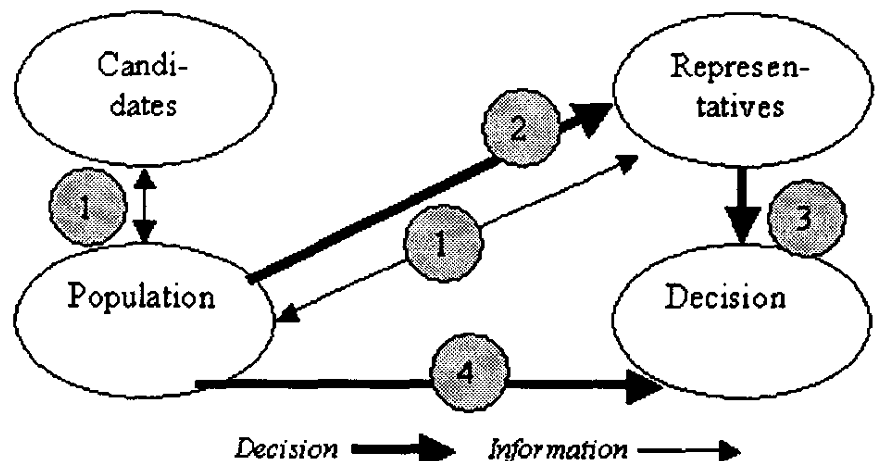 Figure 1: Conceptual flow of the democratic decision path via IT.
The "Anonymous Vote" Innovation
To ensure secrecy, the system uses a Selection Array. The server sends a blank pattern (e.g., a 1x2 array for Yes/No) to the terminal. The smart card, after authenticating the user, populates and enciphers this array. The server receives the encrypted selection without needing to link it to the voter's identity, effectively decoupling authentication from expression.
 Figure 2: The three stages of the electronic voting process.
Experiments & Feasibility
The paper cites real-world precursors to prove viability:
- The Netherlands: Reports 80% of precincts already successfully using e-voting systems.
- University of Exeter: Validated the use of the Mondex smart card system for student elections as early as 1999.
- Operational Benefits: The authors note that such systems provide 100% accuracy, eliminating the need for the controversial manual recounts seen in the 2000 US Presidential Election.
Critical Analysis & Conclusion
Takeaway
The transition to electronic democracy (E-voting) is a maturation of the "Information System" of society. By treating a vote as a secure transaction, we can move closer to the "Ultimate Democracy" where all citizens participate in all decisions.
Limitations
- Technological Literacy: The paper assumes a level of comfort with terminals that may not be universal.
- Infrastructure Security: While the protocol is secure, the "Internet" layer remains vulnerable to DDoS attacks or server-side breaches, a point briefly addressed via firewalls.
Future Outlook
The authors correctly predict that as financial payments move to mobile networks, voting will naturally follow. The synthesis of Biometrics and Smart Cards remains the gold standard for decentralized identity, a concept that modern Decentralized Identity (DID) and Blockchain projects are still refining today.