
Hom: Reinforcing Context-Aware Computing via a Normalized Homophily Indicator
An Initial Homophily Indicator to Reinforce Context-Aware Semantic Computing
The paper introduces "Hom," a normalized homophily indicator designed to reinforce context-aware semantic computing by quantifying social networking behavior. It maps social graphs to a [-1, 1] range to detect whether users connect with similar (homophily) or dissimilar (heterophily) individuals, enabling more accurate user attribute inference in applications.
TL;DR
Context-aware applications often struggle to infer user preferences from raw sensor data alone. This paper proposes Hom, a novel, normalized indicator ( range) that measures Homophily—the tendency of similar individuals to associate. By quantifying this social phenomenon, the authors provide a lightweight tool for the "Context Engine" to improve semantic computing and user attribute inference.
Problem & Motivation: The "Interpretation Gap" in Social Sensors
Modern smartphones are "sensors on wheels," capturing location, proximity, and communication. While we can detect who is near whom, understanding why remains a challenge. Social Network Analysis (SNA) offers a bridge through the concept of Homophily ("birds of a feather flock together").
However, the authors point out a critical gap in existing literature:
- Unbounded Metrics: Prior indicators like "Affinity" are unbounded , making it impossible to determine an "absolute" degree of homophily without deep domain expertise.
- Heterophily Neglect: Most tools ignore the opposite phenomenon (Heterophily), where dissimilar people connect (e.g., romantic relationships or buyer-seller interactions).
- Complexity: Existing models are often too heavy for real-time inference in mobile "Context Engines."
Methodology: Engineering the Hom Indicator
The authors propose a purely structural approach based on graph theory. Given a graph where nodes have boolean attributes:
- Categorization: Edges are classified as Homogeneous () if they connect nodes with the same attribute, or Heterogeneous () otherwise.
- Ratio Calculation: They calculate the ratio of observed edges to the total possible edges in a complete graph for both types ( and ).
- Normalization: The final indicator is defined as:
The Context Engine Architecture
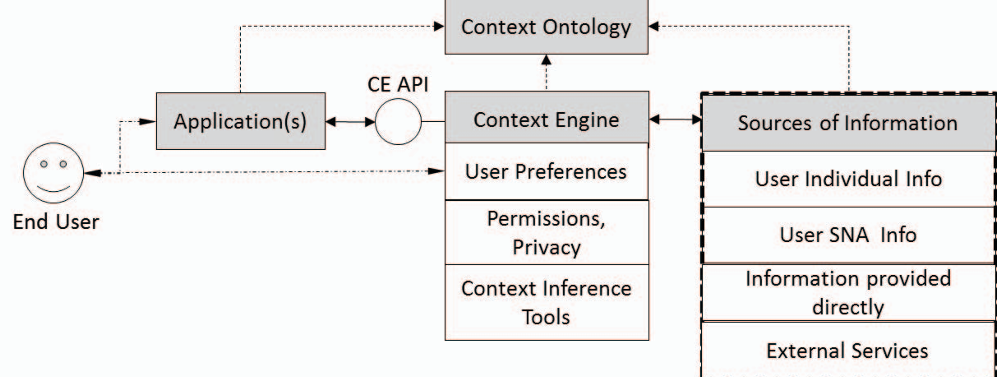
This indicator is designed to sit within a "Context Engine" (CE), serving as an inference tool that transforms raw Bluetooth proximity logs into social insights.
Experiments: Real-World Validation
The authors tested their method using the Nodobo dataset, which tracks 27 students over several months using Bluetooth proximity as edges and "common friends" as the attribute for homophily.
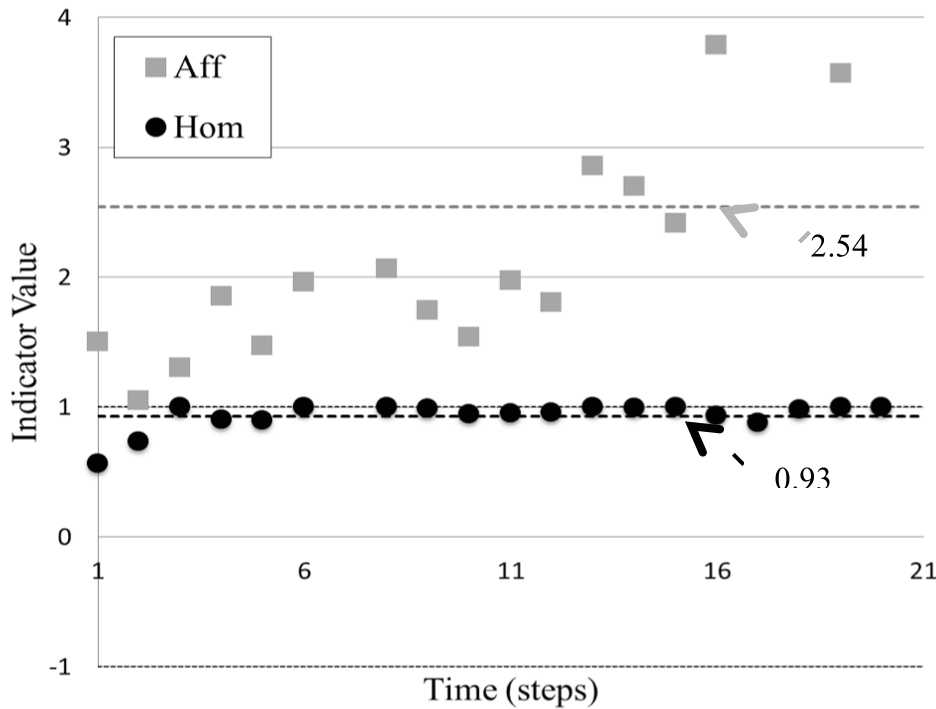
They compared Hom against the Affinity (Aff) indicator across two different experimental settings (varying time windows and friend thresholds ):
- Stability: The mean value for Hom remained remarkably stable at 0.93 across experiments, successfully identifying that the underlying social system was the same despite different discretization parameters.
- Interpretability: While "Affinity" values jumped inconsistently (e.g., from 1.5 to 3.5), "Hom" stayed within a clear, normalized range, making it easier for developers to set thresholds ().
Critical Analysis & Takeaways
The core contribution of this work isn't just a new formula, but the democratization of SNA for app developers. By bounding the indicator to , the authors provide:
- Symmetry: is perfect homophily, is perfect heterophily, and is noise.
- Portability: Indicators can be compared across different social networks (e.g., Facebook vs. a local school) regardless of network size.
Limitations: The current version of Hom is an "initial indicator." It primarily handles static snapshots or discrete time steps. To be truly robust for real-time mobile computing, it would need to incorporate temporal decay—recognizing that a proximity event from five minutes ago is more relevant than one from last month.
Future Outlook
This research moves context-aware systems away from "blind" sensor data toward "socially-aware" semantic computing. Future work involves extending the definition to multi-valued attributes and integrating it into predictive models for user behavior. As personal assistants (like Google Now) evolve, lightweight indicators like Hom will be vital for privacy-preserving, on-device user profiling.