
Why Trust is the Silent Gatekeeper of Digital Banking: A Deep Dive into Initial Trust
Initial trust and the adoption of B2C e-commerce: The case of internet banking
This study investigates the critical role of "Initial Trust" in the adoption of B2C e-commerce, specifically focusing on Internet Banking. By integrating social network and trust theories, it proposes a model where trust in both the electronic channel (the Internet) and the institution (the bank) dictates adoption behavior.
TL;DR
Why do we visit a bank's website but hesitate to click "transfer"? This study argues that adopting Internet banking isn't just about utility—it's about Initial Trust. The researchers find that while you might trust your bank, if you don't trust the "Internet" as a secure pipe, you won't use the service. Crucially, trust is a "necessary but not sufficient" condition: without it, adoption is impossible, but even with it, your product needs more to succeed.
The "Missing Link" in E-Commerce Adoption
In the early 2000s, while web traffic was exploding, actual online sales were lagging. The authors identified a gap in academic literature: researchers were looking at trust in the merchant, but they were ignoring trust in the medium.
In Internet Banking, a user must trust two distinct entities:
- The E-Channel (The Internet): Is the data being intercepted? Is the system available?
- The Merchant (The Bank): Will they honor their commitments? Will they use my data against me?
The Methodology: Deconstructing the "Trust Pipe"
The authors built a research model (see Architecture below) to test how "Initial Trust"—the trust we have before direct experience—is formed.
The Research Model
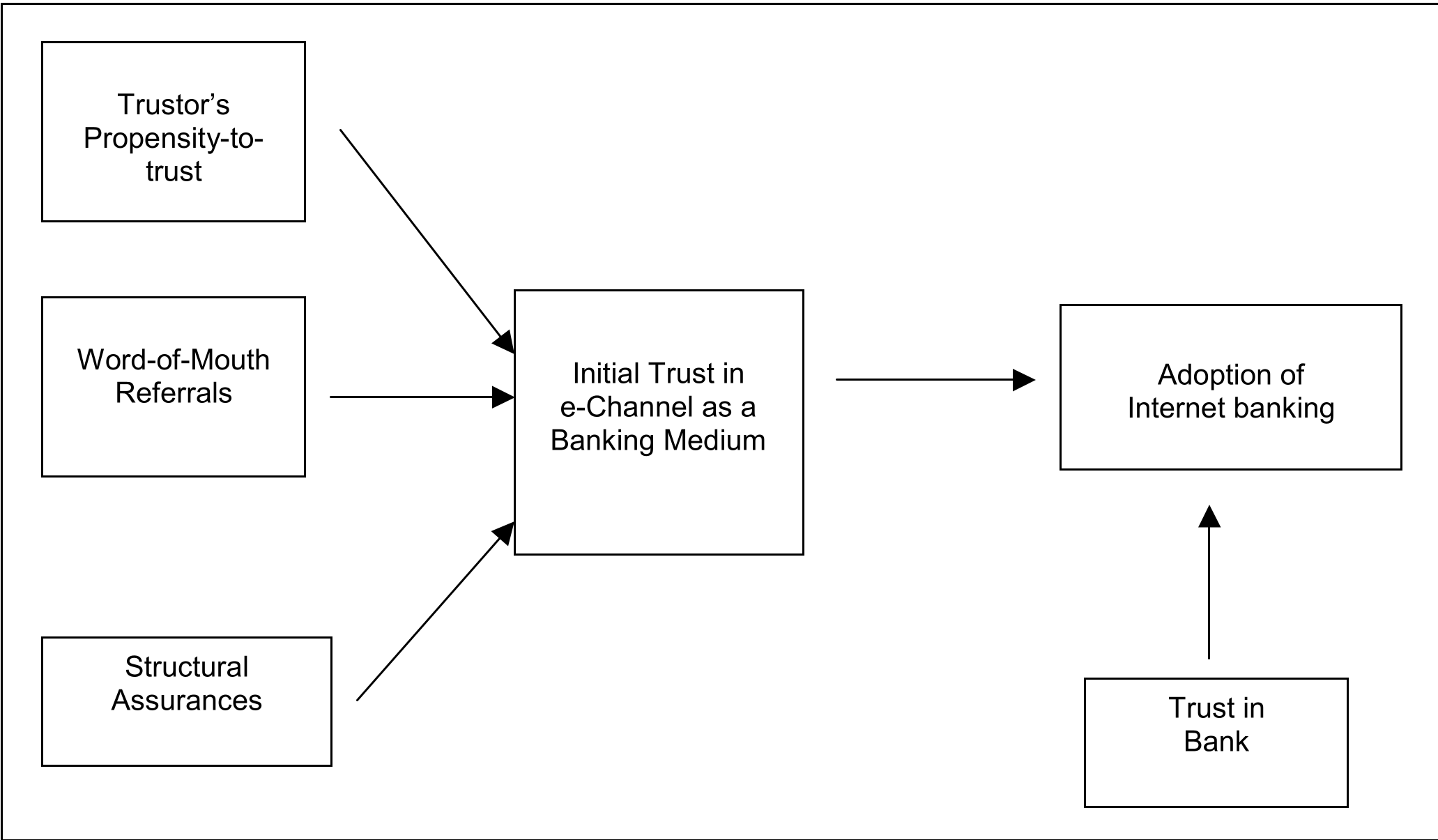
The model tests three main "Inputs" to trust:
- Propensity-to-Trust: Your personality trait—are you naturally a skeptic or a believer?
- Structural Assurances: The "safety nets" (FDIC insurance, encryption symbols, legal contracts).
- Word-of-Mouth (WOM): What your peers tell you about the service.
Key Insights: What Actually Drives Trust?
The study utilized surveys from 266 participants, including both adopters and non-adopters.
1. Competence vs. Intent
The paper makes a sophisticated distinction: We trust the Internet for its competence (Does it work? Is it secure?). We trust the Bank for its intent (Are they benevolent? Do they have integrity?).
2. The Power of Referrals
Interestingly, the study found that Relational Content (what was said) mattered much more than Tie Strength (who said it). If a stranger online confirms a system is reliable and useful, it can be as effective as a close friend saying the same for initial trust formation in this context.
3. The Necessity/Sufficiency Paradox
This is the paper's "Aha!" moment. Through a split-sample analysis, the authors proved:
- Low Trust = No Adoption: If trust levels weren't high, adoption rates were abysmal.
- High Trust ≠ Adoption: Having high trust didn't automatically make someone an adopter.
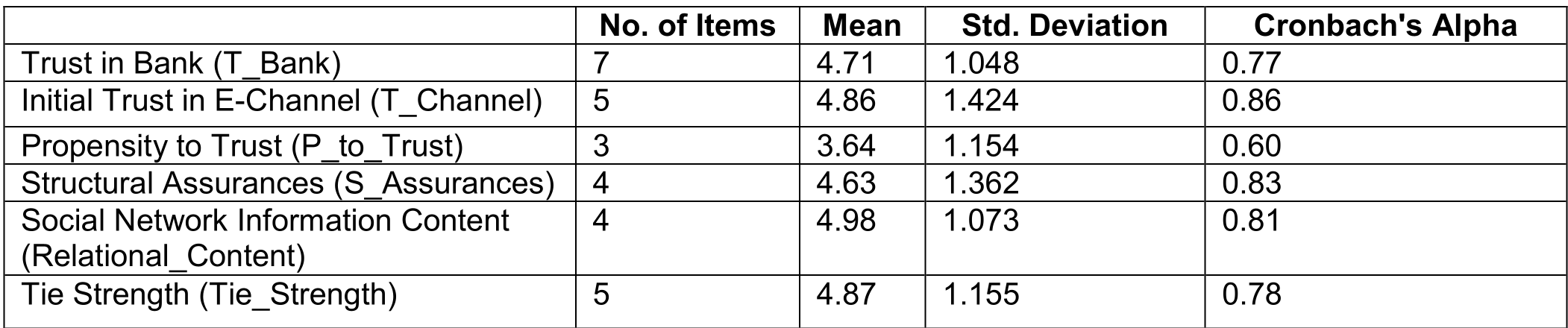 Table showing the descriptive statistics and Cronbach’s Alpha for internal consistency of the trust constructs.
Critical Analysis & Real-World Value
From a Senior Editor's perspective, this work moved the needle by treating the "Technology Medium" as a trustee. It taught the industry that Structural Assurances (guarantees) are the most controllable lever for a company.
Limitations: The study's focus on "Initial Trust" means it doesn't account for how trust evolves after the first hack or the first failed transaction. As we move into the era of AI-driven banking, these 2006 insights remain the bedrock: humans still require "Structural Assurances" (now in the form of AI transparency) before they'll let an algorithm manage their life savings.
Takeaway for Developers & Marketers
If you are building a "high-consequence" system (Medical tech, Fintech, AI Agents):
- Lead with Guarantees: Don't just show "how it works"; show "what happens if it breaks."
- Leverage User Testimonials: Focus on the reliability and utility aspects in your marketing, as these build the "Relational Content" that forms initial trust.