
L-DNL: Breaking Echo Chambers via Strategic Link Injection
Injection for Information Diffusion In Social Networks
The paper introduces L-DNL, a novel framework for boosting information diffusion in social networks by performing limited link injection across community boundaries. By combining diffusion coverage scores, Non-negative Matrix Factorization (NMF), and community detection, the method strategically adds a small number of links to facilitate information flow beyond tightly coupled user clusters.
TL;DR
Information in social networks often gets "trapped" within dense clusters of friends. This paper presents L-DNL, an algorithm that injects a tiny number of strategic links between different communities to exponentially increase information spread. By combining graph theory (eigenvalues) and Matrix Factorization, it identifies where the network is "clogged" and adds the necessary bridges to let information flow.
The "Community Trap" Problem
In social network theory, we know that information spreads like wildfire within a tight-knit group. However, the "structural holes" between these groups act as firewalls. Previous research focused on "Influencer Marketing"—paying celebrities to post content—but this is expensive and often unsustainable.
The authors identify a critical gap: How can we help regular users spread information further? Most recommendation systems (like "People You May Know") suggest friends of friends, which only makes communities tighter and harder to escape. The real challenge is finding links that are socially plausible yet globally beneficial for diffusion.
Methodology: Engineering the Bridges
The L-DNL framework operates through three sophisticated layers:
1. Diffusion Coverage Score ()
Instead of simple degree centrality, the authors use the Perron-Frobenius theorem. They calculate how much the largest eigenvalue of the adjacency matrix drops when a node is removed. This captures the node's importance to the overall network's "connectivity robustness."
2. Community-Aware Link Prediction
The system uses Non-negative Matrix Factorization (NMF) to generate potential links (). But here is the "twist": they add a clustering step. If a potential link connects two different clusters, it receives a "bonus" score.
3. The Injection Strategy
The final score for a potential link between node and is: where is a binary indicator for crossing community boundaries. This ensures the injected links are not just random, but are "strategic bridges."
 Conceptual visualization of crossing community boundaries via link injection.
Experimental Performance
The authors tested L-DNL on massive datasets, including Twitter (456k nodes) and Facebook (46k nodes).
- Baseline Comparison: They compared against PageRank and Random selection.
- Diffusion Models: They utilized both the Independent Cascade (IC) and Linear Threshold (LT) models to ensure results weren't a fluke of one specific simulation style.
- Key Finding: L-DNL consistently outperformed standard DNL (which doesn't consider communities), proving that where you bridge is as important as who you bridge.
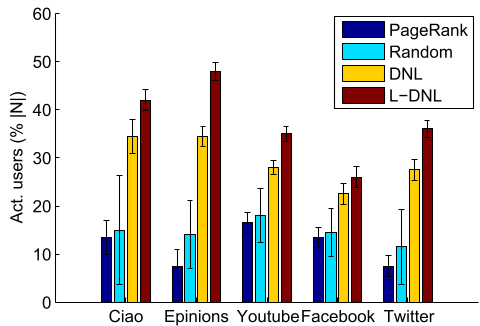 Figure 1: Comparison of L-DNL against baselines across multiple datasets. Note the consistent gap between L-DNL and Random/PageRank methods.
Critical Insight & Conclusion
The brilliance of L-DNL lies in its limited nature. In the real world, you cannot force people to follow 1,000 new accounts. You might only get them to accept 1 or 2 recommendations. By focusing on links that have a high likelihood of being "natural" (via NMF) but possess high structural value (via community crossing), L-DNL offers a pragmatic solution to the "echo chamber" problem.
Limitations: The paper assumes that users will actually accept the recommended links. In future work, incorporating a "probability of acceptance" based on user similarity would make this even more robust for production environments like LinkedIn or X (formerly Twitter).
Future Outlook: As social media becomes more polarized, algorithms that favor "boundary-crossing" connections could be vital for maintaining a healthy, informed digital public square.