
Re-imagining the Bank: How Social Capital is Disrupting the Traditional Business Model
Innovation in Banking Business Models Exploring the Emergent Customer Role in Social Networks
2012-07-01
Summary
Problem
Method
Results
Takeaways
Abstract
This paper investigates the evolution of banking business models in the age of social networks, utilizing Grounded Theory and scenario planning. Through a collaboration between Banco Sabadell, IBM, and academia, the study identifies four distinct future archetypes—Online Banking, Bank à la Carte, Intermediation, and P2P Banking—based on customer engagement and social interaction.
## TL;DR
The banking industry is at a crossroads where social media is no longer just a marketing channel but a catalyst for fundamental business model innovation. This research identifies a shift from one-to-one asynchronous relationships to many-to-many real-time interactions, proposing four future scenarios—most notably **P2P Banking**—where social capital and customer co-creation replace traditional transactional dependencies.
## The Core Tension: From Transactional to Social Logic
For decades, banks have operated on a "Resource-Based View," focusing on internal capacities like capital reserves and CRM systems. However, the rise of social media introduces **contextual uncertainty**.
The authors argue that the biggest threat to traditional banks is not a lack of technology, but a **path dependency trap**: applying old business models to new customers who expect autonomy, transparency, and social validation. As one participant noted, *"I obtain service levels in social networks that I do not obtain in branches"*—a clear signal that the locus of power is shifting from the institution to the network.
## Methodology: Mapping Customer DNA
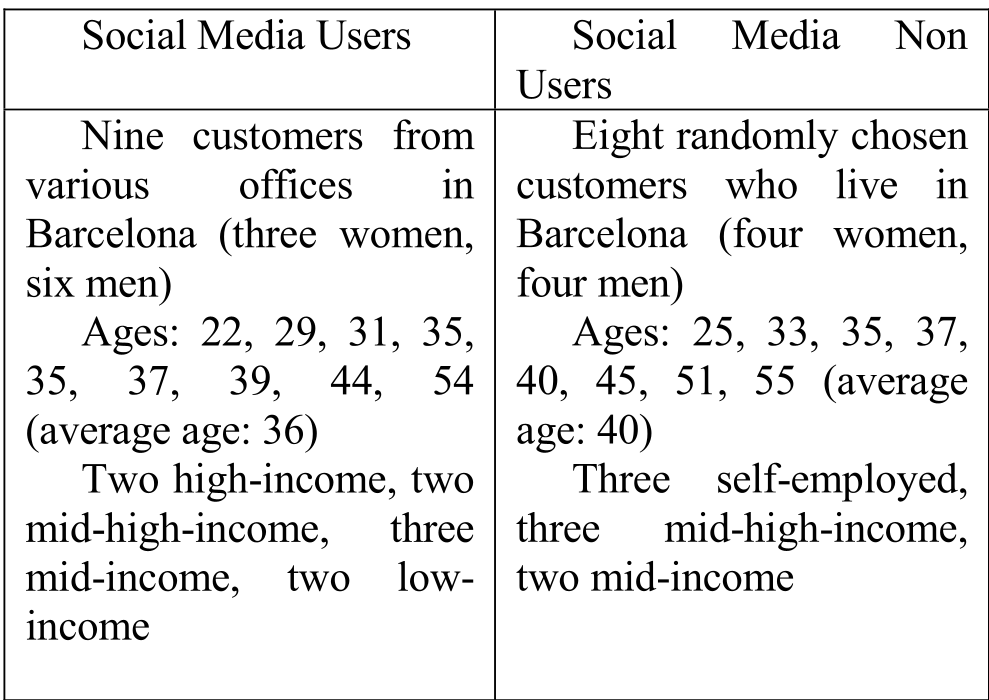
To understand this shift, the researchers conducted focus groups categorized by social media usage and analyzed the data through **Grounded Theory**. By distilling qualitative feedback (e.g., participants wanting the bank to "recognize loyalty" or "lend money to others with the bank's support"), they landed on two crucial dimensions:
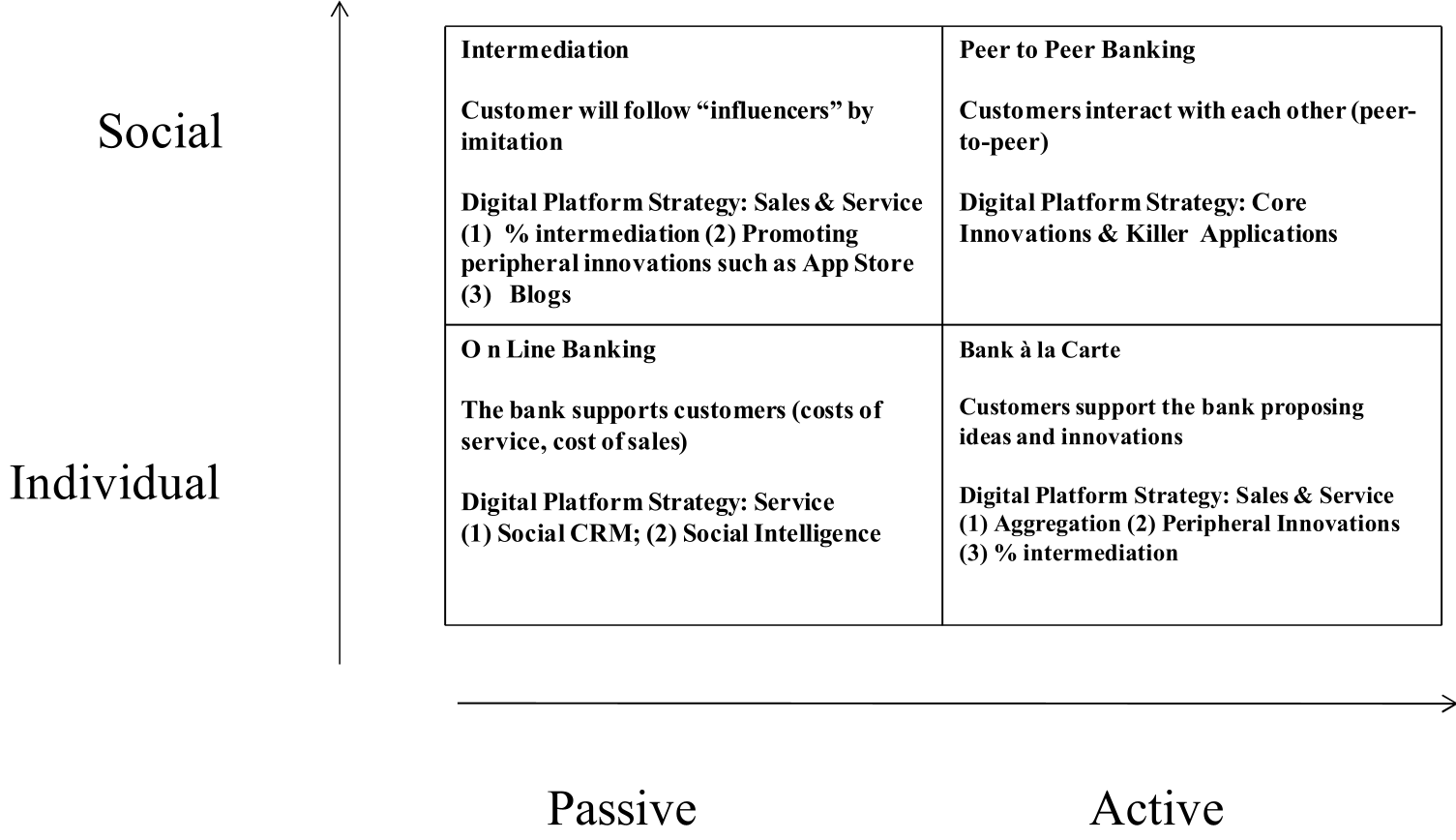
1. **Interaction Type**: Individual (One-to-One) vs. Social (Many-to-Many).
2. **Engagement Level**: Passive (Recipient) vs. Active (Co-creator).
## The Four Scenarios of Banking Evolution
The intersection of these dimensions creates four distinct "futures" that banks must prepare for:
1. **Online Banking (Passive/Individual)**: The baseline. Focuses on efficiency, security, and pushing content. It treats social media as just another CRM channel.
2. **Bank à la Carte (Active/Individual)**: High personalization. Customers use digital tools to "build information according to their needs," requiring banks to offer modular and granular services.
3. **Intermediation (Passive/Social)**: The bank acts as a hub for social intelligence, analyzing influencers to maintain brand equity while integrating service applications into social ecosystems.
4. **P2P Banking (Active/Social)**: The most disruptive stage. Here, customers are co-creators. They might vote on new service implementations or engage in peer-to-peer lending with the bank providing the infrastructure of trust.
## Critical Insight: Social Capital vs. Wealth
One of the paper's most profound findings is that **social activity is not necessarily linked to traditional wealth metrics.** High-value social contributors might not be the wealthiest bank clients, yet they exert significant "Social Power."
For a bank to monetize these opportunities, it must first **create social capital**. Trust is the currency of this new realm. If a customer says, *"I do not trust ties"* (referring to formal corporate connections), they are signaling that the bank needs to facilitate horizontal trust between peers rather than just vertical trust between the client and the institution.
## Future Outlook & Limitations
While the study provides a robust framework, it acknowledges the risk of **Group-think** in its focus groups and the ongoing nature of these technological shifts. Moving from "Online Banking" to "P2P Banking" requires massive investments in **Big Data** and **Social Intelligence**.
**Bottom Line**: The future of banking lies in "escaping" core rigidities. Banks that continue to see social media as a mere "content pushing" tool will likely fall into the path-dependency trap, while those that facilitate social capital will lead the next generation of value creation.