
nm-x: Architecting Innovation through Semantic Networks and Hybrid Engagement
Innovation Networks: A Report on Creating a Specialist Professional Social Network, Offline and Online, to Foster Innovation in the New Media Sector
The paper introduces nm-x, a hybrid professional social network and event program designed to catalyze innovation in London's digital media sector. It details the development of a Drupal-based platform featuring a novel 'Connections Module' for semantic node visualization and a supporting curriculum of live networking events.
TL;DR
In the mid-2000s, while "Web 2.0" was a buzzword, its practical application for professional innovation was still in its infancy. nm-x was a pioneering project that combined a specialist online social network with a live event program to bridge the gap between London's designers and developers. By introducing semantic visualization to the Drupal ecosystem, it moved beyond the "list-based" siloed social networks towards a dynamic, relational map of a creative economy.
Problem & Motivation: The Knowledge Gap in Creative Clusters
Post-2001 recovery, the digital media sector in West London—home to over 70,000 creatives—faced a structural challenge. Despite the rich presence of broadcasters (BBC, Sky) and universities (RCA, UCL), the community was fragmented.
The author identifies a "disparity" between technical vanguardists and business leaders. The goal of nm-x was to create a synergetic potential by drawing these disparate groups—particularly designers and coders—into a single innovation-driven exchange. The core insight was that innovation isn't just about individual talent; it's about the logic of networks: decentralized, collaborative, and adaptive.
Methodology: Drupal, Semantics, and "Database Art"
The project avoided the common "identikit" website approach. Instead, it focused on two pillars:
1. The Aesthetic of Connections
Inspired by Lev Manovich’s "Database Art," the team rejected Flash in favor of an open-source, Javascript-based visualization. This interface allows users to "play" with data, seeing how nodes (people, projects, organizations) are interconnected.
 Figure: Inspiration drawn from Plumb Design's Visual Thesaurus to represent complex database relationships.
2. The Connections Module
Technically, the project contributed a 'Connections Module' to the Drupal CMS. Developed by Peter Brownell, this module allowed for semantic links between nodes, outputting data as XML to drive the front-end visualization. This was a forward-looking experiment in bringing the "Semantic Web" to a functional professional platform.
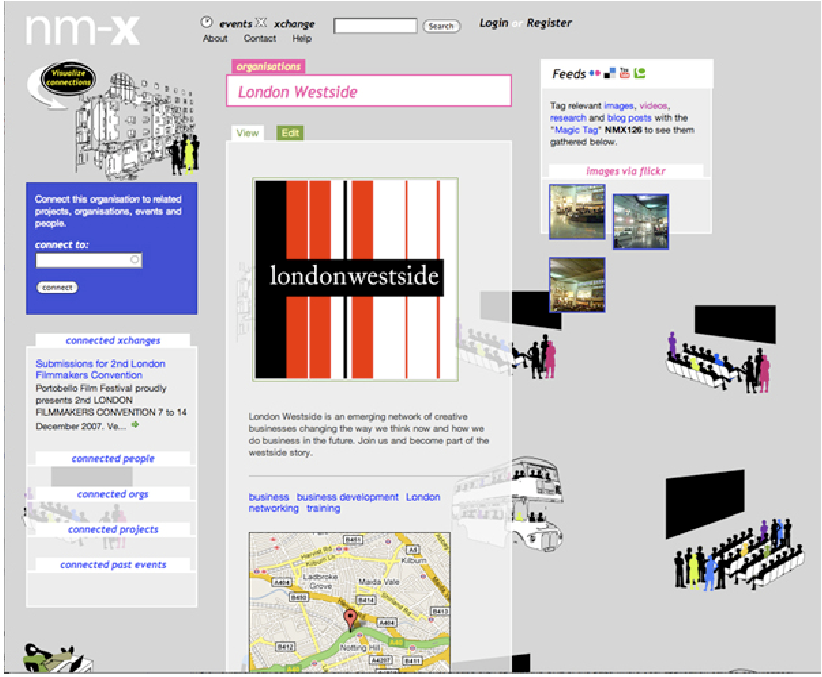 Figure: The final nm-x interface, showcasing the layered approach to visual networking.
Experiments & Results: The Hybrid Strategy
The nm-x project proved that technology alone is insufficient. The online platform was supported by live events, such as "show and tells" and "talk-a-okes," which served as a recruitment tool for the digital network.
- User Quality: While membership remained in the hundreds, it captured the "serious players" of the West London innovation sector.
- Technical Legacy: The project demonstrated that Drupal could be "stretched" to support complex, non-linear visualizations without proprietary plugins.
- Feedback: Designers specifically praised the "visual connections map" for its ability to represent the hierarchy and interconnections of the cluster.
Critical Analysis & Conclusion
The project’s primary struggle was achieving self-sustaining critical mass. The author reflects that live events must be large-scale and frequent to trigger a self-correcting growth loop.
Takeaway: The nm-x experiment serves as a blueprint for specialized professional networks. It suggests that the future of UI for professional data isn't in lists or feeds, but in dynamic visualizations that reveal the underlying social and professional fabric. Despite the challenge of long-term funding, nm-x represents a significant step in move from "information silos" to truly interconnected innovation infrastructures.