
Balancing the Scales: Robust and Energy-Efficient Job Assignment in Modern Server Farms
Insensitive Job Assignment With Throughput and Energy Criteria for Processor-Sharing Server Farms
2013-08-20
Summary
Problem
Method
Results
Takeaways
Abstract
This paper investigates insensitive job assignment policies in Processor-Sharing (PS) server farms to optimize throughput and energy efficiency. It introduces two categories of policies—with and without jockeying—and develops the I-J-OPT policy using a Semi-Markov Decision Process (SMDP) that achieves SOTA energy efficiency while maintaining predictability across varying job size distributions.
## Executive Summary
**TL;DR**: This research tackles the complex dance between maximizing job throughput and minimizing carbon footprints in data centers. By introducing "Insensitive" job assignment policies for Processor-Sharing (PS) servers, the authors provide a mathematical guarantee that system performance remains stable regardless of whether jobs are small bits of data or massive computational tasks.
**Academic Positioning**: This work bridges the gap between classic Queuing Theory (specifically Insensitivity and GSMP) and modern Green Computing. It moves beyond simple "speed scaling" into the realm of intelligent, robust workload distribution.
## The Problem: The "Sensitivity" Trap
In many real-world systems, performance metrics like mean response time or blocking probability are highly sensitive to the **Variance** of the workload. If a data center is tuned for average-sized jobs, a sudden influx of "heavy-tailed" jobs (very large files) can cause the system to collapse.
Most prior work focused on First-Come-First-Served (FCFS) or infinite buffer models. However, modern web servers are better modeled as **Processor-Sharing (PS)** systems with finite buffers. The authors identified a critical gap: how do we assign jobs in these servers to save energy without making the system unpredictable?
## Methodology: The Architecture of Insensitivity
The core of the paper lies in the **Insensitivity Property**. A policy is insensitive if the steady-state distribution of the number of jobs depends only on the *mean* of the job size distribution, not its specific shape (e.g., Exponential vs. Pareto).
### 1. Assignment Without Jockeying (I-SQP & I-SQEP)
For systems where a job cannot move once assigned, the authors proposed a probabilistic preference model.
- **I-SQP**: Favors shorter queues to maximize throughput.
- **I-SQEP**: Introduces a tuning parameter ($\omega$) to steer jobs toward slower, more energy-efficient servers.
### 2. Assignment With Jockeying (The "Fluid" Model)
Jockeying allows jobs to be reassigned instantly—ideal for centers with shared DRAM or high-speed interconnects.
- **I-J-FISF**: "Fastest Idle Server First" - Optimized for raw speed.
- **I-J-SSF**: "Slowest Server First" - A heuristic that packs jobs into the most efficient servers first.

*The transition matrix above defines the state changes governed by independent lifetime distributions, ensuring the balance equations hold for insensitivity.*
## Experiments: The Price of Robustness
The researchers compared their policies against the Gold Standard: **Join-the-Shortest-Queue (JSQ)**.
**Key Findings:**
- **The Insensitivity Dividend**: While I-SQP (without jockeying) pay a slight performance "tax" compared to JSQ to maintain robustness, adding **jockeying** completely eliminates this gap, allowing for both insensitivity and high performance.
- **Extreme Efficiency**: In large-scale tests (100 servers), the I-J-SSF heuristic was nearly identical to the mathematically optimal policy derived via SMDP, reaching an approximation ratio of **1.0004** in most cases.
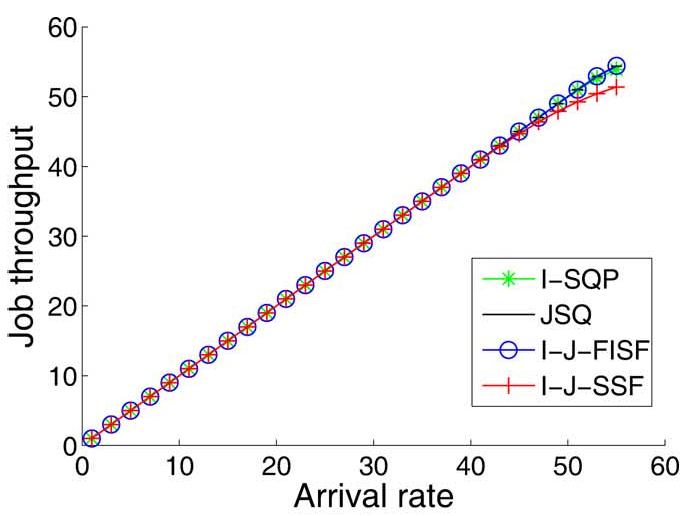
*Fig 4: This chart demonstrates the scalability of the proposed policies in large 100-server systems, showing nearly perfect alignment between heuristic and optimal results.*
## Critical Analysis & Conclusion
**Takeaway**: The study proves that you don't have to sacrifice predictability for energy efficiency. By utilizing jockeying and Processor-Sharing logic, data centers can achieve "Green" operations that are mathematically immune to the "long-tail" job size problem.
**Limitations**: The "jockeying" model assumes zero-cost migration of jobs, which in practice involves some overhead in context switching and memory state transfer. Future work should investigate incorporating these "migration costs" into the SMDP cost function.
**Future Outlook**: As more data centers move toward **RAMClouds** and shared-storage architectures, the "With Jockeying" policies (I-J-SSF) provide a blueprint for next-generation, energy-proportional scheduling.