
Instant Social Graph Search: Beyond the Shortest Path to Meaningful Connections
Instant Social Graph Search
The paper introduces "Instant Social Graph Search," a task aimed at discovering a small, representative subgraph that connects two or more individuals in a large-scale social network. The authors propose three algorithms—Path, Influence, and Diversity—and implement them in real-world systems to provide instant, multi-faceted connection results.
TL;DR
When you ask "How am I connected to a Turing Award winner?", a simple list of names isn't enough. This paper explores Instant Social Graph Search, a method to extract small, diverse subgraphs from massive networks (like LinkedIn or Facebook) in real-time. By prioritizing Topic Diversity over simple path length, the authors increased user engagement by up to 131%.
The "Six Degrees" Paradox
In the world of social computing, we are victims of the "Small World" phenomenon. While any two people are connected by roughly six steps, the number of potential paths between them is astronomical.
If a system simply returns the shortest paths, the results are often redundant (multiple paths sharing 90% of the same nodes) or narrow (only showing connections from one specific context, like college friends). Furthermore, human cognitive load limits us: once a graph exceeds 50 nodes, users lose interest. The challenge is: How many nodes do we pick, and which ones actually matter?
Methodology: Engineering the "Good" Subgraph
The authors move beyond simple Dijkstra-based search to propose three distinct approaches:
- Path Algorithm: A baseline that finds near-shortest paths but suffers from node redundancy.
- Influence Algorithm: Uses influence maximization models to select nodes that have the highest "reach" within the connection space.
- Diversity Algorithm (The Core Contribution): This is the highlight of the paper. It treats each node as a distribution of topics (). The goal is to select a subset of nodes that best "represents" the topics of the entire candidate graph.
The Diversity Objective Function
The diversity model is built on the intuition that a connection between a Data Mining professor and a Complexity Theory professor should show bridges in both fields. The algorithm uses a greedy approach to maximize the representative degree:
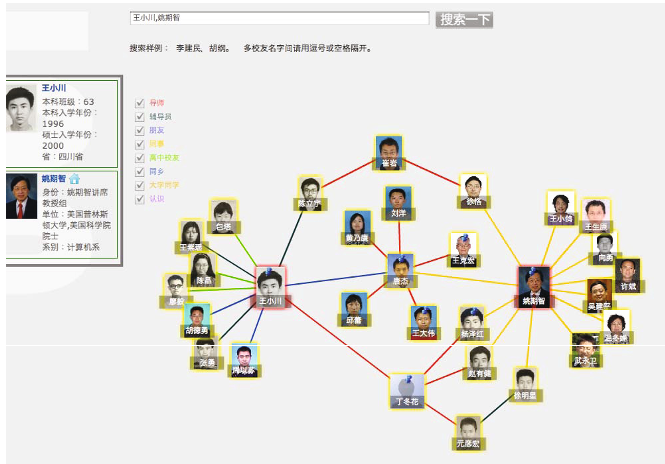 Figure 1: Comparison of social graphs in coauthor networks (a) and alumni networks (b), showing different relationship types.
Experiments: Real-World Deployment
The authors didn't just simulate results; they deployed these algorithms on ArnetMiner (academic search) and a university alumni network.
Key Findings:
- User Interest: The Diversity algorithm led to the longest Viewing Time, suggesting users find diverse graphs more informative.
- Click Quality: They measured the Expand/Remove ratio. While the Path algorithm got many clicks, many were to "remove" irrelevant nodes. The Diversity algorithm had the highest ratio of "expand" clicks, meaning users wanted to dive deeper into the suggested connections.
- Efficiency: Despite the NP-hard nature of the problem, their approximate greedy algorithms return results in under 2 seconds for networks with millions of edges.
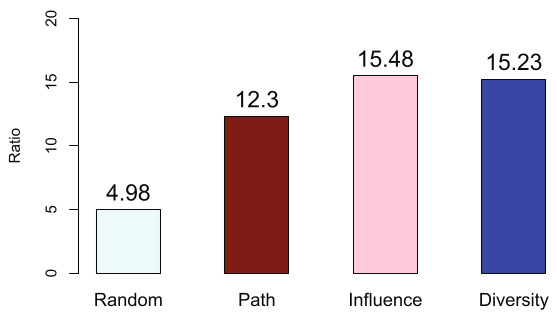 Figure 2: Performance metrics including click ratios and average viewing time across different algorithms.
Critical Insight & Future Outlook
The genius of this work lies in the realization that Search is not just Retrieval; it is Curation. In a social graph, the "best" answer is rarely the shortest one; it is the one that provides the most context.
Limitations: The paper identifies "Name Ambiguity" (e.g., two "John Smiths") as a major source of error. Future iterations would likely benefit from incorporating Entity Resolution (ER) techniques using LLMs or deep graph embeddings.
Takeaway: If you are building a referral or networking tool, don't just show your users that they are connected. Show them the diversity of their connections.