
Dispersing Social Video Services: Navigating the Multi-Cloud Cost Trap
Dispersing Instant Social Video Service Across Multiple Clouds
This paper investigates multi-cloud hosting for instant social video services (like TikTok/Vine). It proposes a heuristic graph-partitioning method to disperse user-generated content across multiple cloud providers, optimizing for both user access speed and inter-cloud operational costs.
TL;DR
Instant social video platforms (e.g., Weishi, Vine) struggle with global delivery. Using multiple clouds solves geographic coverage but introduces massive "inter-cloud replication costs" due to aggressive pricing by providers like Amazon. This paper proposes a heuristic algorithm that partitions social graphs to balance user performance with these operational costs, effectively "grouping" friends within the same cloud to avoid expensive egress fees.
The Multi-Cloud Dilemma: Performance vs. Pricing
To provide a low-latency "instant" experience, video servers must be close to the user. Since no single cloud provider (AWS, Azure, Google Cloud) has a perfect global footprint—especially in restricted or specific regional markets like China—hosting content across multiple clouds is the only way to achieve truly global SOTA performance.
However, the "Replication Roadblock" creates a massive barrier. Cloud providers typically:
- Encourage Ingress: Uploading content is free.
- Tax Egress: Transferring data to a different cloud provider costs significantly more (up to 6x) than keeping it within the same provider's global network.
In a social context, where videos are shared and reshared constantly, this pricing model penalizes a multi-cloud strategy. If User A (Cloud 1) shares a video with Friend B (Cloud 2), the platform pays a premium for that data "hop" across the cloud boundary.
Methodology: The Propagation-Weighted Social Graph
The authors suggest that instead of hosting individual videos, we should host users. If a user is assigned to a specific cloud, all content they generate stays there. The challenge becomes a Graph Partitioning Problem: how do we assign millions of users to a handful of clouds?
1. Modeling Preference
The algorithm defines a Preference Index () for each user, considering:
- Download Performance: Can the user's friends access the content from a local region?
- Upload Performance: Can the user upload their original 10-second clips quickly?
2. Heuristic Re-hosting
Because partitioning a global social graph is NP-Hard, the paper introduces a two-step heuristic.
- Phase 1: Assign users to their "Ideal Cloud" (maximum performance).
- Phase 2: Identify social edges with massive "Propagation Weight" (heavy resharing). If two heavy-sharing friends are in different clouds, the system "re-hosts" one of them to the other's cloud to save on costs.
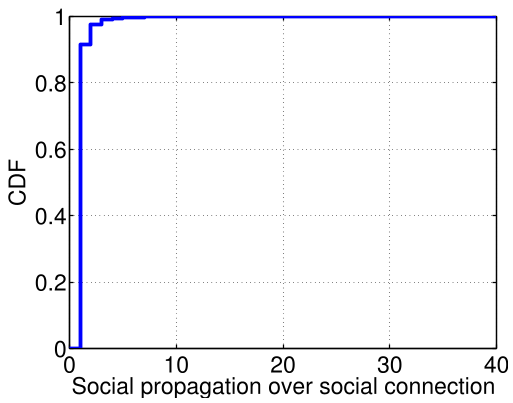 Figure 1: The framework for data-driven multi-cloud hosting, combining social propagation data and cloud pricing.
Experimental Insights: The Power of "A Few"
The research utilized massive traces from Tencent Weibo and Weishi. Two key physical intuitions emerged from the data:
- Locality of Interest: Most users only need a small number of server regions to serve almost all their friends (Heavy-tailed distribution).
- The Pareeto Principle in Social: A tiny fraction of social connections are responsible for the vast majority of content propagation.
By focusing re-hosting efforts only on these "active" social connections (the top 20%), the algorithm achieves massive cost savings without needing to re-calculate the entire global graph.
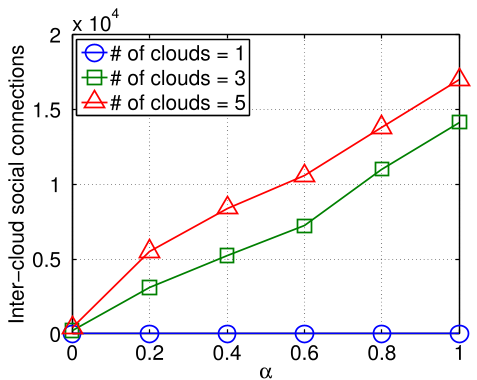 Figure 2: Comparison of different strategies. The proposed design (blue line) maintains low propagation costs even as the number of clouds increases, unlike the Max-Preference strategy.
Conclusion and Analysis
The core contribution of this work is the realization that social topology is a cost-driver in cloud environments. By slightly compromising on "perfect" geographic proximity for a small subset of users, a service provider can drastically reduce its monthly cloud bill.
Limitations: The strategy assumes social connections are relatively stable over a short period. In scenarios with "viral" content from a user with a suddenly shifting follower base, the re-hosting might lag behind the actual traffic spike.
Future Outlook: As the world moves toward "Multi-Cloud by Default," algorithms that treat cloud boundaries as weighted edges in a graph will be essential for the economic survival of high-bandwidth platforms like TikTok or Instagram.