
Beyond Facebook: Can Institutional Social Networks Build Professional Identity?
Do Institutional Social Networks Work? Fostering a Sense of Community and Enhancing Learning
The paper evaluates KINSHIP, an institutional social network at King’s College London, designed to foster a sense of community and model digital professionalism. Through a pilot survey and interviews, it proves that a dedicated academic platform can successfully separate professional identity from personal social media presence.
TL;DR
Higher education is currently caught in a tug-of-war between the ubiquity of commercial social media and the need for private, professional academic spaces. This paper evaluates KINSHIP, an institutional social network at King’s College London. While students appreciate the platform for "digital professionalism" and academic collaboration, the research highlights a critical hurdle: if institutional platforms don't match the UX and mobile-first agility of commercial giants, they risk becoming "ghost towns" despite their inherent value.
The "Context Collapse" Problem
Traditional social media (Facebook, WhatsApp) presents a double-edged sword for students. On one hand, these platforms offer seamless communication; on the other, they force a collision between personal lives and professional aspirations.
The authors identify three main pain points:
- Digital Professionalism: Students are often reluctant to engage in academic discourse on platforms where their private photos and social interactions reside.
- Privacy and IP: Commercial platforms own the data they host. For medical students discussing clinical cases, this poses a massive risk to patient confidentiality and intellectual property.
- Institutional Silence: Many educators lack the confidence to implement emerging technologies, leaving academic social media use as "uncharted territory."
Methodology: The KINSHIP Pilot
The King’s Social Harmonisation Project (KINSHIP) was developed as a ring-fenced social network exclusive to King’s College staff and students. The evaluation focused on a pilot group, using surveys and medical tutor interviews to understand how students navigate this new academic "third space."

Key Findings: The Professional Advantage
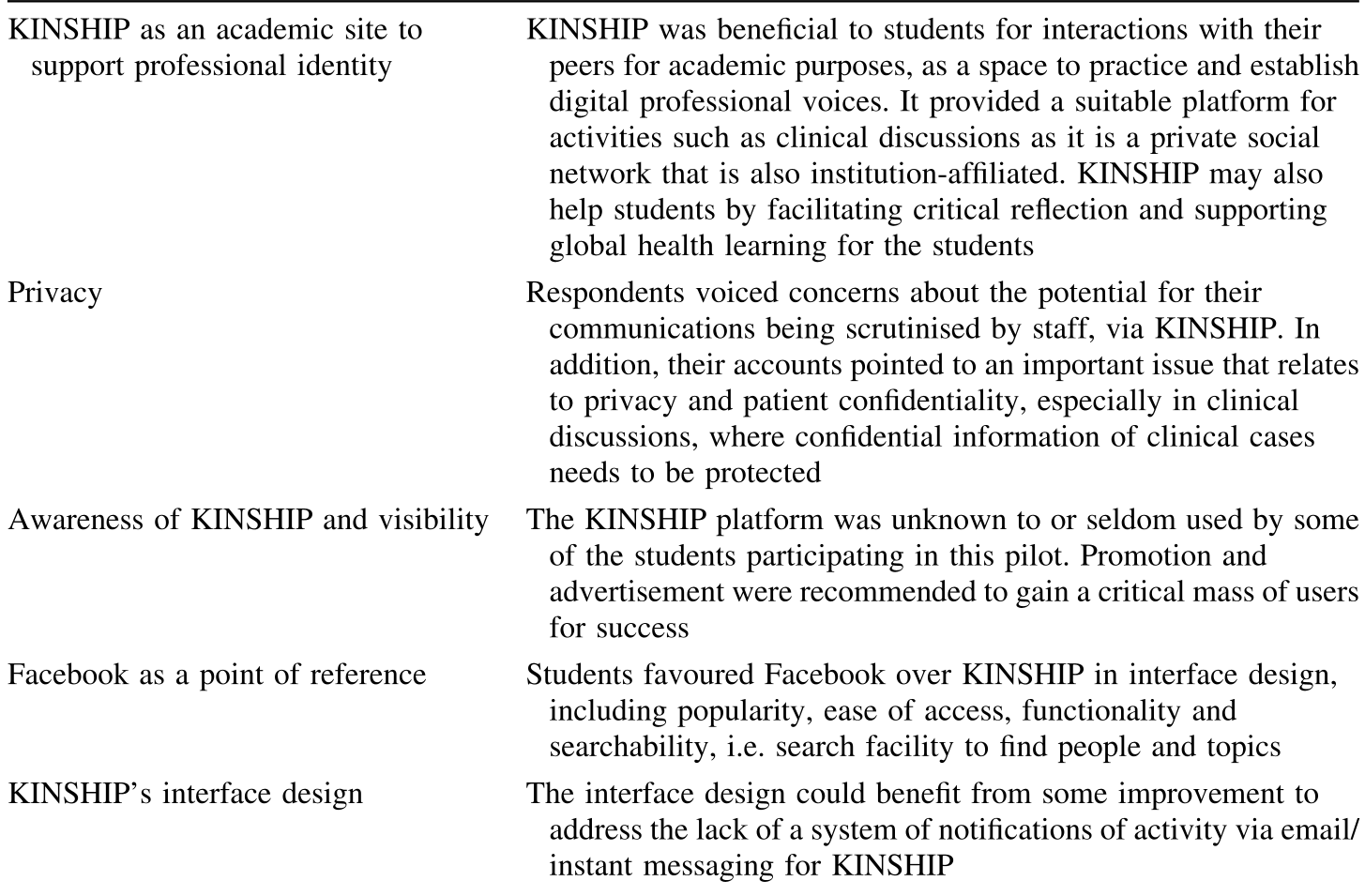
The study found a clear appetite for academic-only spaces. Students used KINSHIP primarily to:
- Collaborate with peers on specific modules (54.8%).
- Establish a professional voice: 64.6% felt the university should offer a space to model digital professionalism.
- Safe Clinical Discussion: For medical students, KINSHIP acted as a secure harbor for clinical reflections that would be inappropriate or unsafe for commercial data-mined sites.
The Functionality Gap
Despite the perceived value, the results showed that "convenience is king." Students constantly compared KINSHIP to Facebook, noting that institutional tools lacked:
- Notifications: Without email or push alerts, engagement dropped.
- Searchability: Finding topics and people was harder than on commercial rivals.
- Mobile Access: Even though 82.8% of students accessed social media via handheld devices, KINSHIP’s web-heavy interface was a barrier.
Deep Insight: The Privacy Paradox
One of the paper’s most intriguing findings is the "Monitoring Paradox." While students feared commercial data mining on Facebook, they paradoxically feared institutional scrutiny on KINSHIP. 66.7% of students were positive about a private network, yet many felt "inhibited," worried that staff would monitor their every move.
This suggests that for an institutional social network to succeed, it must not only be technically secure but also culturally safe—clearly defining the boundaries between "monitored assessment" and "informal learning."
Critical Analysis & Future Directions
The takeaway for universities is clear: Ownership of the platform is a strategic asset. It protects IP and patient data, but it requires a commitment to UX evolution.
Future success factors for institutional networks include:
- Mobile-First Design: It must be an app, not just a responsive website.
- VLE Integration: Seamless links with Moodle or Outlook to make the network part of the daily workflow.
- Moderation over Monitoring: Tutors should act as "professional scaffolds" rather than supervisors to encourage honest peer-to-peer discourse.
In conclusion, KINSHIP demonstrates that students want to be professional online, they just need a platform that works as well as their favorite social apps without the privacy Baggage.