
Decoding the Social Fabric of Virtual Reality: An Integrated Research Approach
Towards an integrated approach to studying virtual reality-mediated social behaviors
This paper proposes an integrated methodological framework for studying social behaviors mediated by Virtual Reality (VR), specifically focusing on multi-user Head-Mounted Display (HMD) applications. It introduces a 2x2 classification system based on "Co-Presence" and "Co-Location" to address the complexities of analyzing human interaction in mixed physical-virtual settings.
TL;DR
As Virtual Reality (VR) shifts from solitary experiences to social platforms, researchers face a "methodological gap." This paper proposes a structured framework to study VR-mediated social behaviors by integrating traditional social science tools with a new classification of user presence and location. It moves beyond simple observation to a synchronized, multi-stage research strategy designed for both HMD and non-HMD participants.
Background: The Complexity of Virtual Presence
Virtual Reality is no longer just about "being there"—it is about "being there together." However, the variety of ways we connect in VR makes it a moving target for researchers. Whether it is four players on a starship bridge (Co-located) or a VR streamer interacting with a Twitch audience (Remote/Asymmetric), the social cues vary wildly.
The author argues that traditional methods like questionnaires and interviews are often too intrusive or fail to capture the "heat of the moment." To solve this, we need a method that bridges the gap between the physical and the virtual.
The 2x2 Matrix of VR Social Scenarios
The core insight of this paper is that social interaction in VR is defined by two dimensions: Co-Location (Are we in the same room?) and Co-Presence (Are we both in HMDs?).
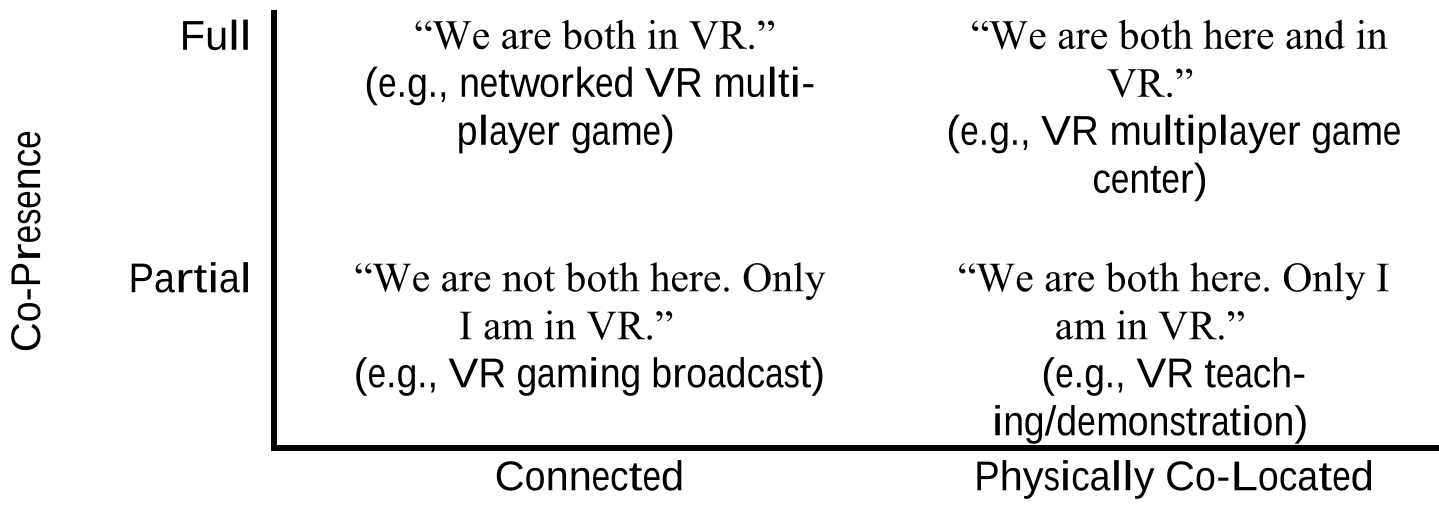
- Physically Co-Located & Full Co-Presence: Users are in the same room, all wearing HMDs (e.g., collaborative design).
- Connected & Full Co-Presence: Remote users, all in HMDs (e.g., Facebook Spaces).
- Physically Co-Located & Partial Co-Presence: One user in an HMD, others interacting via tablets or screens (e.g., ShareVR).
- Connected & Partial Co-Presence: Remote users with mixed hardware (e.g., VR streaming).
Methodology: The Integrated Lifecycle
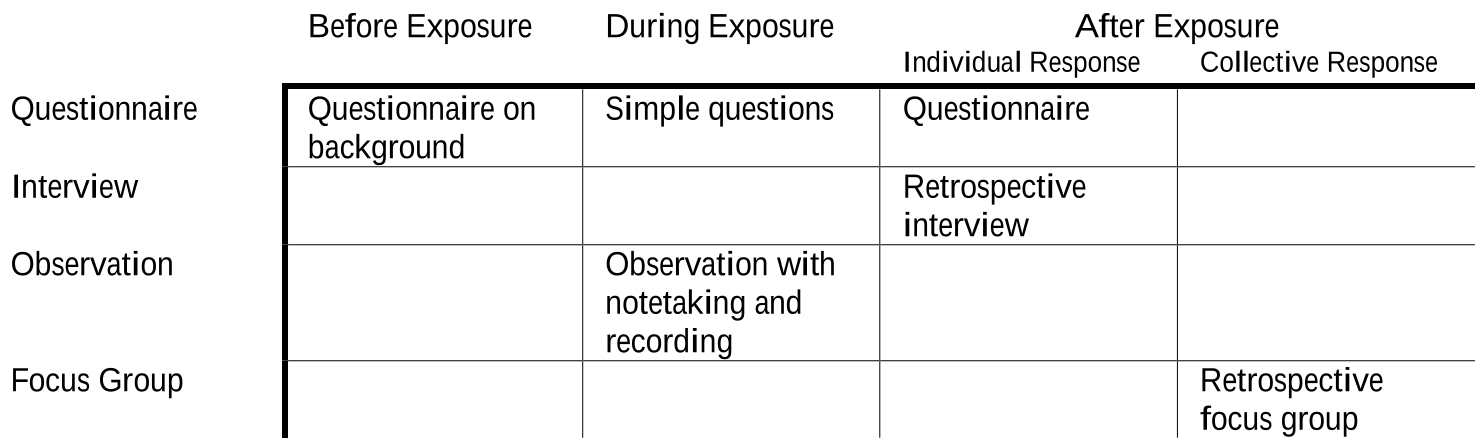
The author proposes a three-stage pipeline to capture a 360-degree view of social behavior:
1. Before Exposure
- Goal: Establish a baseline.
- Method: Questionnaires to capture demographics and previous VR experience. This is crucial for normalizing data across "VR pros" and "novices."
2. During Exposure
- Goal: Capture objective interaction.
- Method: Observation is the hero here. Researchers must record both the physical body (gestures/shouts) and the virtual view (avatar movements).
- The "Gesture Questionnaire": To minimize disruption, the author suggests asking simple questions (e.g., "Rate your excitement 1-5") where participants respond with finger gestures within the VR world instead of taking off the headset.
3. After Exposure
- Goal: Capture internal states and collective dynamics.
- Method: This is a tiered approach.
- Questionnaire/Individual Interview: To get private, uninfluenced thoughts.
- Focus Group: To observe how the group reconstructs their shared experience.
Critical Insight: The Mapping Problem
One of the most profound challenges highlighted is the physical-to-virtual mapping. In co-located VR, a user might shout in the real world while their avatar waves in the virtual one. A researcher needs a synchronized view of both to understand the "Social Cue." This requires complex setups with multiple cameras and screen recorders that must be frame-synced to provide valid retrospective interview data.
Conclusion & Future Look
The paper successfully transitions VR research from a "single-user immersion" focus to a "multi-user interaction" focus. While the methods described are "low-tech" (not requiring EEG or eye-tracking), they provide the foundational logic for how future researchers should structure their experiments.
Limitations: The paper focuses on HMD-based systems and excludes the detailed analysis of interaction transcripts. Future work should look at how AI-driven behavioral analysis can automate the "mapping" between physical and virtual gestures.
Takeaway: If you are designing a social VR study, stop thinking about the headset in isolation. Start thinking about the spatial relationship between your users and their differing levels of "presence."