
Integrated Mining: Uncovering the Hidden Patterns of Cancer Incidences
Integrated Mining for Cancer Incidence Factors from Healthcare Data
This paper presents an integrated data mining framework utilizing Decision Trees, Radial Basis Function (RBF) networks, and Back Propagation Neural Networks (BPN) to identify cancer incidence factors from healthcare questionnaires. By combining these three methods, the authors successfully extract interpretable rules and quantify the relative significance of lifestyle habits on cancer risk.
TL;DR
Researchers have developed a multi-stage data mining template that integrates Decision Trees, Radial Basis Function (RBF) networks, and Back Propagation Networks (BPN) to analyze complex healthcare questionnaire data. This approach moves beyond simple prediction to uncover why specific lifestyle factors—ranging from stress levels and dietary habits to medical history—correlate with cancer, identifying "Blood Transfusion" and "Stress" as high-impact variables.
Background & Motivation: The Complexity of Healthcare Data
Medical datasets derived from questionnaires are notoriously "messy." With over 250 attributes and 47,000 records, the data is filled with missing values and skewed distributions (e.g., a small number of cancer patients versus a large healthy population).
The authors argue that no single algorithm is a silver bullet:
- Decision Trees are great for rules but fail on skewed data and don't allow for easy group comparison.
- BPN is powerful for classification but often acts as a "black box."
- RBF handles noise well and can approximate complex functions but requires a structured approach to generate meaningful patterns.
Methodology: The Power of Three
The core innovation lies in the synergy between three distinct algorithms to process the healthcare data mart:
1. Back Propagation (BPN) & Sensitivity Analysis
Before building complex models, the authors used BPN to perform Sensitivity Analysis. By examining the weight matrix of a trained network, they could calculate which input fields (variables) contributed most to the output. This allowed them to remove irrelevant or redundant variables, simplifying the subsequent Decision Tree.
2. Radial Basis Function (RBF) for "Divide and Conquer"
RBF was used to predict the probability of cancer. Because RBF treats input data as measures of distance from a "center" (using Gaussian functions), it effectively segments the population. This allowed the researchers to compare the "highest incidence segment" against the "lowest incidence segment."

3. Decision Trees for Rule Induction
Once the data was cleaned and features selected, Decision Trees were used to generate human-readable "If-Then" rules.
Key Results and Visual Evidence
The integrated approach yielded specific, actionable insights into cancer prevention.
Sensitivity Ranking
The BPN sensitivity analysis highlighted factors that might be overlooked in simpler statistical models:
- Blood Transfusion: 1.4 Sensitivity
- Job Category: 1.3 Sensitivity
- Stress: A staggering 54.5% of the high-risk female group reported living under stress, compared to 15% in the control group.
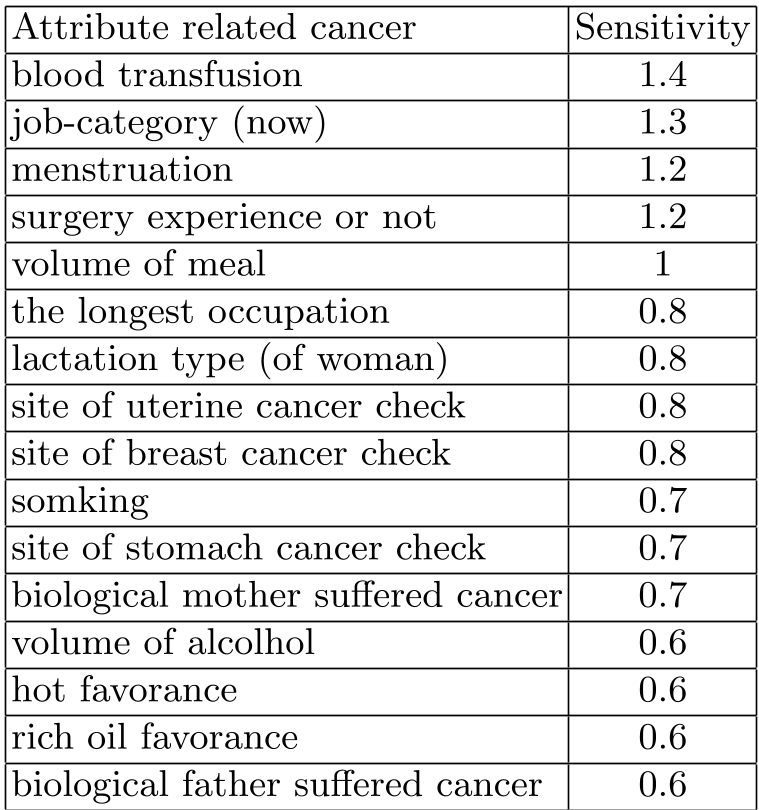 Table: Variables with the most contribution to cancer incidence based on BPN sensitivity.
Behavioral Insights (RBF Comparison)
Through RBF profiling, the study found that lifestyle habits like eating breakfast and specific meat consumption frequencies were significantly different between the cohorts. For instance, non-cancer women showed a much higher regularity in eating breakfast (93.3%) than those in the cancer patient group (87%).
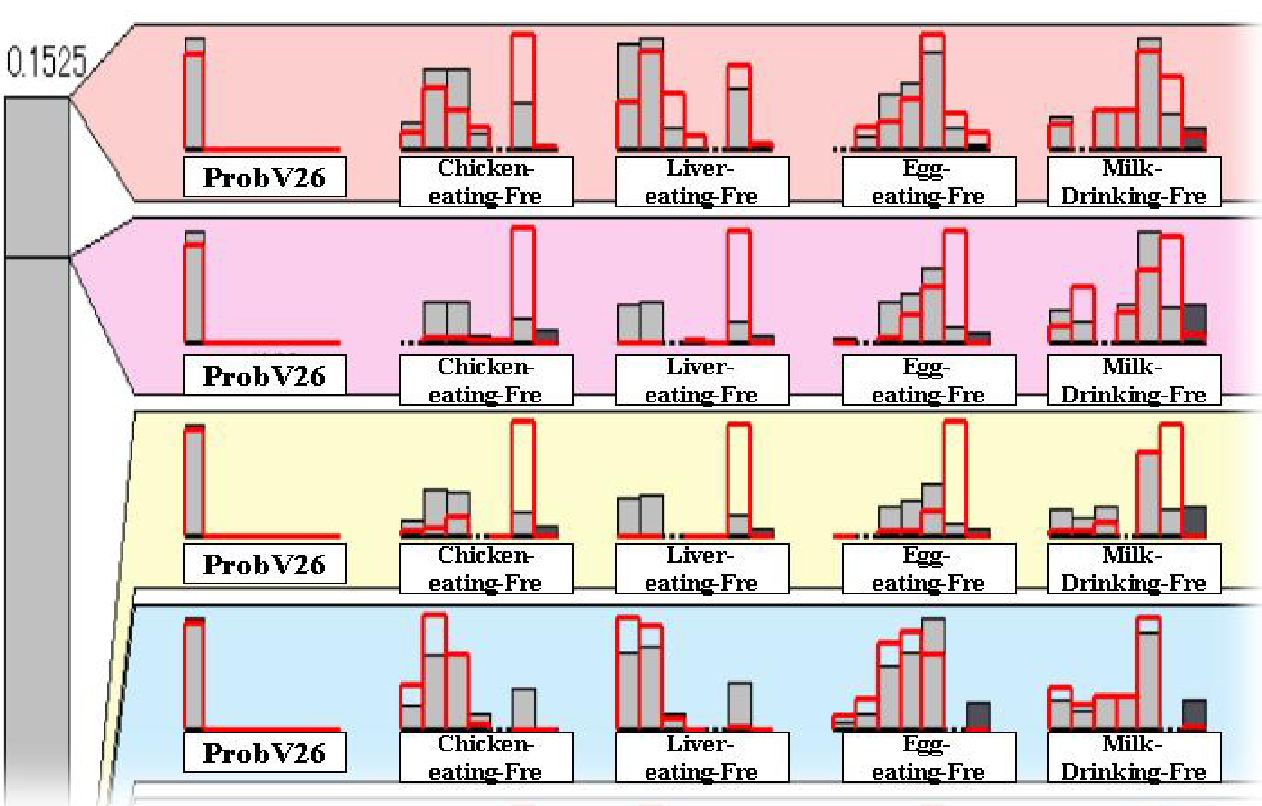 Figure: Distribution of variables within RBF segments showing how specific factors deviate from the general population.
Critical Analysis & Conclusion
Takeaway
The primary value of this paper is the methodological template. It demonstrates that healthcare mining shouldn't just be about building the most accurate classifier; it should be about building a pipeline that supports Knowledge Acquisition. By using BPN for pruning, RBF for comparison, and Decision Trees for interpretation, the researchers created a transparent window into the data.
Limitations
- Temporal Relevance: As the study relies on questionnaire data, it is subject to "recall bias" where patients might over-report or under-report certain habits post-diagnosis.
- Missing Value Imputation: While EM (Expectation-Maximization) was used via SPSS, the high volume of missing data in 250 attributes remains a challenge for generalizability.
Future Work
The shift towards Multi-strategy Data Mining is more relevant today than ever. In the era of Deep Learning, the "Sensitivity Analysis" featured here is a precursor to modern XAI (Explainable AI) techniques. Integrating these classical mining strategies with modern LLMs or Graph Neural Networks could further unlock the "why" behind chronic disease incidences.