
Bridging the Communication Gap: How NAO Robots and Multimodal AI Recommend Books to Autistic Children
Integrating Image and Textual Information in Human–Robot Interactions for Children With Autism Spectrum Disorder
This paper proposes a novel multimodal picture book recommendation framework for children with Autism Spectrum Disorder (ASD), utilizing the NAO robot as an interactive agent. The system integrates textual analysis via Multiple Correspondence Analysis (MCA) and visual feature mining using Near-Duplicated Keyframes (NDK) to match books with conversation topics.
TL;DR
Researchers have developed a sophisticated multimodal AI framework that allows the NAO robot to listen to a child’s conversation, extract key emotional themes (events), and recommend the most relevant picture books. By combining textual patterns with visual "fingerprints" (NDKs), the system achieves a 95% precision rate in its top recommendations, significantly outperforming traditional single-channel methods.
Background: Why Robots and Why Picture Books?
For children with Autism Spectrum Disorder (ASD), interacting with humans can be overwhelming due to complex facial expressions and social cues. Robots like NAO offer a predictable, "safe" engagement partner. Picture books further this by providing a structured medium to help children construct their spiritual worlds. The challenge? Automating the "perfect match" between what a child is talking about and the vast library of children's literature.
The Core Problem: The Modality Weakness
Traditional recommendation engines fail here for two reasons:
- Textual Noise: Picture books often use onomatopoeia or sparse text, making keyword searches unreliable.
- Visual Semantic Gap: Low-level image features (colors, shapes) don't naturally explain high-level concepts like "friendship" or "homesickness."
Methodology: The Fusion of Text and Vision
The researchers' "Secret Sauce" lies in treating the recommendation as a multimodal integration task.
1. Textual Insight via MCA
Instead of simple keyword matching, the system uses Multiple Correspondence Analysis (MCA). It builds an indicator matrix between "Terms" and "Events." It even uses "image neighbors" — if two images look similar, the system assumes their associated text terms are related, helping to de-noise the data.
2. Visual "Trajectories" (NDK)
The system identifies Near-Duplicated Keyframes (NDKs) — essentially visual clusters that appear across different books. Each book is mapped as a trajectory through these visual events.
 Fig 1: The proposed framework integrating data preprocessing, similarity extraction, and multimodal fusion.
Experiments and Superior Results
The framework was tested against two baselines: T-only (Text only) and I-only (Image only).
- The Findings: T-only methods often recommend books that share keywords but miss the emotional context. I-only methods get confused by similar drawing styles (e.g., mistaking a hug between animals for "making friends" when it's just a "family" scene).
- The Winner: The combined framework achieved a P@3 (Precision at 3) of 0.95, meaning nearly every top-3 recommendation was spot-on.
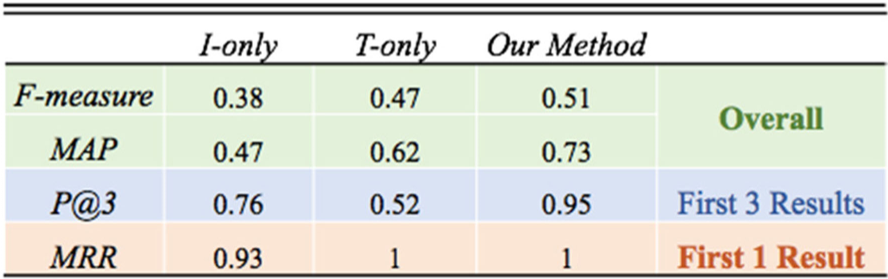 Table 1: The multimodal approach significantly outperforms single-modality baselines.
Deep Insight: Beyond Just Mining
What makes this work stand out is its Human-Centric focus. The authors aren't just solving a search problem; they are creating a feedback loop for therapy. By using the NAO robot's voice to recommend and read books together, the technology moves from a passive tool to an active companion.
Limitations and Future Work
The study currently requires the child to have some verbal capability to extract conversation topics. The next frontier? Extending this to children with non-verbal ASD by using gesture recognition or gaze tracking to infer interests. Additionally, involving therapists to "verify" the AI's choices will ensure that recommendations are not just relevant, but therapeutically sound.
Final Takeaway
This research proves that the future of HRI for ASD lies in Cross-Modal Compensation. When text is sparse, images speak; when images are ambiguous, text clarifies. Together, they create a bridge to reach children in their own unique worlds.