
Unified Radiology: Bridging Differential Diagnosis with Global Clinical Ontologies
Integrating an Ontology of Radiology Differential Diagnosis with ICD-10-CM, RadLex, and SNOMED CT
The study presents a semantic integration of the Radiology Gamuts Ontology (RGO) with major clinical standards including ICD-10-CM, RadLex, and SNOMED CT. By establishing 7,518 exact mappings, the authors created a bridge between radiology-specific differential diagnosis knowledge and generalized clinical terminologies to enhance EHR interoperability.
TL;DR
Researchers have successfully mapped the Radiology Gamuts Ontology (RGO)—a specialized system for differential diagnosis—to the medical industry's "Big Three" vocabularies: ICD-10-CM, RadLex, and SNOMED CT. By generating over 7,500 exact mappings, this work enables computers to understand the causal links between imaging findings (e.g., "fused ribs") and clinical diagnoses (e.g., specific syndromes) across different electronic health record (EHR) systems.
Context & Motivation: The "Language Gap" in Medical Imaging
In clinical practice, a radiologist might identify an "imaging finding" (an observation), but the hospital’s billing system only understands "ICD-10 codes," and the medical record might use "SNOMED CT" for structured data.
The Radiology Gamuts Ontology (RGO) is unique because it focuses on causal logic—the "may_cause" relationship between a disease and its appearance on an X-ray or CT. However, until now, RGO was a standalone island. For this knowledge to be useful for AI-driven diagnostic assistants or large-scale data mining, it must speak the same language as the rest of the healthcare ecosystem.
Methodology: High-Precision Semantic Mapping
The researchers used the National Center for Biomedical Ontology (NCBO) infrastructure to bridge RGO (containing ~17,000 terms) with external standards.
1. The Mapping Process
Using an automated pipeline, the team matched RGO terms against:
- SNOMED CT: The global standard for clinical terminology.
- RadLex: The Radiological Society of North America’s specific lexicon.
- ICD-10-CM: The standard for diagnostic billing codes.
2. Capturing Causal Logic
The most innovative aspect was the project's ability to transfer causal relationships. If RGO knows that "Scleroderma" causes "Achalasia," and both terms are mapped to RadLex, the system can now infer a causal link within RadLex that wasn't previously formalized.
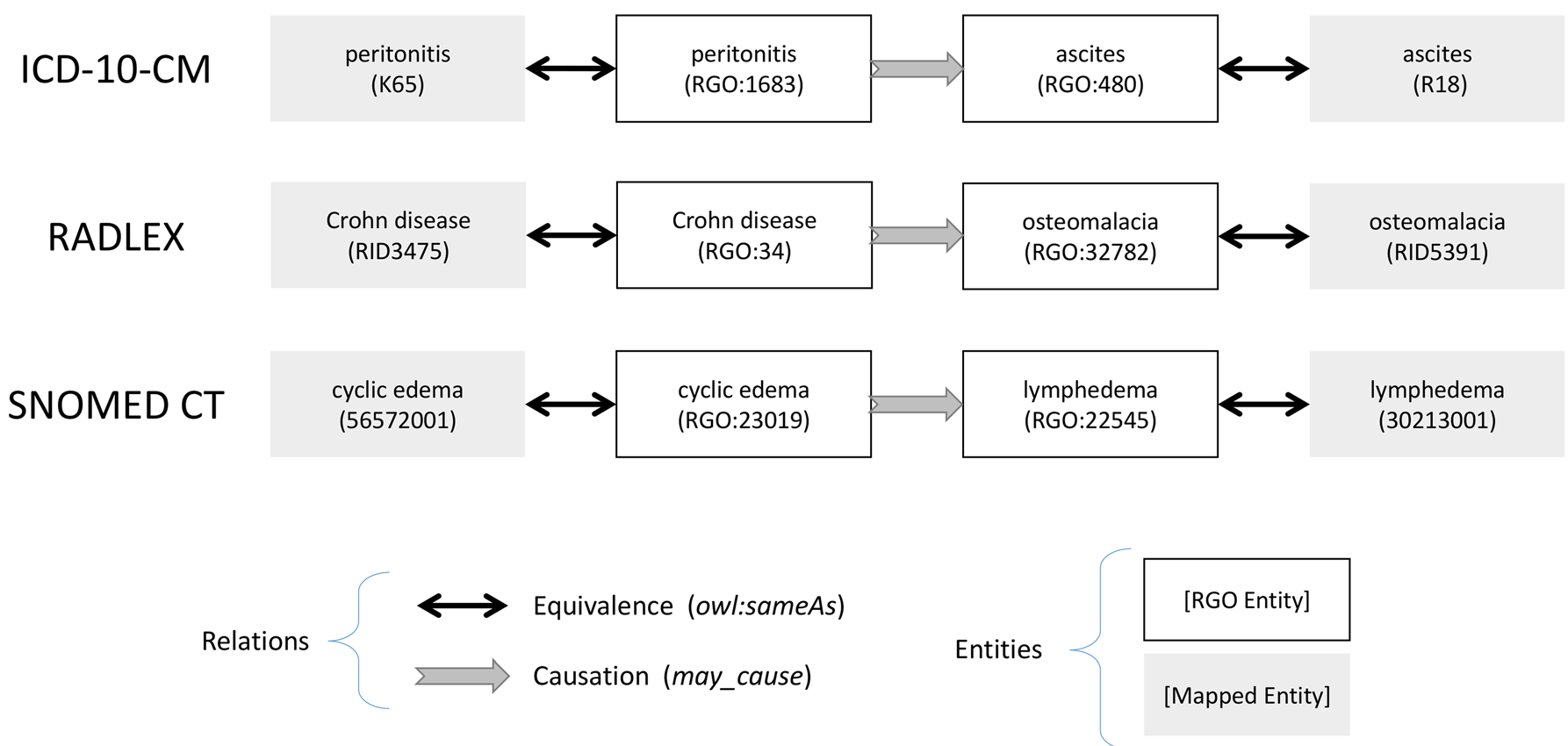 Figure 1: Examples of causal relationships being mapped from RGO to external ontologies, creating machine-computable diagnostic paths.
Key Results: A New Map for Data Mining
The study achieved a 30.2% mapping rate for RGO concepts. While this might seem modest, it is significant given the extreme specificity of radiological findings (e.g., "sloughed calcified renal papilla"), which often do not exist in general medical lists.
Mapping Statistics at a Glance
| Target Ontology | Disorders Mapped | Observations Mapped | Total Exact Matches |
|---|---|---|---|
| SNOMED CT | 4,153 | 1,238 | 5,302 |
| RadLex | 1,162 | 318 | 1,275 |
| ICD-10-CM | 798 | 340 | 941 |
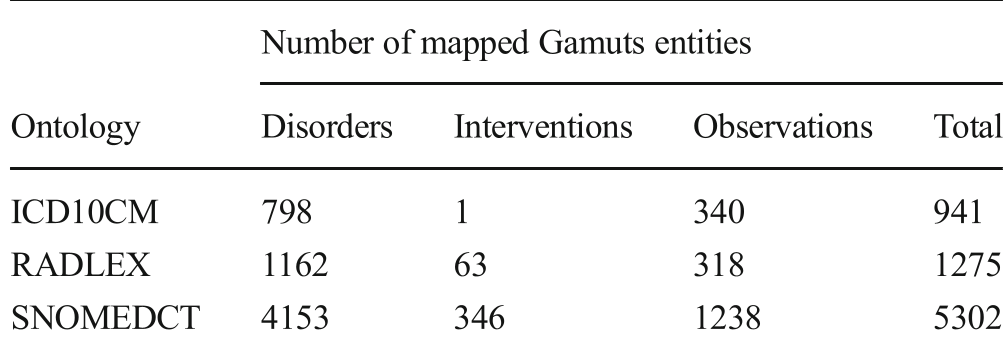 Table 1: Distribution of mapped entities across the three target ontologies.
Verification of these mappings showed zero errors in a random 10% audit, confirming that automated string matching (when restricted to "exact matches") is highly reliable for biomedical integration.
Deep Insight: Why This Matters for Precision Medicine
This integration turns RGO into a "Rosetta Stone."
- Automated Knowledge Discovery: Researchers can now take millions of radiology reports, use RGO to identify findings, and immediately "translate" them into ICD-10 or SNOMED codes to find correlations with genomic data or patient outcomes.
- Diagnostic Reasoning: Modern EHRs can use these mappings to suggest potential differential diagnoses to clinicians in real-time, based on the findings typed into a report.
Limitations & Future Outlook
The study was conservative, only accepting exact matches. The authors acknowledge that "partial matches" (e.g., matching a very specific term to a broader parent term) could significantly increase mapping coverage but would require more intensive manual validation.
As we move toward Precision Medicine, the ability to link unstructured text to structured, machine-readable knowledge is the "missing link." This work provides a foundation for more intelligent, interoperable, and data-driven radiology.
Takeaway
By integrating RGO with global standards, the authors have provided the toolkit needed to transform radiology reports from "passive text" into "active data," fueling the next generation of clinical decision support systems.