
Integrating Social Links into Wireless Networks: A Paradigm Shift in Routing
Integrating Social Links into Wireless Networks: Modeling, Routing, Analysis, and Evaluation
The paper introduces a multi-layer network paradigm that integrates social links as data-delivery overlays on top of physical wireless infrastructures. It proposes a novel "distance discretization" technique to analytically model end-to-end delay and success probability, achieving SOTA performance in heterogeneous network routing.
TL;DR
This research moves beyond using social networks as mere "routing hints" and instead treats them as physical overlays capable of delivering data. By combining conventional short-range wireless links (WiFi/Bluetooth) with long-range social links (overlaid on cellular/satellite), and applying a novel distance discretization mathematical framework, the authors demonstrate significant gains in reliability and a massive 80% reduction in energy waste for delay-sensitive traffic.
Problem & Motivation: The Gap in Social-Aware Routing
Current routing protocols in Delay-Tolerant Networks (DTN) use social ties conceptually—like knowing that "Bob often meets Alice." However, they rarely consider the social link as a data pipe itself (e.g., a friend forwarding a message via a cellular backbone when a direct WiFi link fails).
The authors identify two critical flaws in existing literature:
- The Infrastructure Assumption: Most models assume infinite node density, which is unrealistic. In finite, sparse networks, "greedy routing" often hits a dead-end.
- Link Unreliability: Both communication and social links can fail, and existing models don't provide a unified recursive math foundation for these failures.
Methodology: The Distance Discretization Technique
The core innovation is the Distance Discretization technique. Instead of dealing with continuous, messy physical distances, the authors draw concentric "mini-rings" around the destination.
1. Mathematical Intuition
By discretizing the space, they can define a recursive success probability for a message at mini-hop distance . If a node can't find a WiFi neighbor within one hop, it may find a social friend further away. This "leapfrog" ability is modeled using the Octopus model, which accounts for both short-range and long-range social connections.
2. System Architecture
The routing logic is adaptive. A node calculates whether a social link "payoff" (reduced delay) is worth the "cost" (cellular usage) based on local inference of the network's density () and social connectivity ().
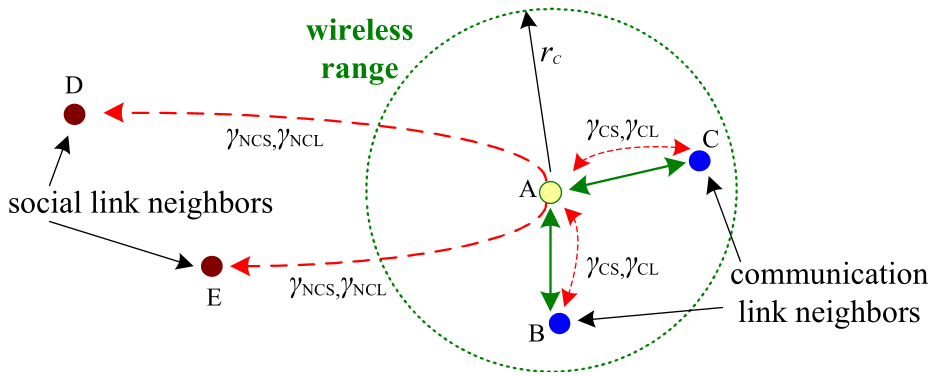 Fig 1: The Multi-layer structure showing communication links (short-range) and social overlays (long-range).
Experiments & Real-World Validation
Unlike papers that rely solely on simulations, this work utilized a high-fidelity testbed (RFnest) with 21 programmable WiFi radios and the MIT Reality Mining dataset.
Key Findings:
- Success Probability: In traditional wireless networks, success probability decays exponentially to zero as distance increases. With integrated social links, the probability stabilizes at a positive constant, ensuring long-distance delivery.
- Mobility Robustness: In "worst-case" mobility scenarios where WiFi links constantly break, social links provide the only viable path for message delivery.
- Energy Efficiency: The "Energy-Saving" routing protocol discards packets that have a >80% chance of missing their deadline, saving up to 80% of transmission energy in sparse conditions.
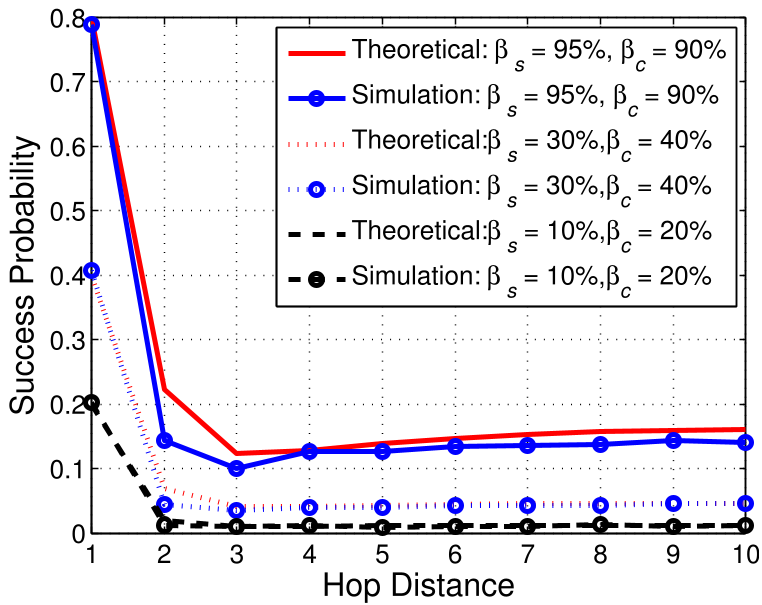 Fig 2: Success probability Sk vs. Hop Distance - demonstrating how social links prevent the "exponential decay" of reliability.
Critical Insight & Conclusion
The true value of this work lies in its Hybridity. By viewing the network not just as a set of radios, but as a tethered social-physical system, we can solve the "sparse network" problem.
Takeaway: Future 6G and IoT designs should not treat "Social Apps" and "Network Layers" as separate silos. The social graph is a physical topology that can be exploited to reach the unreachable.
Limitations: The current framework relies on specific social models like the Octopus model; the complexity of the recursive calculation () might be taxing for low-power IoT devices without further optimization.