
Controlling the Chaos: Autonomous Balancing of Influence in Social Networks
Towards intelligent control of influence diffusion in social networks
This paper formalizes the Network Control Problem (NCP) in social networks and introduces a novel benchmark called the θ-Consensus Avoidance Problem (θ-CAP). It evaluates various control strategies, primarily Artificial Neural Networks (ANN) and Evolutionary ANNs (EANN), for preventing the undesirable convergence of network opinions into a single majority state.
TL;DR
Social networks naturally drift toward "consensus"—a state where everyone agrees, which in financial or biological systems often signals a catastrophic failure (e.g., market bubbles or disease outbreaks). This paper introduces a formal Network Control Problem (NCP) framework and a specific benchmark, θ-CAP, to test how well AI agents can prevent these "opinion collapses" through dynamic intervention. Using Evolutionary Neural Networks (EANN), the authors demonstrate that AI can learn to stabilize a network even when it only controls a small fraction of the participants.
Background: Beyond "Who" to Control
In the literature of social network analysis, two giants loom large:
- Influence Maximization (IMP): Focused on viral marketing—finding the best starters to spread a message.
- Structural Controllability: Focused on the minimum number of "driver nodes" required to theoretically reach any state.
The authors of this paper identify a critical missing link: Behavior. It is not enough to know which accounts to control; we must know what signals to send at every time step to counteract the unpredictable movement of human opinions.
Methodology: The θ-Consensus Avoidance Problem (θ-CAP)
The authors model social networks as graphs where nodes influence their neighbors via the Voter Model. Left alone, these networks always converge to 100% consensus. The goal of θ-CAP is to drive the network homeostatically, keeping it in a state of "healthy disagreement."
The Control Architecture
The system consists of two parts:
- Configuration: Selecting which nodes receive the control signal (Budgeted ).
- Behavior: A mapping function that converts observed network states into specific control signals.
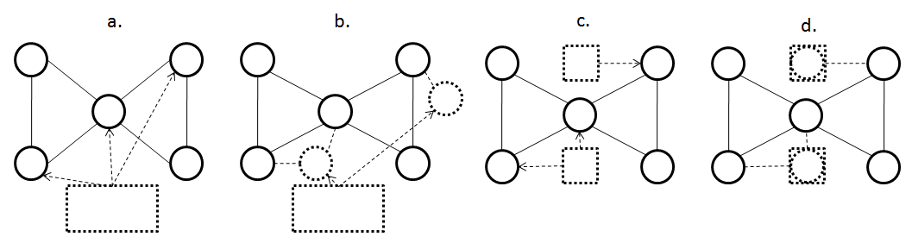 Fig 1: Conceptual diagram of Direct vs. Indirect Network Control.
The Contenders
- Anti-Majority Heuristic: A simple rule—"look at your neighbors and do the opposite of the majority."
- ANN (Gradient Descent): A standard neural net trained via RPROP to minimize disparity.
- EANN (Evolutionary): A neural net where weights are optimized using Genetic Algorithms (GA) to survive the longest without reaching consensus.
Experiments & Results
The researchers tested these agents on Random Graphs (RG) and Preferential Attachment (PA) networks.
Performance Gradient
The problem's difficulty is defined by the budget and the threshold . The "Random" controller serves as a baseline, showing that simple noise is often enough if the budget is high, but fails miserably when the budget is tight.
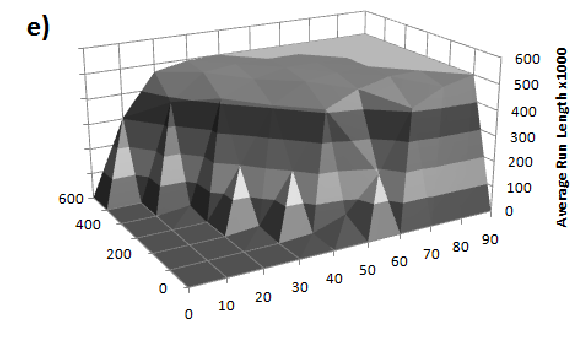 Fig 2: Heatmap showing the survival time (Z-axis) across budget (B) and threshold (). EANN (e) shows a much larger "plateau of success" compared to Random (b) or Anti-Majority (c).
Key Insights from the Data:
- The Heuristic Trap: The "Anti-Majority" rule is brilliant at very low budgets. However, as the controller gets more power (Budget > 50%), it starts "chasing its own tail"—since the controller itself is now the majority, its attempt to oppose the majority results in a rapid oscillating collapse.
- Evolution vs. Gradient Descent: Standard Backpropagation (ANN) struggled with "stuttering" learning curves. The fitness landscape of social influence is highly non-convex and "jagged." EANN, however, provided a smooth learning curve (Fig 4) and achieved the cap of 500,000 steps consistently.
Summary & Future Outlook
The paper successfully proves that intelligent control behavior can compensate for a limited control budget. Even if an organization can only influence 10-20% of a network, an EANN-based controller can effectively prevent the entire population from falling into a consensus trap.
Limitations: The training time for EANN is significant (see Table 5), taking hours or days compared to milliseconds for heuristics. Future research will likely focus on "Hybrid" models—using heuristics to prune the search space for evolutionary algorithms.
Takeaway for Practitioners: In the era of automated misinformation and algorithmic trading, understanding how to "balance" a network is just as important as knowing how to "disrupt" one. This work provides the mathematical and algorithmic foundation for those "digital thermostats."