
Beyond Keywords: Decoding Human Intent in Social Media Crisis Response
Intent Classification of Short-Text on Social Media
The paper introduces a hybrid multiclass classification framework for mining intent (seeking, offering, none) from short-text social media posts during crisis events. It combines top-down knowledge-guided patterns (psycholinguistic and social cues) with bottom-up bag-of-tokens models, achieving state-of-the-art performance in One-vs-One and One-vs-All frameworks.
TL;DR
Determining whether a tweet is seeking help or offering help is remarkably difficult for traditional AI due to linguistic ambiguity and data imbalance. This paper introduces a hybrid methodology that fuses bottom-up machine learning (bag-of-tokens) with top-down psycholinguistic and social behavioral knowledge. By leveraging "Contrast Mining" and linguistic patterns, the authors achieved an F1-score boost of 7% in real-world crisis scenarios.
Contextualizing Intent: The Why and the How
In the wake of a disaster like Hurricane Sandy, social media becomes a chaotic digital "town square." For emergency management units, the goal isn't just to see what people are talking about (Topic Classification) or how they feel (Sentiment Analysis), but to identify actionable intent.
The authors argue that intent—defined here as a purposeful future action—requires a more sophisticated lens than standard text mining. They point out two primary hurdles:
- Ambiguity: The phrase "wanna help" might appear in a request ("I wanna help my mom find water") or an offer ("I wanna help by donating blood").
- Sparsity: In a crisis, people asking for help often vastly outnumber those offering it, creating a "needle in a haystack" problem for classifiers.
Methodology: The Hybrid Engine
The core innovation lies in the v3 Hybrid Processing model. Rather than relying solely on the frequency of words (bottom-up), the system incorporates expert-guided social and psychological rules (top-down).
1. Declarative & Social Knowledge (DK & SK)
Instead of treating words like "the," "anyway," or "thanks" as useless stopwords, the authors treat them as social behavioral indicators. Using Levin's verb classes and Schank’s P-Trans primitives (transfer of property), they created semantic-syntactic patterns that look for the plan behind the text.
2. Contrast Mining-Guided Patterns (CTK & CPK)
This is the "special sauce." The authors used an algorithm to find Emerging Patterns—sequences of words or parts-of-speech (POS) that appear significantly more often in one intent class than in others. For example, the pattern help .* victim .* URL might be a high-strength indicator for the "Seeking" class.
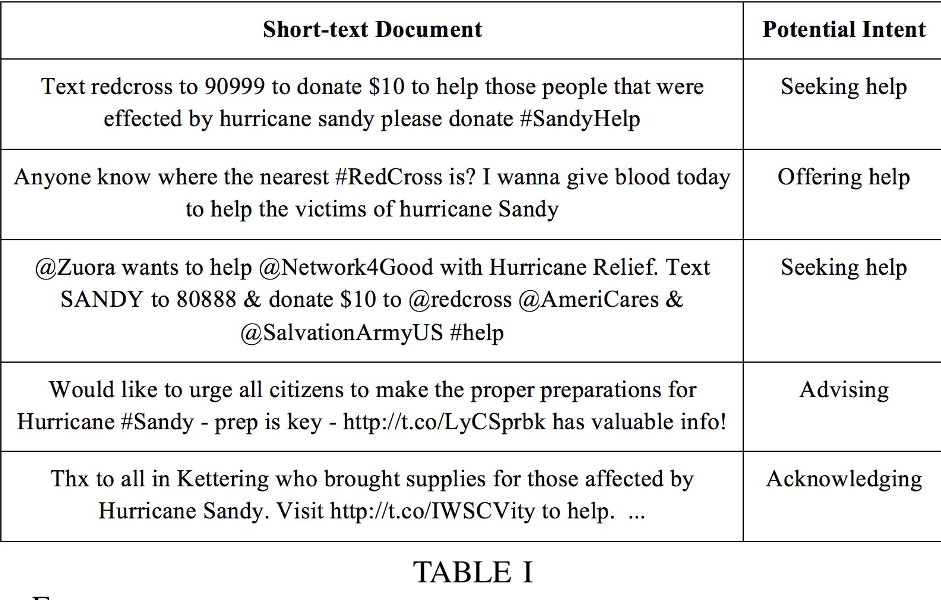 Table 1: Examples of short-text documents and their localized potential intent.
Experimental Battleground: Sandy and Yolanda
The authors tested their framework on two massive datasets:
- Hurricane Sandy (USA): 4.9 million tweets.
- Typhoon Yolanda (Philippines): 1.9 million tweets.
They utilized the One-vs-One (OVO) and One-vs-All (OVA) multiclass frameworks with a Random Forest ensemble. The results were clear: by adding top-down knowledge, they didn't just marginally improve the model; they fundamentally changed its ability to recognize the minority class (Offering).
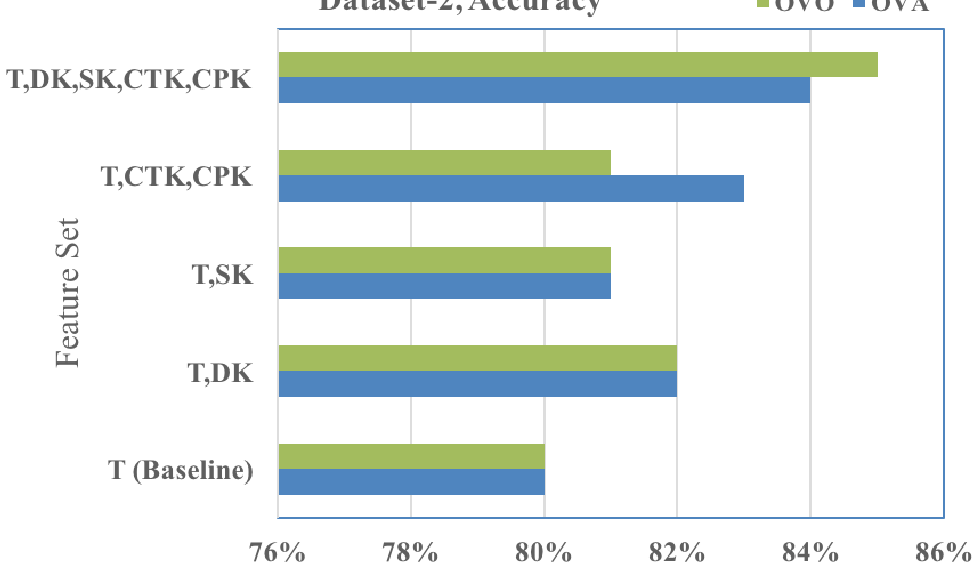 Figure 1: Results showing statistically significant gains in Accuracy and F1-score when using the Hybrid (v3) approach vs. the Baseline (v1).
Deep Insight: Why Knowledge Matters
The most profound takeaway is that human expression has structure. While a bag-of-words model sees a tweet as a "soup" of tokens, the hybrid model sees it as a sequence of social actions.
The fact that 50% of the most discriminating features came from the top-down pattern sets—not the raw text tokens—proves that in low-data or high-noise environments, "declarative knowledge" (knowing how humans ask for things) is more powerful than more data alone.
Critical Analysis & Future Outlook
While the gain is impressive, the authors acknowledge a "socio-cultural gap." A model trained on US-based Hurricane Sandy tweets might not work perfectly for tweets from the Philippines due to different linguistic norms.
Future Work will likely need to bridge this with Multi-label Classification (since a tweet can both seek and offer help simultaneously) and the exploration of Cost-Sensitive Learning to further mitigate the extreme class imbalance found in crisis informatics.
Final Summary
This research moves the needle from simple "social listening" to "social coordinated action." By integrating psycholinguistics into the machine learning pipeline, we can turn a noisy Twitter feed into a prioritized dashboard for emergency responders, potentially saving lives through faster resource allocation.