
Scaling the Ripple: HPC Modeling of Global Social and Biological Contagions
18159_Interaction-based HPC modeling of social, biological, and economic contagions over large networks.
This paper presents a High-Performance Computing (HPC) framework based on Graph Dynamical Systems (GDS) to model complex contagions—ranging from biological diseases to social movements and economic fads—across large-scale networks. It introduces a suite of three specialized simulation tools (InterSim, EpiSimdemics, and EpiFast) that provide a scalable solution for reasoning about co-evolving network dynamics and public policy interventions.
TL;DR
Researchers at Virginia Tech’s NDSSL have developed a suite of HPC tools based on Graph Dynamical Systems (GDS) to simulate how diseases, information, and financial trends spread through populations of millions. By balancing model expressiveness with computational efficiency, they provide a roadmap for using agent-based modeling (ABM) to inform real-world public policy during crises.
Problem & Motivation: The Complexity of "Interaction"
Standard epidemiological models often rely on "mean-field" assumptions—treating populations as homogeneous mixtures. However, real-world contagions are messy:
- Heterogeneity: You are not the same as your neighbor; your behaviors and biological vulnerabilities differ.
- Co-evolution: A disease spreads because people meet, but as people get sick, they stop meeting, which fundamentally changes the underlying network structure.
- Scale: Global pandemic planning requires modeling billions of agents with unstructured dependencies, creating a massive load-balancing nightmare for standard supercomputers.
The authors' core insight is that these diverse phenomena—from a Twitter rumor to an H1N1 outbreak—can be unified under the mathematical umbrella of Graph Dynamical Systems (GDS).
Methodology: A Tale of Three Tools
The paper introduces three distinct tools, each representing a different point on the spectrum of Versatility vs. Performance:
1. InterSim: The Universal Framework
InterSim is the "Swiss Army Knife." It can simulate any GDS. It allows users to plug in "Node Interaction Models" (NIM) to define complex agent behaviors.
- Strength: Highly expressive; can model financial divestiture or shifting political ideologies.
- Cost: High memory footprint (each agent is a unique C++ object).
2. EpiSimdemics: The Location-Based Specialist
Instead of a static graph, this tool uses a "Person-Location-Broker" model. Agents move to locations based on schedules (work, home, school). Interactions only happen when agents are co-located in space and time.
- Core Mechanism: Uses Probabilistic Timed Transition Systems (PTTS) to manage state changes (e.g., Susceptible to Infected).
3. EpiFast: The Speed Demon
Highly optimized for the SEIR (Susceptible-Exposed-Infectious-Recovered) model. It uses a synchronous update scheme and a master-worker MPI architecture to achieve lightning-fast results on specific epidemic tasks.
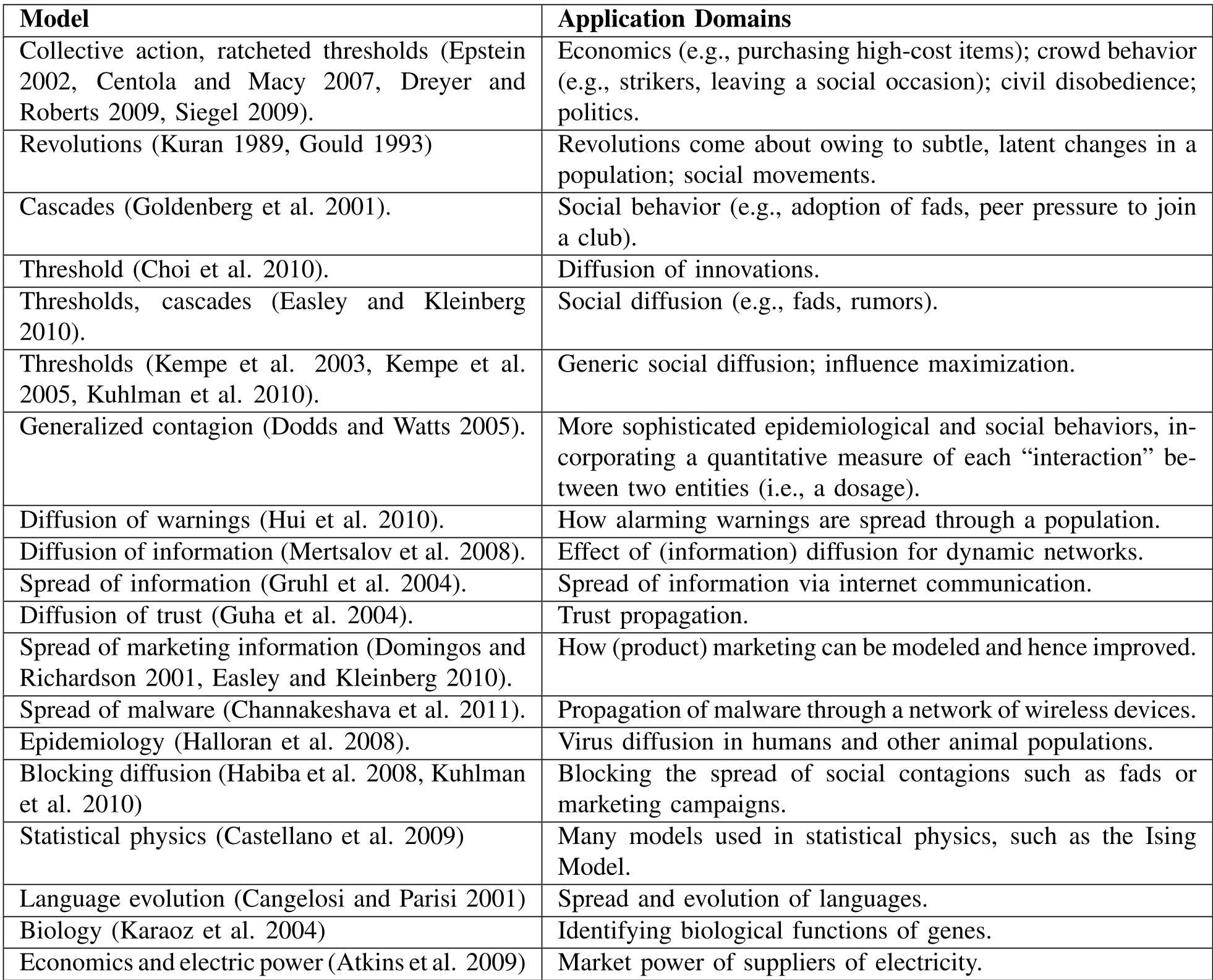 Above: Diverse domains successfully modeled using the GDS formalism, from language evolution to market power in electric grids.
Performance & Experiments
The researchers tested their tools across four major U.S. cities. The results highlight the "No Free Lunch" theorem in simulation:
| City | Population | EpiFast Time | InterSim Time |
|---|---|---|---|
| Miami | 2.09M | 18.09s | 131.0s |
| Chicago | 9.04M | 44.31s | 635.5s |
While InterSim takes much longer, it allows for "context-dependent" reasoning that EpiFast cannot handle. This modularity allows policymakers to choose InterSim for complex behavioral research and EpiFast for urgent, real-time pandemic tracking.
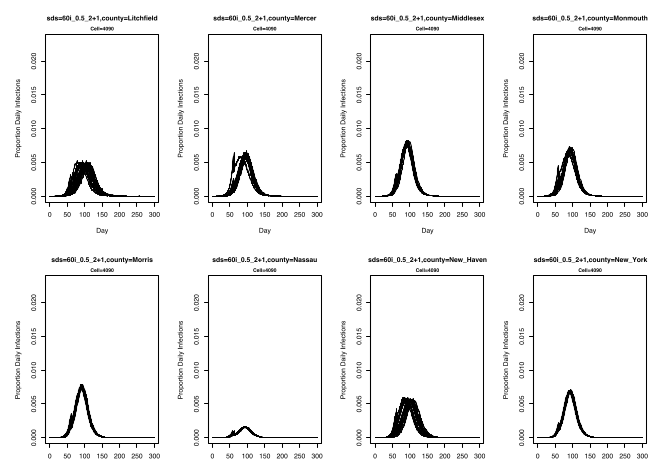 Above: Time-series data of outbreak sizes across different counties, providing actionable intelligence for vaccine distribution.
Critical Insight: Controlling the Chaos
The paper goes beyond "What happens?" to "How do we stop it?". By identifying Critical Nodes, the researchers demonstrate that you don't need to vaccinate everyone. Even suboptimal interventions—targeted at high-influence spreaders—can "flatten the curve," buying time for secondary responses.
Conclusion and Future Outlook
This work establishes GDS as a universal language for contagion. However, limitations remain: modeling reactions involving three or more agents (A+B+C -> D) or networks that change as fast as the contagion itself (e.g., instant mobile ad-hoc networks) remains computationally expensive.
The takeaway for the industry is clear: Agent-Based Modeling is no longer an academic exercise. On petascale machines, it is a viable high-fidelity digital twin for society, capable of triaging public health interventions before they are deployed in the real world.