
IBR: Leveraging the Power of Indirect Ties for Efficient Mobile Social Routing
Interaction based routing algorithm for opportunistic mobile social networks
The paper introduces Interaction Based Routing (IBR), a single-copy distributed algorithm for Opportunistic Mobile Social Networks (MSNs). It leverages both direct and indirect effects of node interactions to calculate node popularity, achieving significant delivery performance with minimal overhead compared to benchmarks like BubbleRap and Prophet.
TL;DR
In the world of Opportunistic Mobile Social Networks (MSNs), where connectivity is intermittent and social structures are fluid, Interaction Based Routing (IBR) emerges as a highly efficient single-copy protocol. By mathematically modeling both direct meetings and the subtle "indirect effects" of social influence, IBR achieves high delivery rates with significantly lower overhead than traditional community-based or flooding-based methods.
Background: Beyond the Limits of Community
Routing in MSNs typically relies on the "store-carry-and-forward" paradigm. Previous SOTA methods like BubbleRap focus on social "communities." However, humans are fickle—we join and leave communities constantly. This instability makes community-aware algorithms fragile.
The authors of IBR argue for a return to the fundamental unit of social networks: Interaction. While many have tracked direct contacts, the "indirect effect"—the impact a person has on you through a mutual friend—has been largely overlooked in protocol design, despite its proven importance in sociology (e.g., job searching or restaurant recommendations).
Methodology: The Math of Social Influence
The core innovation of IBR is how it quantifies a node's "popularity" using a distributed, threshold-free approach.
1. Direct vs. Indirect Effects
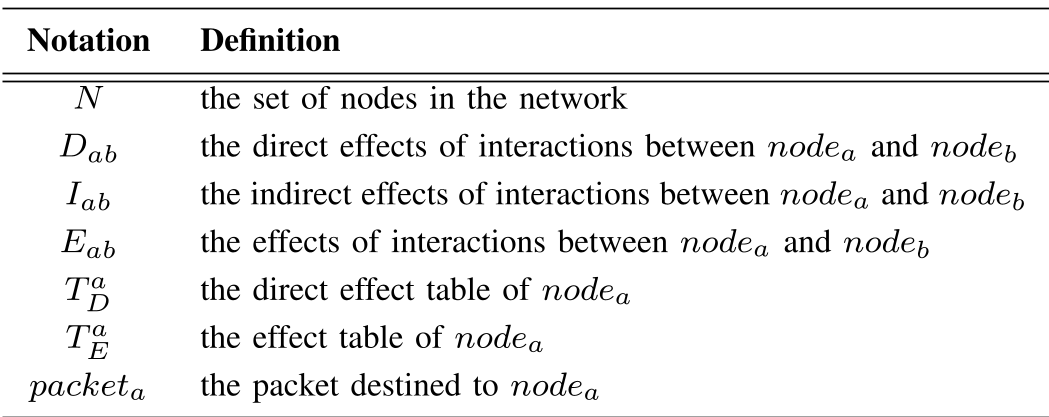
- Direct Effect (): A simple counter of physical contacts between node a and node b.
- Indirect Effect (): Calculated based on the interaction shares of a mutual neighbor c. It asks: "How much of node a's total attention does c get, and how much of node b's attention does c get?"
- Total Effect (): The sum of direct and indirect metrics.
2. The IBR Forwarding Logic
IBR is a distributed algorithm. When two nodes meet, they exchange "Effect Tables." A node will forward a packet to a peer only if that peer has a higher value (higher popularity/influence) relative to the packet's destination.
Experimental Validation
The researchers tested IBR against three heavyweights: Epidemic (the flooding benchmark), Prophet (probability-based), and BubbleRap (community-based). They used three distinct real-world traces:
- PMTR: Sparse (49 nodes in university buildings).
- MIT Reality: Medium density (97 smartphones over 9 months).
- Infocom 2006: Dense (78 iMotes at a 3-day conference).
Key Findings:
- Adaptability: Unlike Prophet, which requires a pre-set threshold to weigh past data, IBR adapts naturally to different environments without manual tuning.
- Extreme Efficiency: In the sparse PMTR dataset, IBR matched the delivery rate of Prophet but with drastically lower total costs and shorter latency.
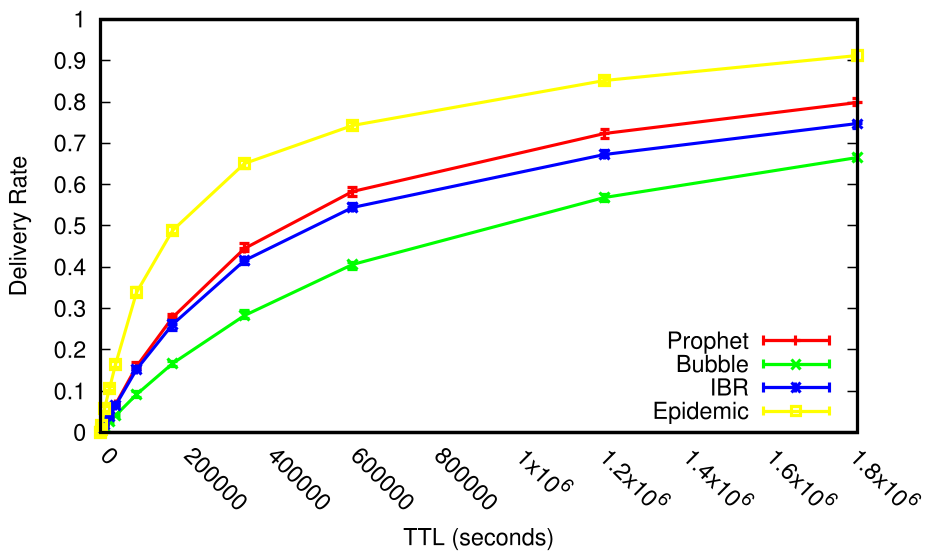 Performance charts showing (a) Delivery Rate, (b) Latency, and (c) Cost.
Critical Insight: Why Indirect Effects Matter
The success of IBR over BubbleRap provides a vital academic insight: Popularity is not just about who you talk to, but who your contacts talk to. By including the 2-hop indirect effects, IBR creates a more nuanced "gradient" of popularity that helps packets find their way even in sparse networks where direct hotspots aren't immediately visible.
Conclusion and Future Outlook
IBR proves that effective routing doesn't require complex community detection or resource-heavy flooding. By focusing on the "quality" of interactions (indirect effects) alongside the "quantity" (direct effects), we can build leaner, more adaptable mobile networks.
The authors suggest that future work will look beyond 2-hop paths. However, as any social scientist knows, the "horizon of observability" typically drops off quickly; finding the mathematical "sweet spot" between hop-count and predictive power remains the next great challenge in MSN research.